반도체소자 Lecture1 4
Keywords
Summary
172 words
Critical Evaluation
Value of the Information & Strength of the Argument
The lecture provides a clear and logical progression from quantum mechanics to energy band theory, which is essential for understanding semiconductor devices. The instructor uses intuitive explanations and mathematical derivations to build the concepts step by step. The argumentation is solid, as he connects the Pauli exclusion principle to the formation of energy bands and explains how band structure determines electrical properties. The value lies in its pedagogical approach, making complex topics accessible to students.
Scientific Rigor, Source Quality, Title Accuracy
The lecture is scientifically accurate, but it does not cite any external sources or references. The title accurately reflects the content, as it is a lecture on semiconductor devices. The presentation is informal and somewhat disorganized, but the core concepts are correctly explained. No comments were provided for analysis.
139 words
Title / Content Match
The title accurately reflects the content, which is the fourth lecture in a series on semiconductor devices.
Quality & Reliability
7/10
The lecture provides a solid introduction to quantum mechanics and energy band theory, with correct derivations and explanations. However, it lacks citations and references, and the presentation is informal and somewhat disorganized.
Key Moments
Markers derived by PSI from the transcript: the creator did not define chapters.
- Introduction and review of quantum mechanics
- Discussion of uncertainty principle
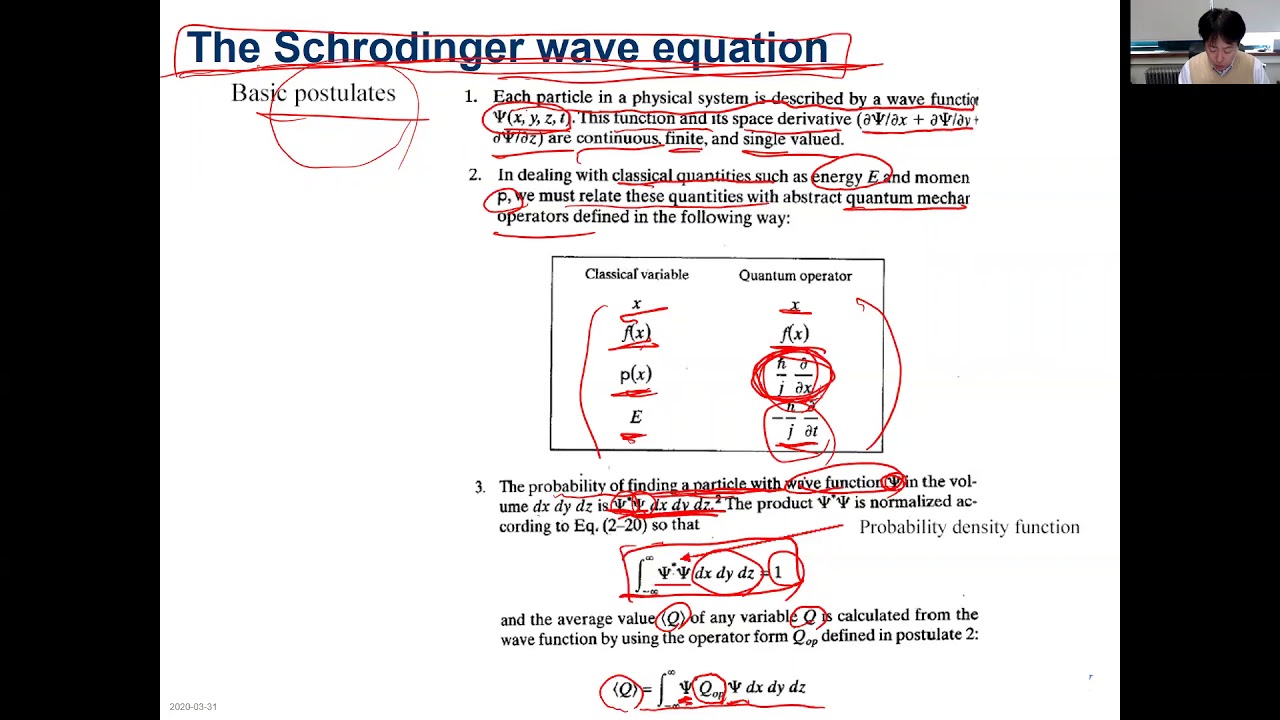
- Introduction to wave functions and Schrödinger equation
- Solving infinite potential well problem
- Quantum numbers and Pauli exclusion principle
- Formation of energy bands in solids
- Conductors, insulators, and semiconductors
- Preview of next chapter and homework assignment
Contribution & Novelties
This lecture provides a comprehensive introduction to quantum mechanics and energy band theory, specifically tailored for semiconductor device education. It bridges the gap between abstract quantum concepts and practical semiconductor physics. The instructor’s approach of deriving energy bands from the Pauli exclusion principle is particularly effective.
Pour aller plus loin :
- Quantum mechanics — Foundational concepts.
- Schrödinger equation — Core equation for wave functions.
- Energy band theory — Directly related to band formation.
- Pauli exclusion principle — Key principle for electron states.
82 words
Radar Profile
The radar profile shows high scores in information quantity and technical level, indicating a content-rich lecture with substantial depth. The quality and reliability scores are moderate, reflecting the lack of citations and informal style.