반도체공정 Lecture6 cleaning Lecture7 metallization 1 201117
Keywords
Summary
115 words
Critical Evaluation
Value of the Information & Strength of the Argument
The lecture provides valuable insights into semiconductor cleaning and metallization, explaining the ‘why’ behind each process step. The argumentation is solid, based on physical principles and industry practices. The instructor effectively links contamination to yield loss and device performance, and justifies material choices (e.g., copper over aluminum) with clear reasoning. The content is well-structured, progressing from contamination sources to cleaning methods, then to metallization challenges and solutions.
Scientific Rigor, Source Quality, Title Accuracy
The lecture is scientifically rigorous, presenting established knowledge in semiconductor manufacturing. However, it does not cite specific sources or references, relying on general industry knowledge. The title accurately reflects the content, which is a technical tutorial. The lack of formal citations is a minor weakness, but the information is consistent with standard textbooks and industry practices.
138 words
Title / Content Match
The title accurately reflects the content: it covers cleaning (Lecture 6) and metallization (Lecture 7) in semiconductor processing.
Quality & Reliability
7/10
The lecture is a detailed technical tutorial on semiconductor cleaning and metallization processes, based on established industry knowledge. It covers key concepts such as particle contamination, cleaning methods (RCA, plasma), and metallization materials (Al, Cu). The content is accurate and aligns with standard semiconductor manufacturing principles, though it lacks formal citations and is presented from a single instructor's perspective.
Key Moments
Markers derived by PSI from the transcript: the creator did not define chapters.
- Introduction to cleaning in semiconductor processing
- Importance of removing contaminants for device performance
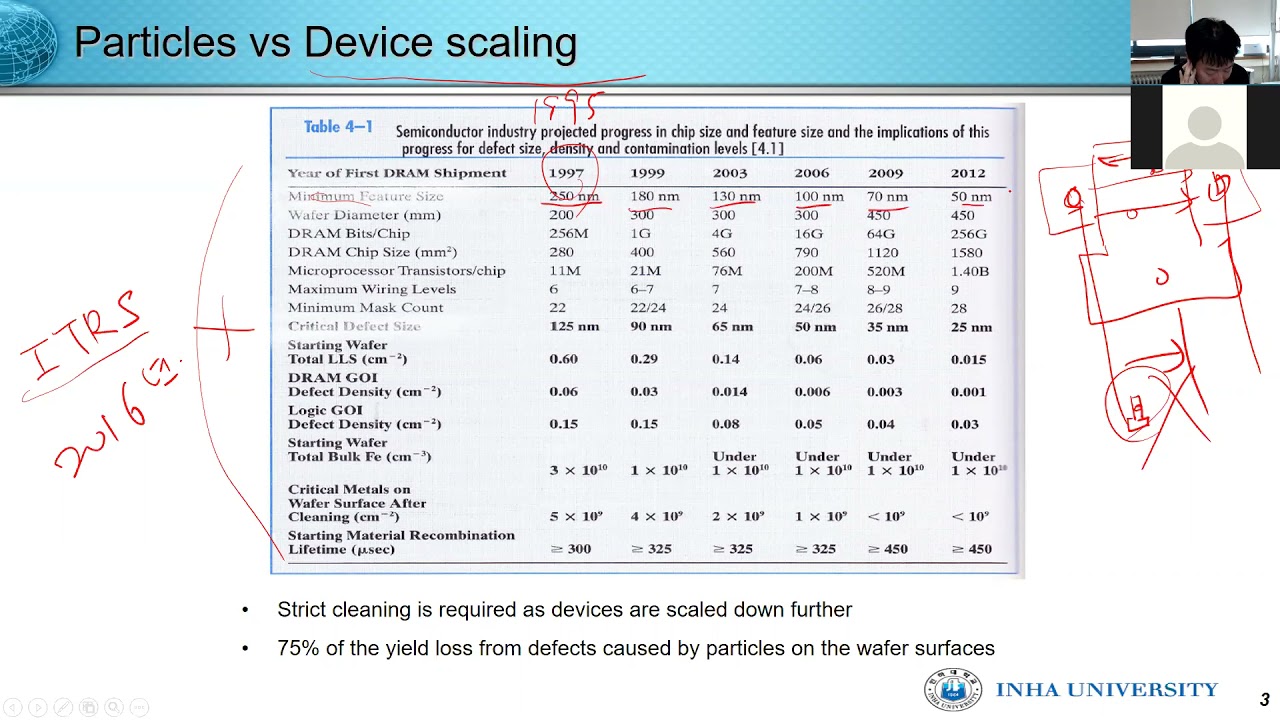
- Particle size and density requirements over technology nodes
- Cleanroom classes and air flow control
- Wet cleaning methods: RCA clean (SC1, SC2)
- Plasma cleaning and other techniques
- Introduction to metallization and interconnect layers
- Requirements for metal materials: resistivity, adhesion, etc.
- Transition from aluminum to copper interconnects
- Challenges of scaling and contact resistance
Contribution & Novelties
The lecture provides a clear and structured explanation of semiconductor cleaning and metallization, emphasizing the practical importance of contamination control and material selection. It bridges theoretical concepts with industrial practices, making it valuable for students and engineers.
Pour aller plus loin :
- RCA clean — Standard wet cleaning method in semiconductor fabrication.
- Copper interconnects — Replacement of aluminum with copper for better conductivity.
- Semiconductor device fabrication — Overview of the entire manufacturing process.
73 words
Radar Profile
The radar profile shows high scores in information quantity, technical level, and reliability, indicating a dense and technically accurate lecture. The quality of information is also high, but slightly lower due to lack of formal citations. Overall, the lecture is a solid educational resource for semiconductor processing.