반도체공정 Lecture0 1
Keywords
Summary
130 words
Critical Evaluation
Value of the Information & Strength of the Argument
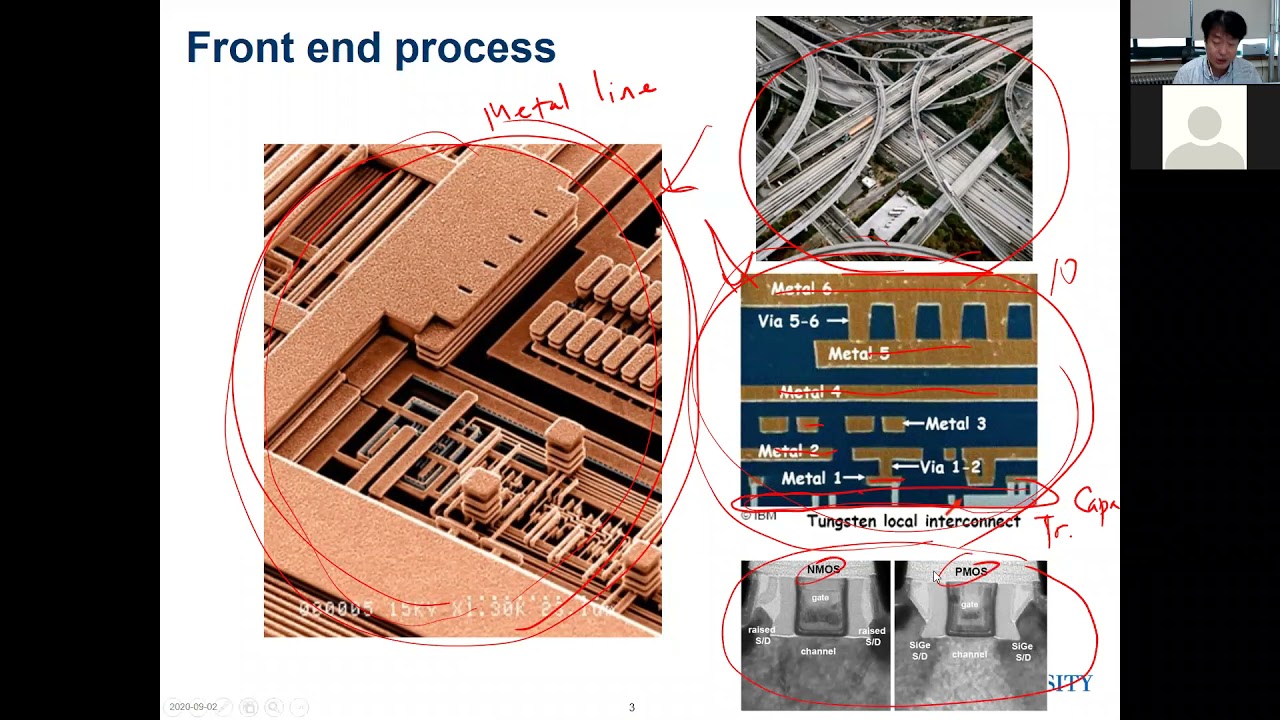
The video provides a valuable introduction to semiconductor manufacturing, making complex concepts accessible to beginners. The instructor uses analogies (e.g., water flow for current) and clear diagrams to explain device operation and scaling. The argumentation is logical, starting from the need for solid-state devices, to the invention of the integrated circuit, and then to the principles of scaling. However, the lecture lacks depth in some areas, such as specific process steps (lithography, etching, deposition) which are only briefly mentioned. The instructor’s enthusiasm and interactive style enhance engagement, but the informal digressions and occasional audio issues detract from the overall clarity.
Scientific Rigor, Source Quality, Title Accuracy
The scientific rigor is moderate. The instructor accurately describes historical events and basic principles, but does not provide specific citations or references. The video is based on established knowledge in semiconductor physics and engineering, but the lack of sources limits its use for advanced study. The title accurately reflects the content, though it is more of an overview than a detailed process lecture. The instructor mentions that further resources are provided in the video description, but the description is empty in this case. Overall, the content is reliable for introductory purposes but not for in-depth research.
211 words
Title / Content Match
The title '반도체공정 Lecture0 1' accurately reflects the content as an introductory lecture on semiconductor processes, though it is more of an overview than a detailed process explanation.
Quality & Reliability
7/10
The video provides a solid introductory overview of semiconductor manufacturing, covering historical context, basic device physics, and scaling trends. The content is accurate but lacks depth and detailed citations. The instructor's explanations are clear and accessible, but the video is a lecture recording with occasional audio issues and informal digressions.
Key Moments
Markers derived by PSI from the transcript: the creator did not define chapters.
- Introduction to the course and why we study semiconductor processes.
- Explanation of the three basic materials: conductor, insulator, semiconductor.
- Historical development from vacuum tubes to transistors and the invention of the integrated circuit.
- Explanation of the planar process and its advantages for mass production.
- Introduction to MOSFET operation and the CMOS inverter.
- Discussion on the importance of scaling for performance and cost.
- Explanation of Moore's law and its impact on the industry.
- Challenges in scaling, including leakage and the need for new materials.
- Overview of the semiconductor industry and the collaborative nature of development.
- Future directions and the importance of process technology.
Contribution & Novelties
The video provides a clear and engaging introduction to semiconductor manufacturing, suitable for beginners. It effectively explains the historical context and the fundamental principles of device operation and scaling. The instructor’s use of analogies and diagrams helps demystify complex concepts. However, the content is not novel for those already familiar with the field, and it lacks depth in specific process details.
Pour aller plus loin :
- Semiconductor device fabrication — Provides a comprehensive overview of the steps involved in manufacturing integrated circuits.
- Moore’s law — Explains the observation and its implications for the semiconductor industry.
- CMOS — Details the technology used in most modern integrated circuits.
- Transistor — Covers the history and operation of transistors.
115 words
Radar Profile
The radar profile shows a balanced performance across all dimensions, with slightly higher scores in information quantity and quality, reflecting the video's comprehensive yet accessible content. The technical level is moderate, suitable for beginners, while reliability is solid due to the accurate presentation of established concepts.