반도체소자 Lecture2 4
Keywords
Summary
177 words
Critical Evaluation
Value of the Information & Strength of the Argument
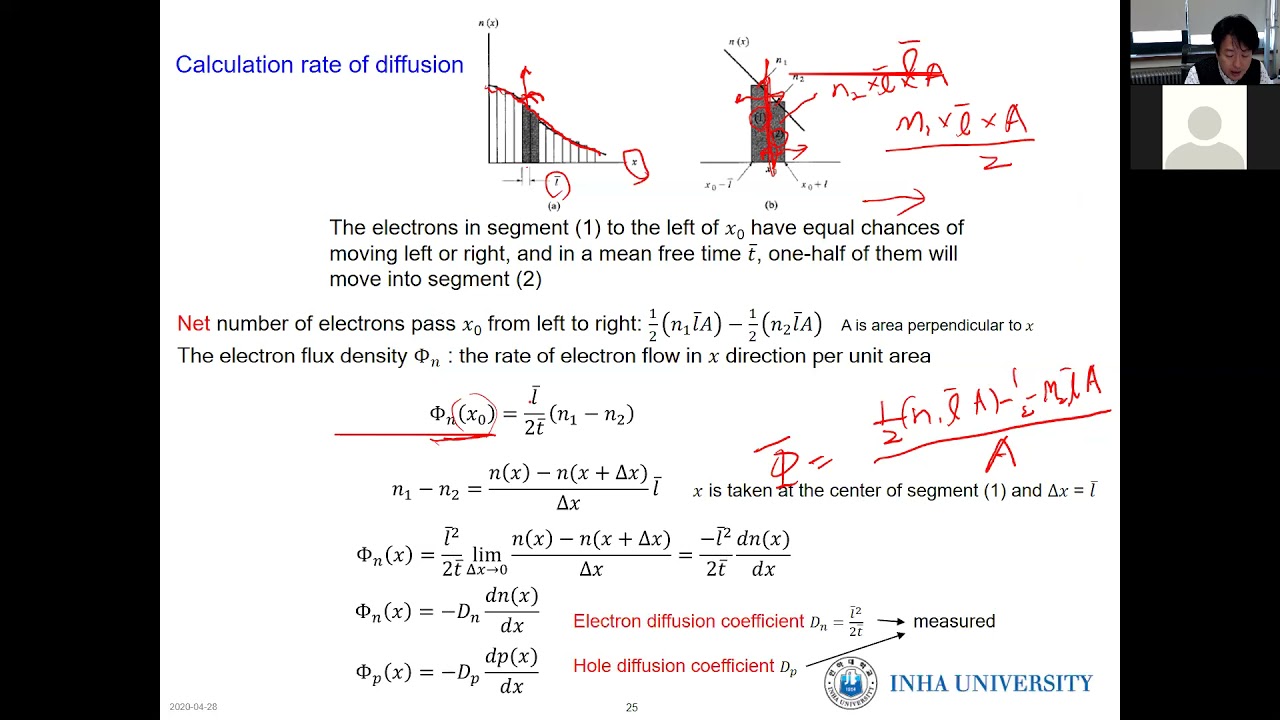
The lecture provides a solid, step-by-step derivation of carrier diffusion and drift currents, using intuitive analogies and clear mathematical formulations. The argumentation is logical and builds on previous knowledge, making it accessible for students. The instructor explains the physical meaning behind each equation, such as the diffusion coefficient and the Einstein relation, which enhances understanding. The value lies in its pedagogical approach, breaking down complex concepts into manageable parts. However, the lecture lacks references to external sources or experimental data, which could strengthen the argumentation.
Scientific Rigor, Source Quality, Title Accuracy
The scientific rigor is high, as the content aligns with standard semiconductor physics textbooks. The instructor uses correct terminology and equations, and the derivations are consistent. However, no sources are cited, and the lecture relies solely on the instructor’s explanations. The title accurately reflects the content, as it is a continuation of a lecture series on semiconductor devices. The lack of citations is a minor weakness, but the material is presented in a rigorous manner.
175 words
Title / Content Match
The title accurately reflects the content as it is the fourth part of Lecture 2 on semiconductor devices.
Quality & Reliability
7/10
The lecture is a formal educational presentation on semiconductor device physics, covering carrier diffusion, drift, and built-in electric fields. The content is mathematically rigorous and consistent with standard textbook treatments, but lacks citations and references to external sources.
Key Moments
Markers derived by PSI from the transcript: the creator did not define chapters.
- Introduction and review of previous lecture on carrier generation and recombination.
- Introduction to diffusion as a natural process driven by concentration gradients.
- Derivation of the diffusion current equation using a particle model.
- Explanation of drift current and its dependence on electric field.
- Combination of drift and diffusion currents in a semiconductor.
- Discussion of built-in electric field at a PN junction and its origin.
- Derivation of the relationship between electric field and band bending.
- Equilibrium condition: drift and diffusion currents cancel.
- Worked examples and problem-solving session.
- Conclusion and summary of key concepts.
Contribution & Novelties
The lecture provides a clear and intuitive explanation of carrier diffusion and drift, emphasizing the physical mechanisms behind the equations. It bridges the gap between abstract mathematics and physical intuition, which is valuable for students. The instructor’s use of analogies (e.g., perfume diffusion) makes the concepts more accessible.
Pour aller plus loin :
- Einstein relation — This relation connects the diffusion coefficient to mobility, a key concept in semiconductor physics.
- PN junction — The built-in potential and depletion region are fundamental to PN junction operation.
- Drift-diffusion equation — This equation governs carrier transport in semiconductors and is central to device modeling.
101 words
Radar Profile
The radar profile shows high scores in quantity of information, technical level, and reliability, indicating a dense and rigorous lecture. The quality of information is also high, but the lack of citations slightly reduces the overall reliability score.