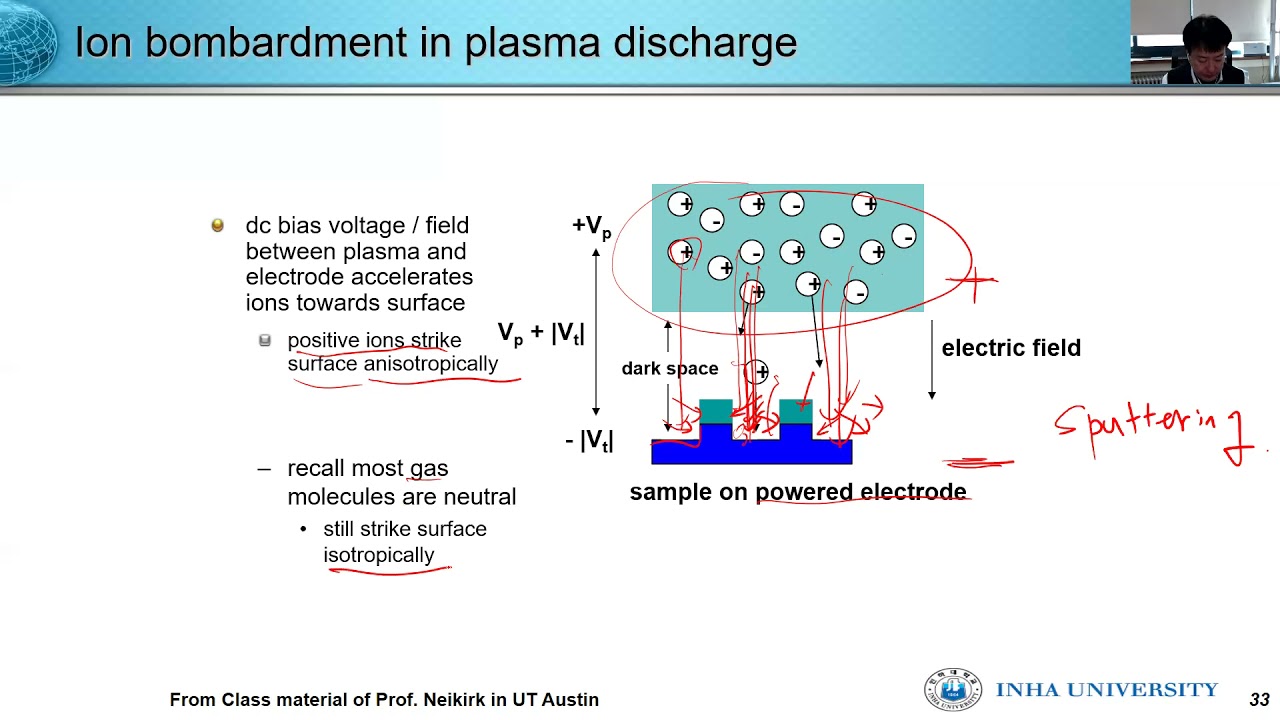
반도체공정 Lecture5 etch 3
Keywords
Summary
140 words
Critical Evaluation
Value of the Information & Strength of the Argument
The lecture provides valuable insights into dry etching processes, explaining both physical and chemical mechanisms in detail. The instructor uses clear examples and analogies to illustrate complex concepts, such as the role of ion bombardment in enhancing chemical reactions. The argumentation is logical and well-structured, building from basic principles to more advanced topics. However, the lack of formal references and the reliance on personal explanations reduce the overall rigor. The instructor also mentions a blog for further reading, but no specific sources are cited.
Scientific Rigor, Source Quality, Title Accuracy
The scientific rigor is moderate; the lecture is based on established knowledge in semiconductor processing, but no formal citations are provided. The quality of sources is limited to the instructor’s expertise and a blog reference. The title accurately reflects the content, as it is a continuation of a lecture series on etching. The content is consistent with standard textbook material, but the lack of verifiable references is a weakness.
168 words
Title / Content Match
The title accurately reflects the content, as it is the fifth lecture on semiconductor processes focusing on etching.
Quality & Reliability
7/10
The lecture provides a detailed and structured explanation of dry etching processes, including physical and chemical mechanisms, with practical examples. However, it lacks formal citations and relies on a single instructor's perspective, which limits verifiability.
Key Moments
Markers derived by PSI from the transcript: the creator did not define chapters.
- Introduction to dry etching and its importance in semiconductor fabrication.
- Explanation of ion milling and sputtering as physical etching methods.
- Discussion on plasma etching and the role of reactive species.
- Explanation of DC bias and plasma potential in etching systems.
- Comparison of physical and chemical etching, and the concept of selectivity.
- Introduction to reactive ion etching (RIE) and its advantages.
- Discussion on polymer passivation for anisotropic etching.
- Examples of etching silicon and silicon dioxide with different gas chemistries.
- Introduction to Bosch process for deep silicon etching.
- Application of etching in through-silicon vias (TSVs) for 3D integration.
Cited Sources
- Blog on plasma etching (mentioned in lecture) — Instructor recommends a blog for further study on plasma etching, but no URL is provided.
Concurring Sources
- Semiconductor device fabrication — Provides general background on semiconductor processes, consistent with the lecture's context.
Contribution & Novelties
The lecture provides a comprehensive overview of dry etching techniques, bridging theoretical concepts with practical applications. It clarifies the mechanisms behind physical and chemical etching, and highlights the importance of process parameters like ion energy and gas chemistry. The discussion on polymer passivation and its role in anisotropic etching is particularly valuable. For further exploration, one can look into the Bosch process, reactive ion etching, and the chemistry of fluorocarbon plasmas.
Pour aller plus loin :
- Bosch process — A key technique for deep silicon etching, directly related to the lecture’s discussion on deep etching.
- Reactive-ion etching — The core method discussed, with detailed principles and applications.
- Plasma etching — General overview of plasma-based etching, complementing the lecture’s content.
119 words
Radar Profile
The radar profile shows high scores in information quantity and technical level, indicating a dense and advanced lecture. The lower score in reliability reflects the lack of formal citations. Overall, the lecture is informative but would benefit from more rigorous sourcing.