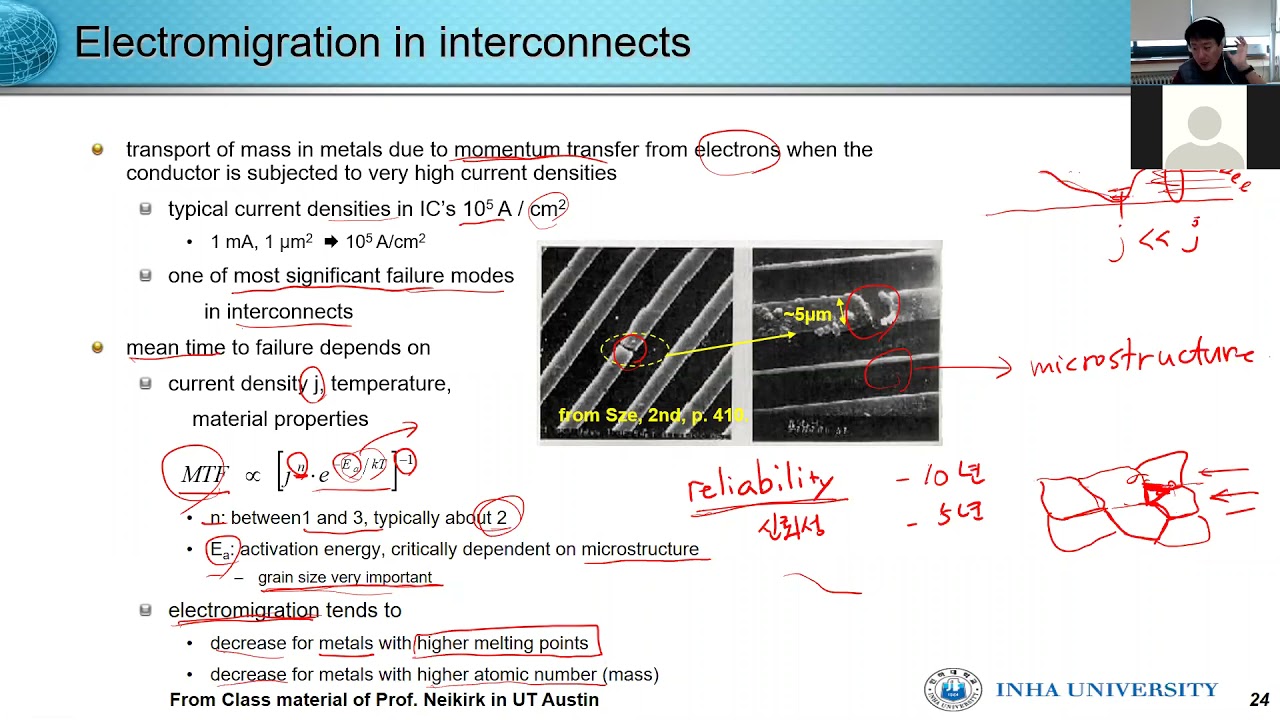
반도체공정 Lecture7 metallization 3 201123
Keywords
Summary
172 words
Critical Evaluation
Value of the Information & Strength of the Argument
The lecture provides valuable insights into the practical aspects of metallization in semiconductor manufacturing. The instructor explains complex phenomena like electromigration and stress voiding with clear analogies and real-world implications. The argumentation is solid, based on established principles of materials science and semiconductor physics. The discussion on reliability testing and the use of accelerated conditions is particularly useful for understanding how interconnects are qualified. The lecture also highlights the trade-offs in material selection and process integration, offering a balanced view of the challenges.
Scientific Rigor, Source Quality, Title Accuracy
The lecture is scientifically rigorous in its technical content, but it lacks explicit citations to external sources. The instructor relies on established knowledge in the field, which is generally accurate. The title accurately reflects the content, as it is a lecture on metallization. The presentation is informal, with some digressions, but the core information is reliable. No comments were provided for analysis.
160 words
Title / Content Match
The title accurately reflects the content, as the lecture focuses on metallization processes in semiconductor fabrication.
Quality & Reliability
7/10
The lecture provides a detailed and technically accurate explanation of metallization processes in semiconductor manufacturing, including electromigration, stress-induced voiding, and the use of barrier layers. The content is consistent with established semiconductor physics and engineering principles. However, the lack of citations and the informal presentation style reduce the overall reliability score.
Key Moments
Markers derived by PSI from the transcript: the creator did not define chapters.
- Introduction and review of previous lecture on aluminum metallization
- Explanation of stress-induced voiding and hillock formation
- Detailed discussion on electromigration and its effects
- Methods to mitigate electromigration: alloying and grain size control
- Accelerated life testing and reliability prediction
- Introduction to barrier layers and anti-reflective coatings
- Evolution of interconnect structures and the need for planarization
- Damascene process and copper metallization advantages
- Challenges with copper: diffusion barriers and low-k dielectrics
- Conclusion and preview of next lecture
Contribution & Novelties
The lecture provides a comprehensive overview of metallization in semiconductor manufacturing, with a focus on reliability issues and process integration. It offers practical insights into the trade-offs between material properties and process complexity. The discussion on accelerated testing and the evolution from aluminum to copper is particularly valuable for understanding the industry’s progression.
Pour aller plus loin :
- Electromigration — Provides a detailed explanation of the phenomenon and its impact on interconnects.
- Damascene process — Describes the copper interconnect fabrication technique.
- Low-k dielectric — Discusses materials used to reduce capacitance in interconnects.
92 words
Radar Profile
The radar profile shows high scores in quantity of information and technical level, indicating a dense and specialized lecture. The quality and reliability scores are moderate, reflecting the lack of citations and informal style. Overall, the lecture is strong in content but could benefit from more rigorous sourcing.