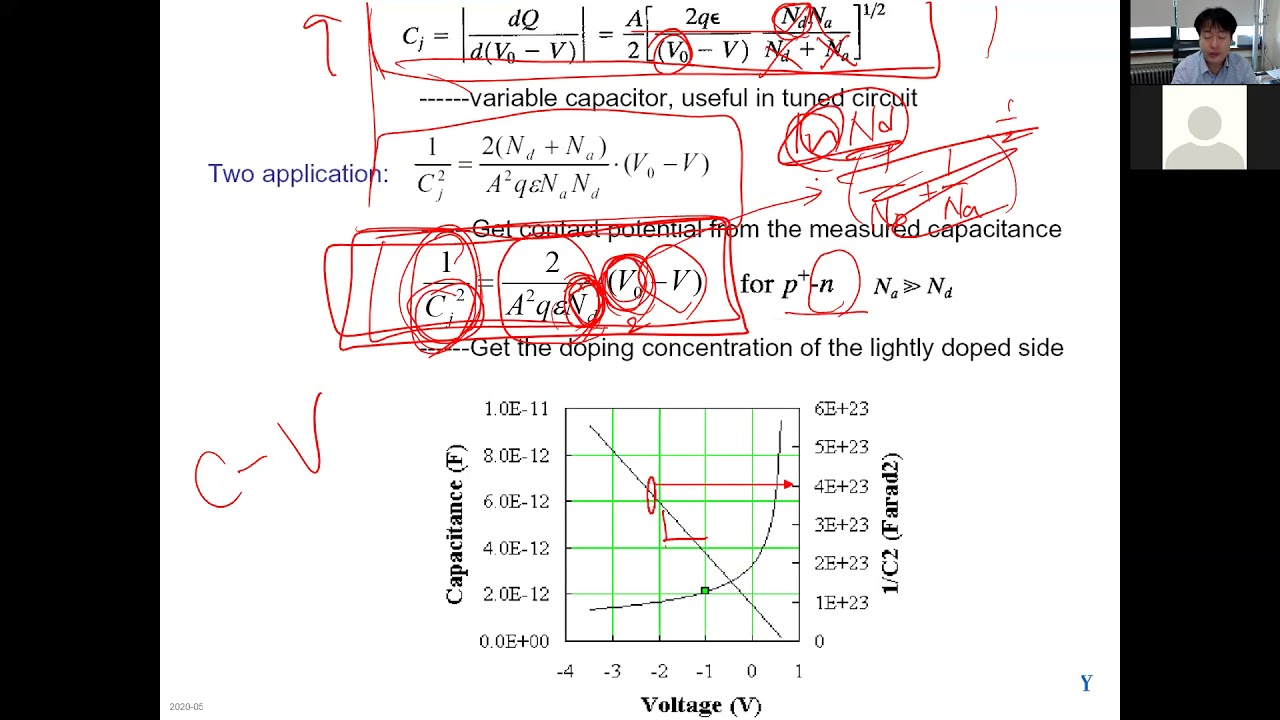
반도체소자 Lecture3 6
Keywords
Summary
146 words
Critical Evaluation
Value of the Information & Strength of the Argument
The lecture provides a thorough explanation of metal-semiconductor contacts, a fundamental topic in semiconductor device physics. The instructor uses clear diagrams and step-by-step reasoning to illustrate how energy band diagrams change with different work functions and bias conditions. The argumentation is logical and builds on previous knowledge of p-n junctions, making it valuable for students. However, the presentation is informal and the audio quality is poor, which may hinder comprehension. The instructor encourages active learning by asking students to draw diagrams themselves, which is pedagogically effective.
Scientific Rigor, Source Quality, Title Accuracy
The lecture does not cite any external sources or references, relying solely on the instructor’s knowledge. The content appears consistent with standard semiconductor physics, but the lack of citations reduces its scientific rigor. The title accurately describes the content as part of a lecture series on semiconductor devices. The informal style and occasional digressions may detract from the overall quality, but the core material is presented correctly.
168 words
Title / Content Match
The title '반도체소자 Lecture3 6' accurately reflects the content as it is the sixth part of Lecture 3 on semiconductor devices.
Quality & Reliability
7/10
The lecture is a detailed tutorial on semiconductor device physics, specifically metal-semiconductor contacts. The instructor explains concepts step-by-step with diagrams, but the audio transcription is noisy and contains many inaccuracies, making it difficult to follow precisely. The content appears technically sound, but the lack of clear references and the informal presentation style reduce its reliability.
Key Moments
Markers derived by PSI from the transcript: the creator did not define chapters.
- Introduction and review of breakdown mechanisms in p-n junctions.
- Discussion on the importance of reverse bias and the two types of breakdown: Zener and avalanche.
- Introduction to metal-semiconductor contacts and the concept of work function.
- Explanation of energy band diagrams for metal and semiconductor before contact.
- Case 1: Metal with n-type semiconductor, work function of metal greater than semiconductor.
- Analysis of forward and reverse bias for the first case, showing rectifying behavior.
- Case 2: Metal with n-type semiconductor, work function of metal smaller than semiconductor.
- Demonstration of ohmic contact formation and its symmetric current-voltage characteristics.
- Case 3: Metal with p-type semiconductor, work function of metal greater than semiconductor.
- Case 4: Metal with p-type semiconductor, work function of metal smaller than semiconductor.
- Summary of conditions for Schottky and ohmic contacts, and assignment of homework.
Contribution & Novelties
This lecture provides a clear pedagogical explanation of metal-semiconductor contacts, a topic often challenging for students. The instructor’s methodical approach of drawing energy band diagrams for each case helps demystify the formation of Schottky and ohmic contacts. The lecture emphasizes the practical implications for device design, such as choosing the appropriate metal for ohmic contacts.
Pour aller plus loin :
- Schottky barrier — Overview of the Schottky barrier formation and its role in rectifying contacts.
- Ohmic contact — Explanation of ohmic contacts and their importance in semiconductor devices.
- Work function — Definition and significance of work function in metal-semiconductor junctions.
100 words
Radar Profile
The radar profile shows high scores in technical level and information quantity, indicating a detailed and advanced lecture. However, the lower scores in information quality and reliability reflect the lack of citations and the informal presentation style. Overall, the lecture is technically strong but could benefit from more rigorous sourcing.