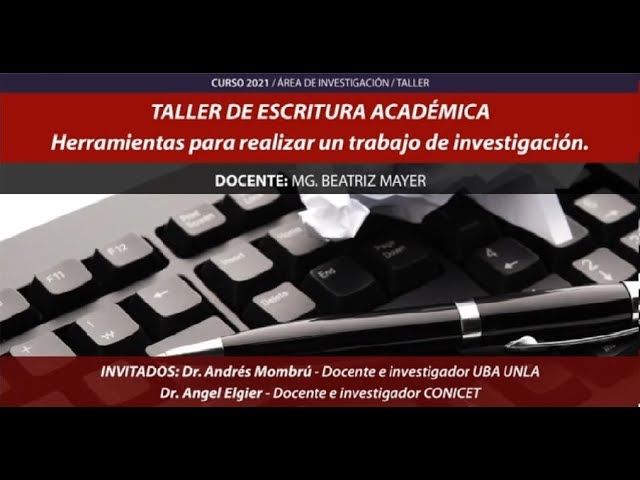
Taller de Escritura Académica
Keywords
Summary
179 words
Critical Evaluation
Value of the Information & Strength of the Argument
The value of the information lies in its practical guidance for academic writing, grounded in the speakers’ extensive experience as researchers and editors. They provide clear distinctions between concepts such as methodology vs. tools, and different types of academic texts, which are useful for graduate students and researchers. The argumentation is solid, based on logical reasoning and examples from their own practice, though it lacks empirical evidence or citations to specific studies. The speakers also engage in a constructive dialogue, acknowledging different epistemological perspectives, which strengthens the credibility of their claims.
Scientific Rigor, Source Quality, Title Accuracy
The scientific rigor is moderate: the speakers are credible experts, but they do not cite specific sources or studies during the talk. The quality of sources is therefore based on their authority rather than on explicit references. The title accurately reflects the content, as it is indeed a workshop on academic writing. The discussion is well-structured and coherent, but the lack of formal citations limits its scholarly depth.
174 words
Title / Content Match
The title accurately reflects the content, which is a workshop on academic writing.
Quality & Reliability
7/10
The video features two academics with relevant expertise, providing a thoughtful discussion on academic writing. However, it lacks formal citations and empirical evidence, relying on personal experience and general principles.
Key Moments
Markers derived by PSI from the transcript: the creator did not define chapters.
- Introduction by Beatriz, welcoming participants and introducing the speakers.
- Andrés Mumbrú begins his talk on academic writing, emphasizing the need to understand the consignas before writing.
- Discussion on the three marks of writing: citation, paraphrase, and own writing.
- Explanation of the difference between methodology and tools, and the importance of epistemological context.
- Andrés talks about the distinction between theses, monographs, and research reports, and their different requirements.
- Discussion on the concept of originality in postgraduate theses and the need for critical self-reflection.
- Andrés addresses the challenges faced by professionals returning to academia and the pressure to pursue postgraduate studies.
- Ángel Elgier joins the discussion, adding perspectives on the plurality of methodologies in psychology.
- Interactive segment with questions from the audience about their specific writing challenges.
- Further discussion on the importance of following publication norms and the role of academic writing in professional practice.
Contribution & Novelties
The video provides a comprehensive overview of academic writing from a methodological and epistemological perspective, emphasizing the need to align writing with the specific requirements of different academic genres. It offers practical advice for graduate students and researchers, particularly in the social sciences and psychology. The discussion highlights the importance of critical self-reflection and the distinction between professional and scientific profiles.
Pour aller plus loin :
- Academic writing — Provides a general overview of academic writing conventions.
- Epistemology — Relevant to the discussion on epistemological frameworks.
- Methodology — Explains the concept of methodology in research.
- Thesis — Discusses the structure and purpose of a thesis.
105 words
Radar Profile
The radar profile shows high scores in quantity of information and fiabilité, but lower in technical level, indicating that the content is accessible and reliable but not highly technical. This is consistent with a workshop aimed at graduate students and professionals.