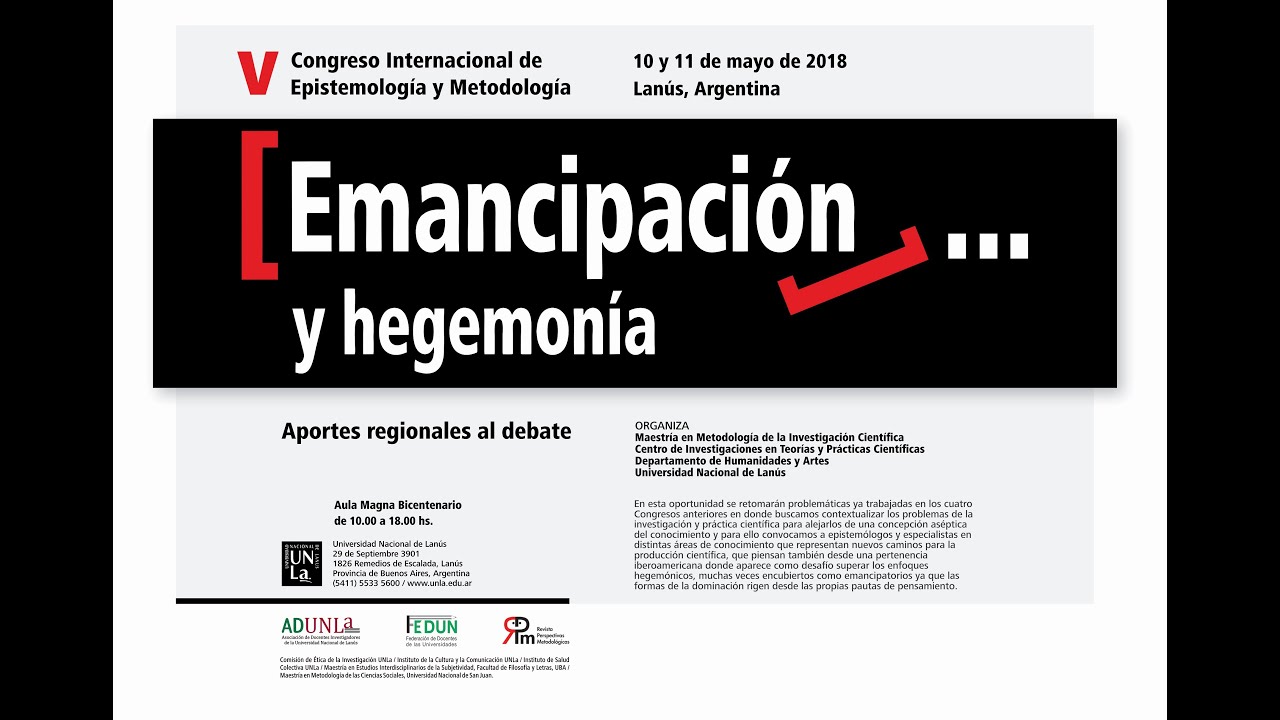
V Congreso Internacional de Epistemología y Metodología / Conferencia Dra. Nélida da Costa Pereira
Keywords
Summary
168 words
Critical Evaluation
Value of the Information & Strength of the Argument
The presentation offers valuable insights into the often-overlooked dimension of silence in territorial studies, challenging researchers to consider what is not said. The argumentation is well-structured, drawing on philosophical concepts (Foucault’s ‘art of listening’) and geographical theories (Santos, Soja) to support the claim that silences are meaningful and must be methodologically addressed. However, the argumentation is largely theoretical and relies on anecdotal examples rather than systematic empirical evidence, which weakens its scientific rigor. The speaker’s passion and expertise are evident, but the lack of concrete data or a clear methodological framework for studying silence limits the practical applicability.
Scientific Rigor, Source Quality, Title Accuracy
The presentation demonstrates strong scientific rigor in its use of established theories and concepts, with clear references to Foucault, Santos, Soja, and others. The sources are relevant and appropriately cited, though not formally listed. The title accurately reflects the content, focusing on the conference and the speaker’s topic. The adequacy between title and content is high, as the presentation directly addresses the announced theme of ’territorial silences’ and the scientific commitment to listening. No comments were provided for analysis.
192 words
Title / Content Match
The title accurately reflects the content: a conference presentation by Dra. Nélida da Costa Pereira at the V International Congress on Epistemology and Methodology.
Quality & Reliability
7/10
The presentation is grounded in established philosophical and geographical frameworks (Foucault, Santos, Soja), and the speaker demonstrates extensive academic expertise. However, it is primarily an opinion-based lecture with limited empirical data or systematic methodology, and the video quality and transcription issues reduce reliability.
Key Moments
Markers derived by PSI from the transcript: the creator did not define chapters.
- Introduction and presentation of the speaker by the moderator.
- Speaker begins her talk, referencing the work of her research group and key concepts.
- Discussion of the importance of everyday territorialities and the metaphor of the 'lyricist'.
- Introduction of the concept of 'territorial silences' and two types of silence.
- Reference to Foucault's 'art of listening' and its three components.
- Example of a strike and the observation of silence at a train station.
- Discussion of methodological implications and the need for active observation.
- Conclusion and call to action for researchers to listen to unspoken words.
Cited Sources
- Michel Foucault - The Hermeneutics of the Subject — Referenced for the concept of the 'art of listening' and its components.
- Milton Santos - The Nature of Space — Referenced for the concept of 'rugosities' in space.
- Eduardo Soja - Postmetropolis — Referenced for the concept of 'spatial justice' and 'postmetropolis'.
Concurring Sources
- Michel Foucault - The Hermeneutics of the Subject — Supports the idea of listening as a philosophical practice.
- Milton Santos - The Nature of Space — Aligns with the concept of space as layered and historical.
Contribution & Novelties
The presentation offers a novel perspective on the role of silence in territorial studies, proposing that unspoken words are a crucial dimension of everyday life that researchers must actively listen to. It bridges philosophical concepts with geographical methodology, suggesting practical approaches for incorporating silence into research. The speaker’s emphasis on the ‘art of listening’ as a methodological tool is a valuable contribution to the field.
Pour aller plus loin :
- Michel Foucault - The Hermeneutics of the Subject — Provides the philosophical basis for the ‘art of listening’.
- Milton Santos - The Nature of Space — Offers the concept of ‘rugosities’ relevant to understanding spatial layers.
- Eduardo Soja - Postmetropolis — Discusses spatial justice and the ‘postmetropolis’ concept.
118 words
Radar Profile
The radar profile shows balanced scores across all dimensions, with slightly lower technical level and higher information quality. This indicates a presentation that is intellectually rich but not highly technical, suitable for an academic audience interested in qualitative and philosophical approaches.