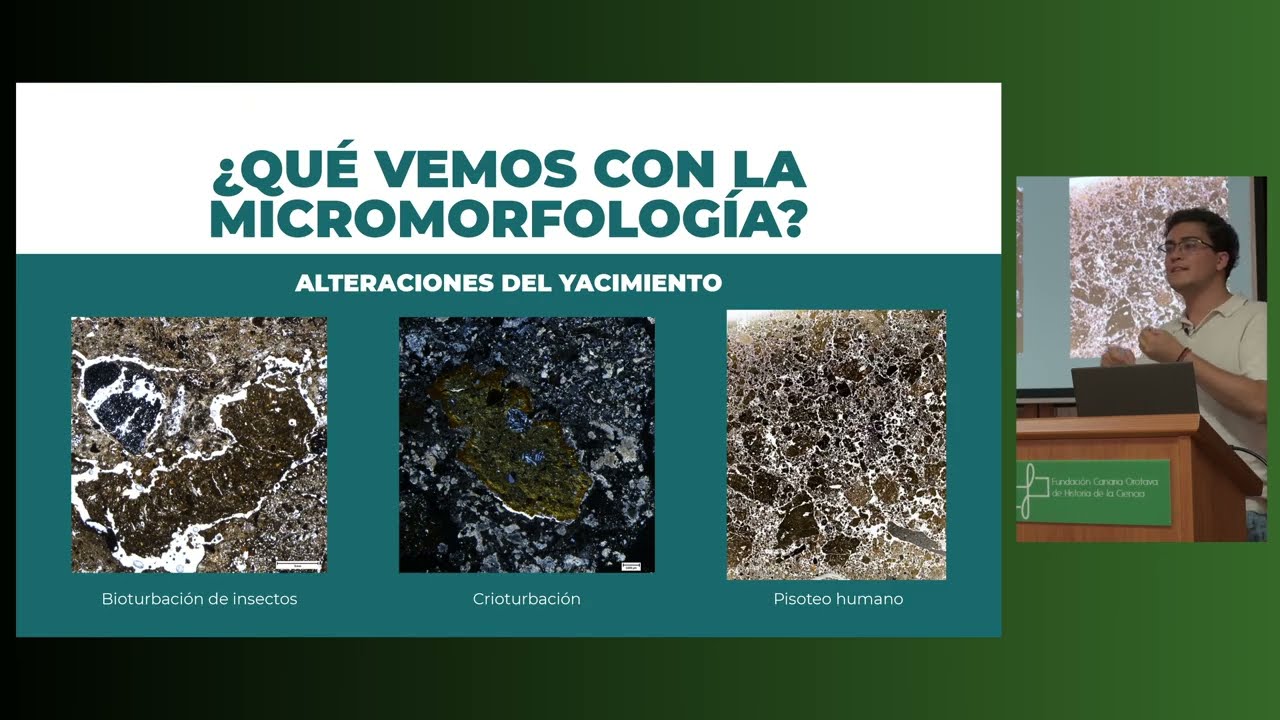
Microarqueología. Pedro García Villa, Fundación Canaria Orotava de Historia de la Ciencia
Keywords
Summary
170 words
Critical Evaluation
The conference provides a clear and informative introduction to microarchaeology, specifically its application to the Canary Islands. The speaker, Pedro García Villa, demonstrates a solid command of the subject, explaining complex methodologies in an accessible manner. The presentation is well-structured, starting with the theoretical background of geoarchaeology and the shift towards studying sediments, then detailing the three main techniques used in his laboratory: micromorphology, lipid biomarkers, and phytoliths. The use of concrete examples from Canarian sites, such as Las Estacas and Zonzamas, helps to illustrate the practical applications and potential discoveries. The speaker also addresses the specific challenges of Canarian archaeology, such as acidic volcanic soils and the reuse of sites, which justify the need for these microscopic approaches. The argumentation is logical and grounded in scientific practice, though the talk is more of an overview than a detailed presentation of original research. The speaker does not cite specific sources or publications, which limits the ability to verify claims independently. However, the methods described are well-established in the field, and the speaker’s affiliation with a recognized laboratory adds credibility. The title accurately reflects the content, and the talk successfully conveys the importance of looking beyond the visible to understand past human activities. Overall, the presentation is valuable for those interested in archaeological science and the prehistory of the Canary Islands, offering a compelling case for the integration of microarchaeological techniques.
230 words
Title / Content Match
The title accurately reflects the content, focusing on microarchaeology and the speaker's affiliation.
Quality & Reliability
8/10
The speaker is a doctoral researcher from AMBILAB, presenting established scientific methods (micromorphology, lipid biomarkers, phytoliths) with concrete examples from Canarian sites. The content is well-structured and grounded in current research, though no external sources are cited in the video.
Key Moments
Markers derived by PSI from the transcript: the creator did not define chapters.
- Introduction to the concept of invisible archaeology and the importance of sediment analysis.
- Explanation of geoarchaeology and its two main branches: macroscopic and microscopic.
- Overview of the Canary Islands' colonization and the unique challenges for archaeology.
- Introduction to the three main methodologies: micromorphology, lipid biomarkers, and phytoliths.
- Detailed explanation of soil micromorphology, including sampling and thin section preparation.
- Examples of micromorphology applications in Canarian sites, such as identifying stabling areas.
- Discussion of lipid biomarkers and their use in detecting organic residues.
- Phytolith analysis and its potential for reconstructing past plant use.
- Conclusion and future directions for microarchaeology in the Canary Islands.
Contribution & Novelties
The talk provides an accessible overview of microarchaeological techniques applied to the Canary Islands, highlighting their potential to reveal invisible aspects of past human activities. It emphasizes the importance of sediment analysis in overcoming the challenges of acidic volcanic soils and site reuse.
Pour aller plus loin :
- Micromorphology (archaeology) — Provides a detailed explanation of the technique and its applications.
- Phytolith — Overview of phytoliths and their use in archaeological and paleoenvironmental studies.
- Lipid biomarker — Introduction to lipid biomarkers and their role in archaeological chemistry.
- Geoarchaeology — General overview of the interdisciplinary field combining geology and archaeology.
99 words
Radar Profile
The radar profile shows high scores in quantity and quality of information, with a moderate technical level and high reliability. This indicates a well-balanced presentation that is both informative and credible, suitable for a general audience interested in archaeological science.