Viaje a la transtierra. La última singladura
Keywords
Summary
175 words
Critical Evaluation
The conference offers a valuable personal perspective on Blas Cabrera, enriched by the speaker’s own connections to the Cabrera family and his knowledge of the scientific community in the Canary Islands. Trujillo provides a vivid portrayal of Cabrera’s early life, his scientific achievements, and his political stance during a turbulent period in Spanish history. The talk is well-structured, moving chronologically from Cabrera’s childhood to his exile, and it weaves in personal anecdotes and reflections that humanize the historical figure. However, the presentation is largely based on the speaker’s memory and personal interpretation, with no formal citations or references to primary sources. While the information is plausible and consistent with known historical facts, the lack of verifiable details and the reliance on anecdotal evidence limit its scholarly rigor. Trujillo’s discussion of the ‘Third Spain’ is thought-provoking but somewhat speculative, as he does not provide extensive evidence to support this interpretation. The talk also touches on the concept of ’two Spains’ and critiques the binary view, offering a nuanced perspective. Overall, the conference is informative and engaging, but it would benefit from more rigorous sourcing and a clearer distinction between personal recollections and established historical facts.
194 words
Title / Content Match
The title is poetic and metaphorical, referring to the 'transtierra' (exile) and the 'last voyage' of Blas Cabrera. The content indeed covers his life, work, and exile, so it is adequately aligned.
Quality & Reliability
7/10
The speaker is a knowledgeable colleague of Blas Cabrera's family and provides personal anecdotes and historical context. However, the talk is based on memory and personal interpretation, with no formal citations or references to primary sources. The information is plausible and consistent with known historical facts, but lacks verifiable details.
Key Moments
Markers derived by PSI from the transcript: the creator did not define chapters.
- Introduction and thanks to the audience.
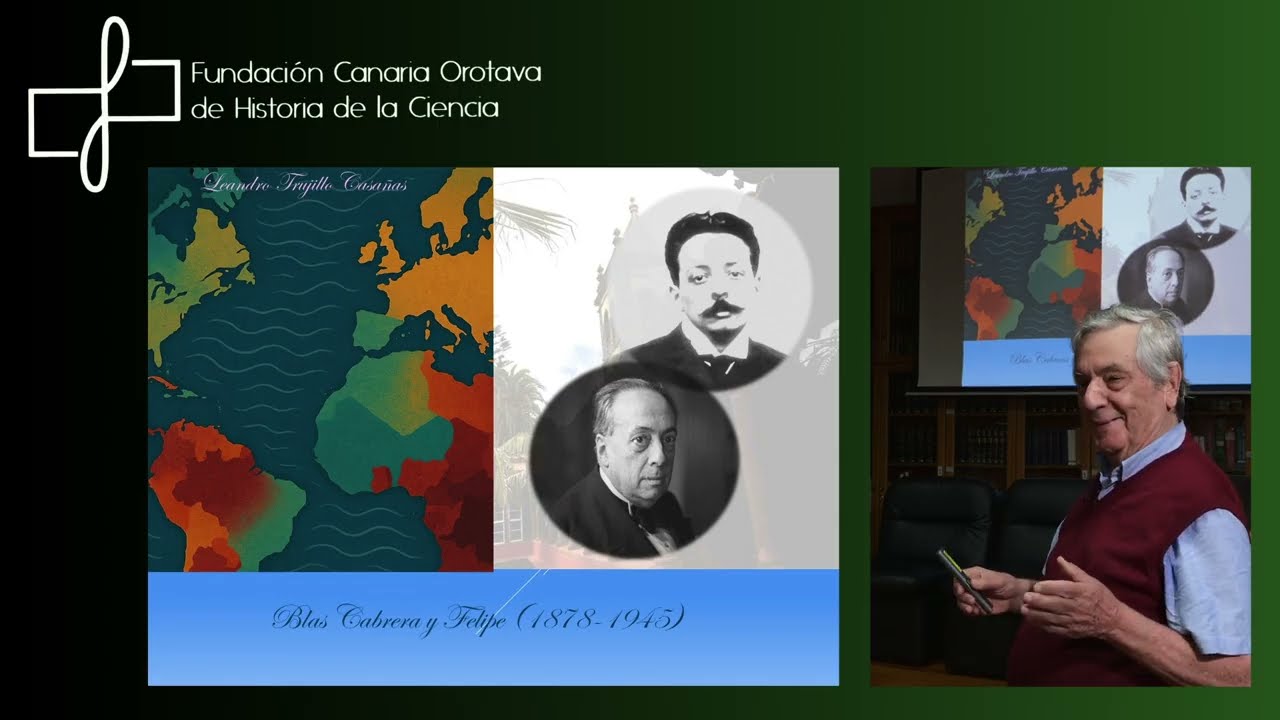
- Presentation of two photos of Blas Cabrera from 1905 and 1936.
- Description of Cabrera's childhood in La Laguna and his family background.
- Discussion of Cabrera's academic career and his early work in magnetism.
- Mention of the 1978 centenary conference in honor of Cabrera.
- Cabrera's role as rector of the University of Madrid in 1930.
- Cabrera's exile to Paris and his work with the International Bureau of Weights and Measures.
- Discussion of the 'Third Spain' and Cabrera's political neutrality.
- Cabrera's final exile to Mexico and his death in 1945.
- Conclusion and reflections on the legacy of Blas Cabrera.
Cited Sources
- Libro de ponencias del centenario de Blas Cabrera (1978) — Mentioned as a publication containing the proceedings of the 1978 centenary conference.
- Historia de las dos Españas — Referenced as a book by Santos Juliá that discusses the concept of two Spains.
- La tercera España — Referenced as a pamphlet by Vicente Cachu based on a conference.
Concurring Sources
- Blas Cabrera y Felipe — Wikipedia article that corroborates the main biographical details mentioned in the talk.
Contribution & Novelties
The talk provides a personal and anecdotal perspective on Blas Cabrera, offering insights into his character and political stance that may not be widely known. It also introduces the concept of the ‘Third Spain’ as a framework for understanding the moderate intellectual movement during the Spanish Civil War.
Pour aller plus loin :
- Blas Cabrera y Felipe — Wikipedia article providing a comprehensive overview of his life and work.
- Junta para Ampliación de Estudios — Wikipedia article on the institution that supported Cabrera’s research.
- Spanish Civil War — Wikipedia article for historical context.
93 words
Radar Profile
The radar profile shows a balanced performance across all dimensions, with slightly higher scores in quantity and quality of information, reflecting the speaker's personal knowledge and the historical richness of the topic. The lower score in technical level indicates that the talk is more accessible to a general audience.
💬 No comments were provided for analysis.