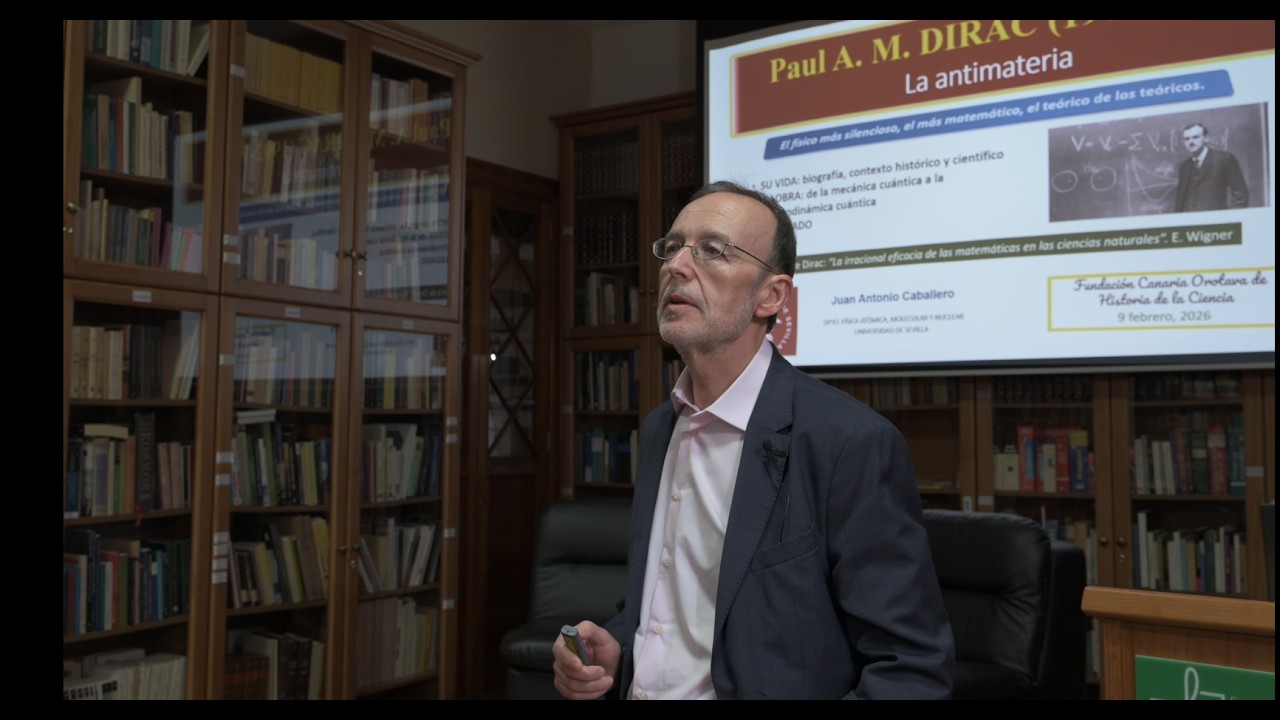
Dirac: la antimateria. Conferencia de Juan Antonio Caballero en la Fundación Orotava.
Keywords
Summary
186 words
Critical Evaluation
The lecture provides a comprehensive and engaging overview of Paul Dirac’s life and scientific achievements. Professor Caballero, an expert in the field, delivers the content with clarity and enthusiasm, making complex topics accessible to a non-specialist audience. The historical narrative is well-structured, tracing Dirac’s development from a shy child to a Nobel laureate, and effectively highlights the revolutionary nature of his work. The scientific content is accurate, with correct explanations of the Dirac equation, its implications for spin and antimatter, and the foundations of quantum electrodynamics. The speaker appropriately emphasizes the mathematical elegance of Dirac’s approach, while also offering a nuanced critique of the ‘principle of mathematical beauty’ as a simplistic explanation for his motivations. The lecture benefits from personal anecdotes and historical context, which humanize Dirac and make the material more relatable. However, as a popular science talk, it lacks formal citations and does not delve into the technical details of the mathematics, which may leave some viewers wanting more depth. The title accurately reflects the content, and the lecture successfully fulfills its aim of introducing Dirac’s significance to a broader audience. Overall, this is a high-quality educational resource that combines historical insight with scientific explanation, suitable for anyone interested in the history of physics and the origins of antimatter.
211 words
Title / Content Match
The title accurately reflects the content, focusing on Dirac and his prediction of antimatter.
Quality & Reliability
8/10
The lecture is given by a university professor in atomic, molecular and nuclear physics, and is hosted by a reputable foundation. The content is historically accurate and scientifically sound, though it is a popular science talk without formal citations.
Key Moments
Markers derived by PSI from the transcript: the creator did not define chapters.
- Introduction and welcome by the speaker.
- Overview of Dirac's importance and the lecture structure.
- Discussion of Dirac's early life and character.
- Dirac's education and self-study of relativity and quantum theory.
- The heroic period: Dirac's contributions to quantum mechanics.
- Introduction of the Dirac equation and its implications.
- Explanation of antimatter and the positron.
- Quantum electrodynamics and Dirac's later work.
- Discussion of the magnetic monopole and cosmology.
- The principle of mathematical beauty and Dirac's legacy.
Cited Sources
- Fundación Orotava de Historia de la Ciencia — Official website of the organizing foundation.
- XXXV Seminario Orotava — Event page for the seminar series where this lecture was given.
- Jornadas sobre el exilio republicano español en México — Another event organized by the foundation, mentioned in the description.
Concurring Sources
- Dirac equation - Wikipedia — Confirms the scientific content of the lecture regarding the Dirac equation.
- Antimatter - Wikipedia — Supports the discussion on antimatter and positron.
Contribution & Novelties
The lecture provides a comprehensive and accessible overview of Paul Dirac’s life and work, emphasizing his role in the development of quantum mechanics and the prediction of antimatter. It offers a balanced perspective on Dirac’s character and scientific contributions, including a critical examination of the ‘principle of mathematical beauty’ often associated with him. The speaker’s personal anecdotes and historical context add depth to the narrative, making it valuable for both newcomers and those familiar with the subject.
Pour aller plus loin :
- Dirac equation - Wikipedia — For a detailed mathematical treatment of the equation.
- Antimatter - Wikipedia — Overview of antimatter and its experimental discovery.
- Quantum electrodynamics - Wikipedia — Further reading on the theory that Dirac helped found.
120 words
Radar Profile
The radar profile shows high scores in information quantity, quality, and reliability, with a slightly lower score in technical level, reflecting the lecture's balance between depth and accessibility.
💬 No comments were provided for analysis.