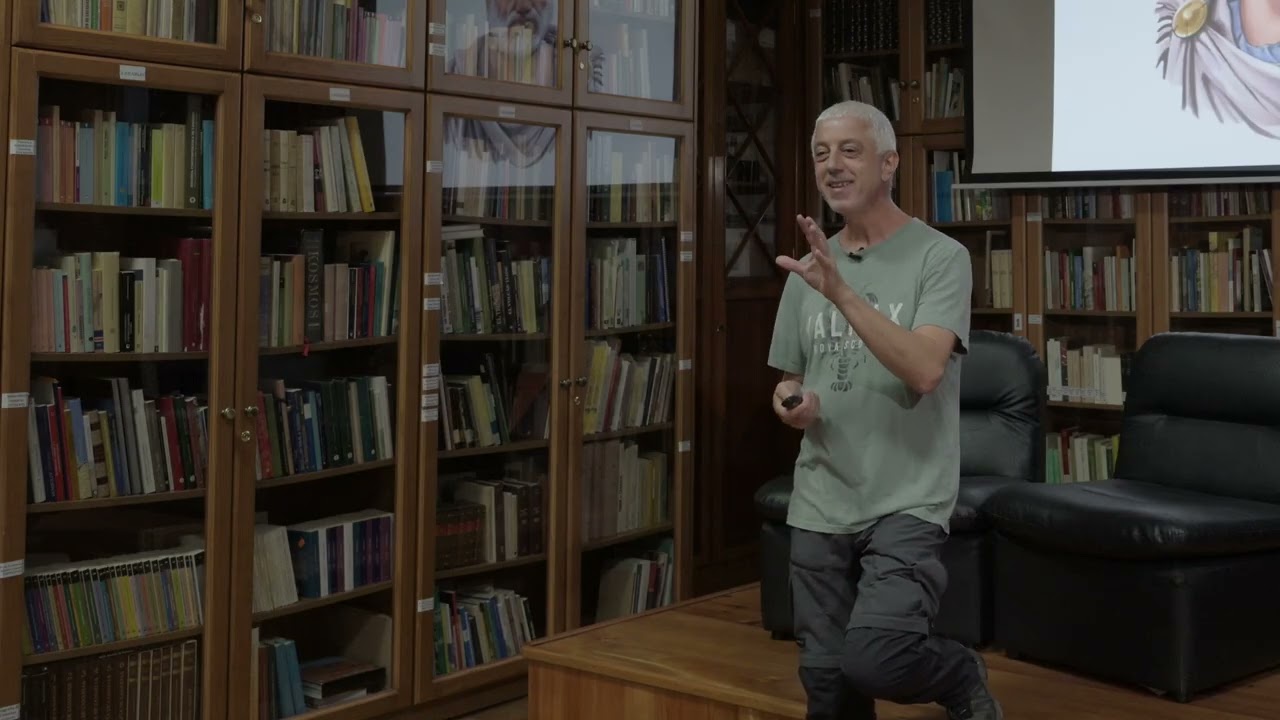
Xurxo Mariño: "Historia de la mente" en la Fundación Orotava.
Keywords
Summary
155 words
Critical Evaluation
The conference provides a valuable historical perspective on the neuroscience of the mind, effectively tracing the evolution of ideas from ancient Greece to the 17th century. Mariño demonstrates expertise in both neuroscience and history, offering clear explanations of complex concepts. The argumentation is generally solid, though some historical claims are presented without specific citations, which is common in public lectures. The talk is well-structured, moving chronologically and highlighting key figures and their contributions. The speaker’s use of everyday examples, such as the effects of alcohol, makes the content accessible. However, the conclusion that the brain alone is insufficient for the emergence of the self is somewhat underexplored in this excerpt, and the speaker does not provide detailed evidence for this claim. Overall, the content is informative and engaging, but it is more of an expert opinion than a rigorous scientific review. The title accurately reflects the content, and the talk is well-suited for a general audience interested in the history of neuroscience.
162 words
Title / Content Match
The title accurately reflects the content: a historical overview of ideas about the mind by a neuroscientist.
Quality & Reliability
8/10
The speaker is a recognized neuroscientist and science communicator. The content is based on historical and scientific knowledge, with references to specific historical figures and works. However, it is a conference talk, not a peer-reviewed article, and some claims are presented without detailed citations.
Key Moments
Markers derived by PSI from the transcript: the creator did not define chapters.
- Introduction and thanks
- Discussion of sleep and the disappearance of the self
- Current neuroscientific view: mind arises from brain activity
- Historical debate: brain vs. heart, Alcmaeon and Hippocrates
- Aristotle's arguments for the heart as the seat of the mind
- Herophilus and the cerebral ventricles
- Vesalius and the ventricles in the 16th century
- Descartes and the pineal gland
- Thomas Willis and the shift to brain tissue
- Discovery of animal electricity and nerve conduction velocity
Cited Sources
- Fundación Orotava de Historia de la Ciencia — Organizing institution and source of the conference.
- XXXV Seminario Orotava — Event series where this conference took place.
- El exilio republicano español en México — Another event series mentioned in the description.
Concurring Sources
- Fundación Orotava de Historia de la Ciencia — Institutional source supporting the event and its content.
Contribution & Novelties
The talk offers a synthesis of historical and contemporary perspectives on the mind, emphasizing that the brain alone is not sufficient for the emergence of the self. It highlights the role of environmental factors, which is a nuanced view often overlooked in popular neuroscience.
Pour aller plus loin :
- History of neuroscience — Provides a broader context for the historical developments mentioned.
- Cerebral ventricles — Relevant to the discussion of ventricular theories.
- Thomas Willis — Key figure in shifting the focus to brain tissue.
84 words
Radar Profile
The radar profile shows high scores in information quantity and quality, with moderate technical level and high reliability. This indicates a well-balanced presentation suitable for a general audience with some scientific background.