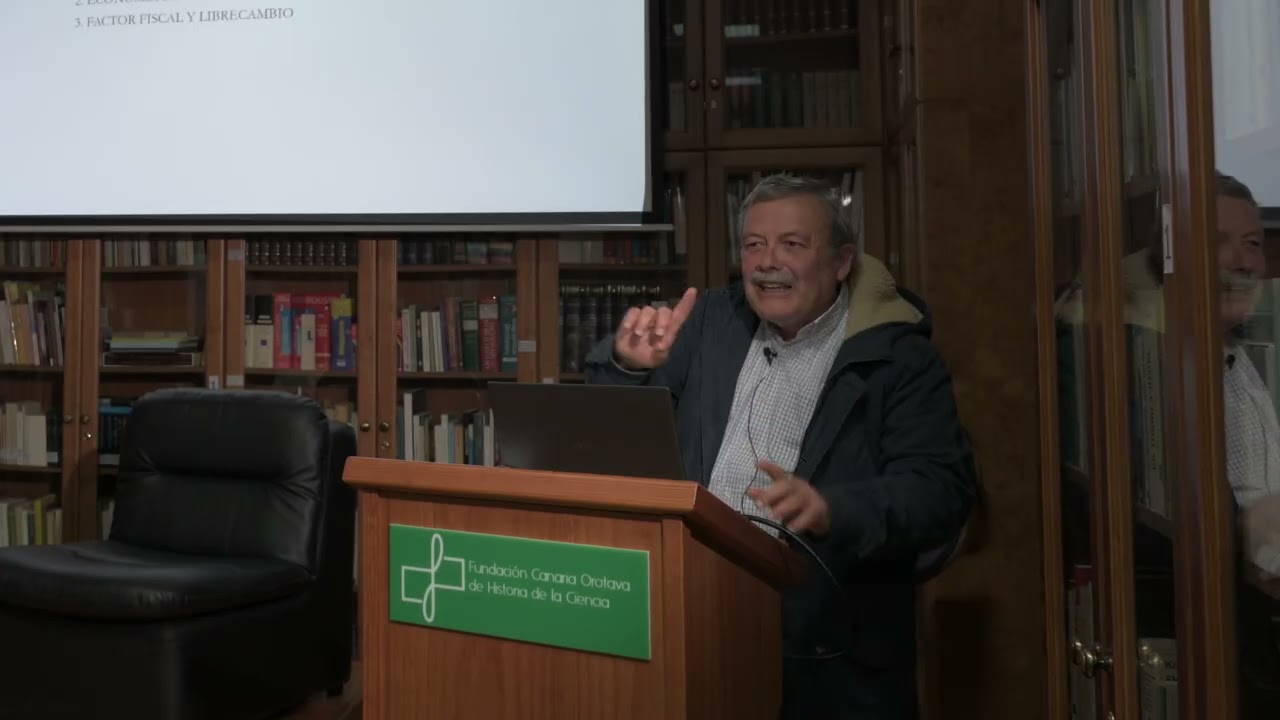
Antonio M. Macías, conferencia en la Fundación Orotava sobre los ingenios azucareros canarios
Keywords
Summary
148 words
Critical Evaluation
The conference provides a compelling and well-structured argument that challenges traditional narratives about the Canary Islands’ economic history. Macías demonstrates a deep knowledge of the subject, using quantitative data to support his claims about rapid growth and trade expansion. The argument is logically coherent, moving from the general model to specific examples and technological details. However, the talk lacks explicit citations to primary sources, which would strengthen its scholarly rigor. The speaker’s assertive style, while engaging, sometimes oversimplifies complex historical debates. The adéquation between title and content is excellent, as the focus remains on the sugar mills and their economic impact. The presentation is more of an expert opinion than a balanced review of historiography, but it offers a valuable perspective. The use of historical data and comparisons with other regions adds credibility. The lack of visual aids or detailed charts might limit the accessibility for some viewers, but the oral explanations are clear. Overall, the conference is informative and thought-provoking, though it would benefit from more explicit references to sources.
171 words
Title / Content Match
The title accurately reflects the content, which focuses on the Canary sugar mills and their economic context.
Quality & Reliability
8/10
The speaker is a recognized historian and professor, and the talk is hosted by a reputable foundation. The content is based on original research and historical data, but lacks explicit citations to primary sources during the talk.
Key Moments
Markers derived by PSI from the transcript: the creator did not define chapters.
- Introduction: the speaker sets the stage, emphasizing the importance of understanding the Canary economic model.
- Presentation of the three pillars of the Canary economic model: agro-export specialization, maritime services, and fiscal freedom.
- Discussion on the need for competitiveness and innovation in the agro-export sector, with examples from the wine trade.
- Explanation of the fiscal advantages of the Canary Islands, including low taxes and free trade.
- Presentation of economic data showing rapid growth in the early 16th century.
- Introduction to the sugar cane variety and its journey from the Mediterranean to the Canaries.
- Comparison between Mediterranean and Canary sugar mills, highlighting technological improvements.
- Discussion on the impact of sugar mills on the colonization and economic development of the islands.
Cited Sources
- Fundación Orotava de Historia de la Ciencia — Official website of the organizing foundation, providing information about their activities and mission.
- XXXV Seminario Orotava — Page for the seminar series where this conference took place.
- Jornadas sobre el exilio republicano español en México — Related event page, indicating the foundation's broader activities.
Concurring Sources
- Fundación Orotava de Historia de la Ciencia — The foundation's mission aligns with the promotion of science history, supporting the credibility of the talk.
Contribution & Novelties
The talk offers a fresh perspective on the Canary Islands’ economic history, arguing that the sugar mills were a key driver of innovation and capitalism, contrary to traditional views of a feudal or monoculture economy. It provides a detailed analysis of the economic model and its components.
Pour aller plus loin :
- Sugar industry in the Canary Islands — Overview of the historical sugar industry in the Canaries.
- Canary Islands economic history — General economic history context.
- Atlantic slave trade and sugar — Related to the broader context of sugar production and trade.
93 words
Radar Profile
The radar profile shows high scores in information quantity, quality, and reliability, with a slightly lower technical level, indicating a well-researched and credible presentation that is accessible to a general audience.