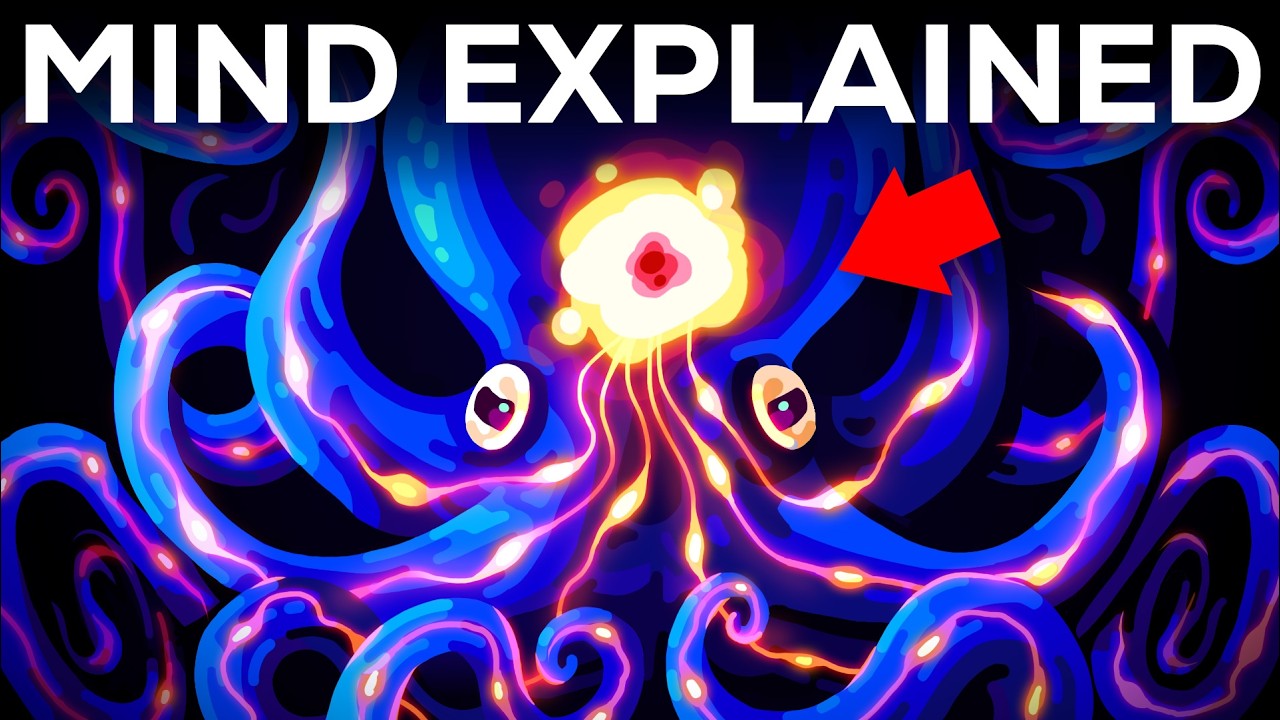
Our Minds Are Weirder than You Think
Keywords
Summary
133 words
Critical Evaluation
The video provides a compelling and scientifically grounded overview of the evolution and diversity of minds. It effectively synthesizes research from comparative psychology, neuroscience, and evolutionary biology, presenting complex ideas in an accessible manner. The argumentation is solid, building from simple organisms to complex social cognition, and the use of specific examples (e.g., bees, octopuses, scrub jays) adds credibility. The sources cited in the description are reputable, including scientific papers and reviews. The video also acknowledges the limitations of our understanding, such as the debate over whether simple organisms have minds. The production quality is high, with clear animations and narration. The title accurately reflects the content, and the video does not overstate claims. However, the video simplifies some concepts, which is expected for a general audience, and it does not delve into philosophical debates about consciousness. Overall, it is a reliable and informative piece of science communication.
148 words
Title / Content Match
The title accurately reflects the content, which explores the surprising and diverse nature of minds across species.
Quality & Reliability
8/10
The video presents a well-structured overview of the evolution and diversity of minds, referencing scientific studies and expert consensus. The information is accurate and up-to-date, though simplified for a general audience. The sources are credible and cited in the description.
Key Moments
Markers derived by PSI from the transcript: the creator did not define chapters.
- Introduction to the concept of the mind as a private inner universe.
- Discussion on the evolution of minds as a gap between sensory input and motor output.
- Examples of simple minds: roundworms and bees.
- Octopus distributed nervous system and its implications for mind.
- Bird cognition and social simulation, leading to human social minds.
- Human self-awareness, theory of mind, and storytelling as sharing internal simulations.
Cited Sources
- Sources & further reading — The video description links to a page with sources and further reading.
Concurring Sources
- The Evolution of Consciousness — Supports the evolutionary perspective on minds.
External References
Contribution & Novelties
The video offers a comprehensive and engaging synthesis of current scientific understanding of minds, emphasizing their evolutionary origins and diversity. It highlights the social nature of human minds and the role of storytelling in sharing internal experiences.
Pour aller plus loin :
- Theory of mind — Relevant to the discussion of simulating other minds.
- Aphantasia — Directly mentioned in the video, relevant to variations in mental imagery.
- Octopus intelligence — Relevant to the distributed nervous system and cognition.
- Scrub jay caching behavior — Relevant to the example of food caching and social cognition.
93 words
Radar Profile
The radar profile shows high scores in information quantity, quality, and reliability, with a moderate technical level. This indicates a well-researched and accessible science communication piece.
💬 Très positif. Sur les 30 commentaires analysés, le public exprime une admiration générale pour la qualité de la vidéo, avec des références à des jeux vidéo et des anecdotes personnelles, sans critiques négatives.