Computational Imaging Through Scatterers using Spatially Structured Optical Beams | Francis Gracy
Keywords
Summary
157 words
Critical Evaluation
Value of the Information & Strength of the Argument
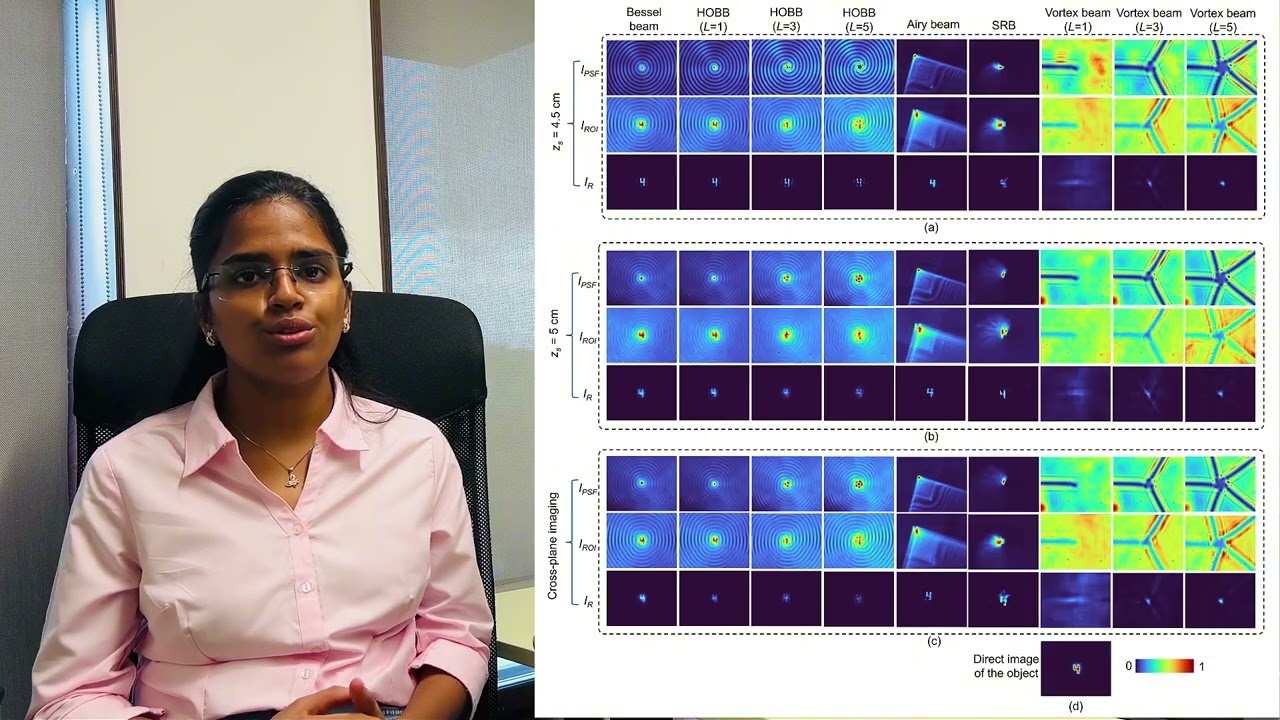
The video provides valuable information on a novel computational imaging approach, with clear explanation of the methodology and experimental results. The argumentation is solid, supported by quantitative metrics (RMSE, entropy) and comparative analysis across different beam types and scattering conditions. The presenter effectively justifies the superiority of Airy beams based on their physical properties. The study is original and contributes to the field of optical imaging through scattering media.
Scientific Rigor, Source Quality, Title Accuracy
The scientific rigor is high, as the work is published in a peer-reviewed journal (Optics and Laser Technology). The presenter cites the full article link in the description. The methodology is detailed, and the results are presented with quantitative metrics. The title accurately reflects the content. The video does not include external sources beyond the paper, but the research is well-contextualized within existing literature on structured beams and imaging through scattering.
155 words
Title / Content Match
The title accurately reflects the content, which focuses on computational imaging through scatterers using structured optical beams.
Quality & Reliability
8/10
The video presents original research published in a peer-reviewed journal (Optics and Laser Technology). The methodology is clearly described, with experimental details and quantitative metrics. The presenter is a PhD student, and the work is funded by EU Horizon 2020, adding credibility. However, the video is a presentation and lacks peer-review context or external validation within the video itself.
Key Moments
Markers derived by PSI from the transcript: the creator did not define chapters.
- Introduction: presenter introduces himself and the research topic.
- Motivation: challenges of imaging through scattering media.
- Overview of existing methods and the proposed framework.
- Experimental setup description: components and beam generation.
- Baseline study without scatterer: comparison of beam performances.
- Baseline study with scatterer but without structured beams.
- Results with weak scatterer: performance of different beams.
- Results with strong scatterer: Airy beam superiority.
- Conclusion and potential applications.
Cited Sources
- Full article: Computational Imaging Through Scatterers using Spatially Structured Optical Beams — The presenter refers to the full paper published in Optics and Laser Technology, linked in the description.
Concurring Sources
- Full article: Computational Imaging Through Scatterers using Spatially Structured Optical Beams — The video is based on this peer-reviewed article, which provides detailed methodology and results.
Contribution & Novelties
The video presents a novel framework (CITS-SSOB) that integrates spatially structured optical beams into computational imaging through scattering layers, demonstrating that beam choice significantly affects reconstruction quality. The finding that Airy beams outperform others due to their self-accelerating properties is a notable contribution. The study systematically compares multiple beam types under various scattering conditions, providing insights for designing beams for imaging applications.
Pour aller plus loin :
- Airy beam — Background on Airy beams and their properties.
- Bessel beam — Properties of Bessel beams, relevant to the study.
- Lucy–Richardson deconvolution — The algorithm used for reconstruction.
- Scattering media imaging — General concept of light scattering.
105 words
Radar Profile
The radar profile shows high scores across all dimensions, indicating a well-rounded and reliable presentation. The video excels in providing detailed information and technical depth, with strong scientific rigor. The only slight weakness is the relatively low number of views, but this does not affect the content quality.