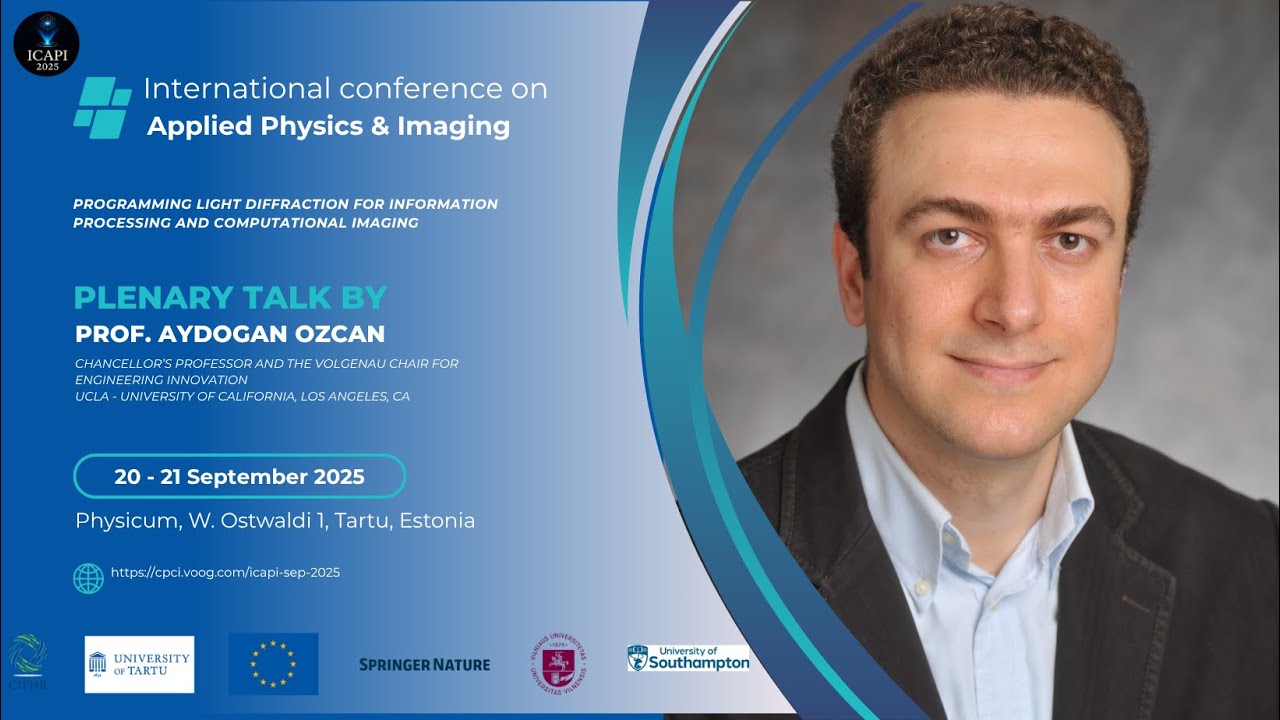
ICAPI SEP 2025 | International Conference | Plenary Presentation | Prof. Aydogan Ozcan
Keywords
Summary
125 words
Critical Evaluation
Value of the Information & Strength of the Argument
The talk provides a comprehensive overview of diffractive optical networks, showcasing their capabilities through multiple experimental demonstrations. The argumentation is strong, supported by quantitative results (e.g., classification accuracy, diffraction efficiency) and comparisons with conventional approaches. The speaker effectively explains the underlying physics and the role of deep learning in designing these systems. The value lies in the novel concept of using passive, low-power optical processors for complex computational tasks, with potential for significant impact in imaging and sensing.
Scientific Rigor, Source Quality, Title Accuracy
The presentation is scientifically rigorous, with references to peer-reviewed publications and experimental validations. The speaker cites specific papers and datasets (e.g., MNIST, Fashion-MNIST) and describes the methods in sufficient detail. The title accurately reflects the content, focusing on programming light diffraction for information processing. The talk is well-structured and the claims are supported by experimental evidence. However, as a conference presentation, it lacks detailed methodology and full citations, which are available in the referenced papers.
168 words
Title / Content Match
The title accurately reflects the content: a plenary presentation on programming light diffraction for information processing and computational imaging.
Quality & Reliability
8/10
Presentation by a leading expert in computational imaging and diffractive optics, with peer-reviewed publications and experimental validations. However, the talk is a conference presentation without detailed methodology or citations, and the video has low viewership.
Key Moments
Markers derived by PSI from the transcript: the creator did not define chapters.
- Introduction to diffractive optical networks and their advantages.
- Demonstration of handwritten digit classification using diffractive processors.
- Explanation of phase encoding and its role in nonlinear processing.
- All-optical phase conjugation using diffractive networks.
- Application to defect detection in packaged products using terahertz waves.
- Imaging through random diffusers with diffractive processors.
- Hybrid systems: diffractive encoder with digital decoder for information hiding.
- Discussion of wavelength multiplexing and experimental results in visible spectrum.
- Conclusion and potential applications.
Cited Sources
- Diffractive optical networks for classification and imaging (paper referenced in talk) — Referenced as a recent paper on phase encoding and diffractive processors.
- MNIST dataset — Used for handwritten digit classification examples.
- Fashion-MNIST dataset — Used for fashion product classification examples.
Concurring Sources
- All-optical machine learning using diffractive deep neural networks — Seminal paper by Lin et al. demonstrating diffractive neural networks.
- Deep learning for computational imaging — Review of deep learning applications in computational imaging.
Dissenting Sources
- Potential limitations of diffractive networks — Some researchers argue that diffractive networks may have scalability issues and limited accuracy compared to digital neural networks for complex tasks.
Contribution & Novelties
The talk presents original research on diffractive optical networks, demonstrating their versatility in performing complex tasks such as phase conjugation, imaging through diffusers, and information hiding. The key novelty is the use of deep learning to design passive optical components that compute at the speed of light with minimal power consumption. The integration with digital networks opens new possibilities for hybrid optical-electronic computing.
Pour aller plus loin :
- Diffractive deep neural networks — Overview of the concept and its applications.
- Optical computing — General background on optical computing approaches.
- Phase conjugation — Explanation of the nonlinear optical process discussed in the talk.
102 words
Radar Profile
The radar profile shows high scores in technical level and information quality, reflecting the advanced nature of the content. The lower score in quantity of information is due to the concise presentation format, but the talk is dense with examples and results.