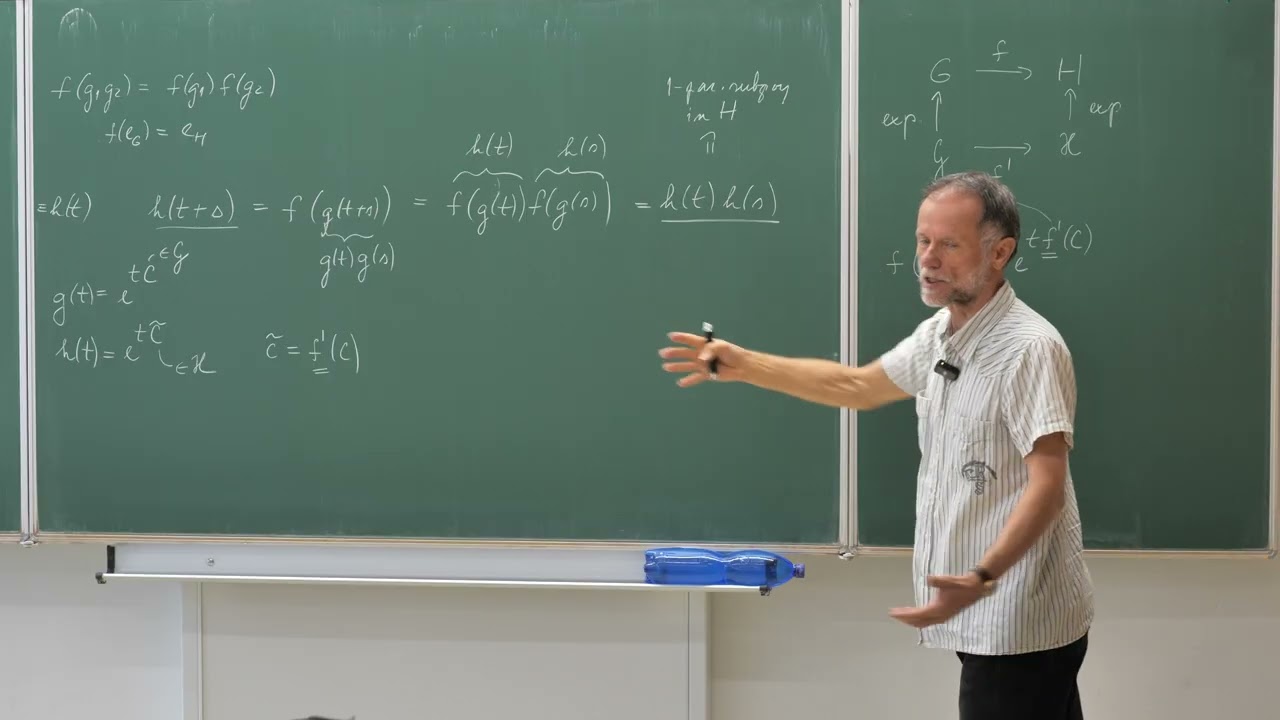
09 | Derived homomorphism, representation of a group and Lie algebra
Keywords
Summary
160 words
Critical Evaluation
Value of the Information & Strength of the Argument
The lecture provides a clear and rigorous exposition of derived homomorphisms and representations. The argumentation is solid, with definitions, theorems, and proofs presented logically. The use of examples, such as determinant and trace, helps to illustrate abstract concepts. The instructor emphasizes the importance of commutative diagrams and provides a practical algorithm for computing derived maps. The treatment of representations is thorough, covering both group and Lie algebra representations, and the connection between them is well explained.
Scientific Rigor, Source Quality, Title Accuracy
The lecture is mathematically rigorous and self-contained, relying on standard definitions and theorems from Lie group theory. No external sources are cited, but the content aligns with established mathematical knowledge. The title accurately reflects the content, and the lecture is well-structured. The instructor’s explanations are precise, and the examples are chosen to reinforce the concepts. The lecture is part of a university course, indicating a high level of academic rigor.
161 words
Title / Content Match
The title accurately reflects the content: the lecture covers derived homomorphisms and representations of groups and Lie algebras.
Quality & Reliability
8/10
The lecture is mathematically rigorous, with clear definitions, proofs, and examples. The instructor demonstrates a deep understanding of the subject and provides a solid pedagogical structure. The content is consistent with standard mathematical literature on Lie groups and Lie algebras.
Key Moments
Markers derived by PSI from the transcript: the creator did not define chapters.
- Introduction to derived homomorphism: mapping of one-parameter subgroups under a homomorphism.
- Commutative diagram for f and derived f'.
- Algorithm for computing f' from f using first-order expansion.
- Proof that f' is a Lie algebra homomorphism.
- Example: f = det, f' = Tr.
- Definition of representations of groups.
- Example: rho(A) = A for matrix groups.
- Examples: rho(A) = 1, rho(A) = det A, rho(A)B = ABA^{-1}.
- Derived representation rho' of the Lie algebra.
- Example: For rho(A)B = ABA^{-1}, rho'(C)B = CB - BC.
Cited Sources
- Playlist: Differential geometry and Lie groups for physicists — The lecture is part of this playlist, which contains the full course.
Concurring Sources
- Playlist: Differential geometry and Lie groups for physicists — The lecture is part of this playlist, which contains the full course.
Contribution & Novelties
The lecture provides a clear and accessible introduction to derived homomorphisms and representations, with a focus on computational techniques. It emphasizes the commutative diagram and the algorithm for computing derived maps, which is valuable for physicists. The example of determinant and trace is particularly illuminating.
Pour aller plus loin :
- Lie group — Provides background on Lie groups and their properties.
- Lie algebra — Definition and properties of Lie algebras.
- Representation theory — General overview of representations.
- Exponential map — Detailed explanation of the exponential map in Lie theory.
89 words
Radar Profile
The radar profile shows high scores in quantity of information, technical level, and reliability, with slightly lower but still strong scores in quality of information. This indicates a dense, technically rigorous lecture that is highly reliable, though the presentation could be more engaging or visually polished.