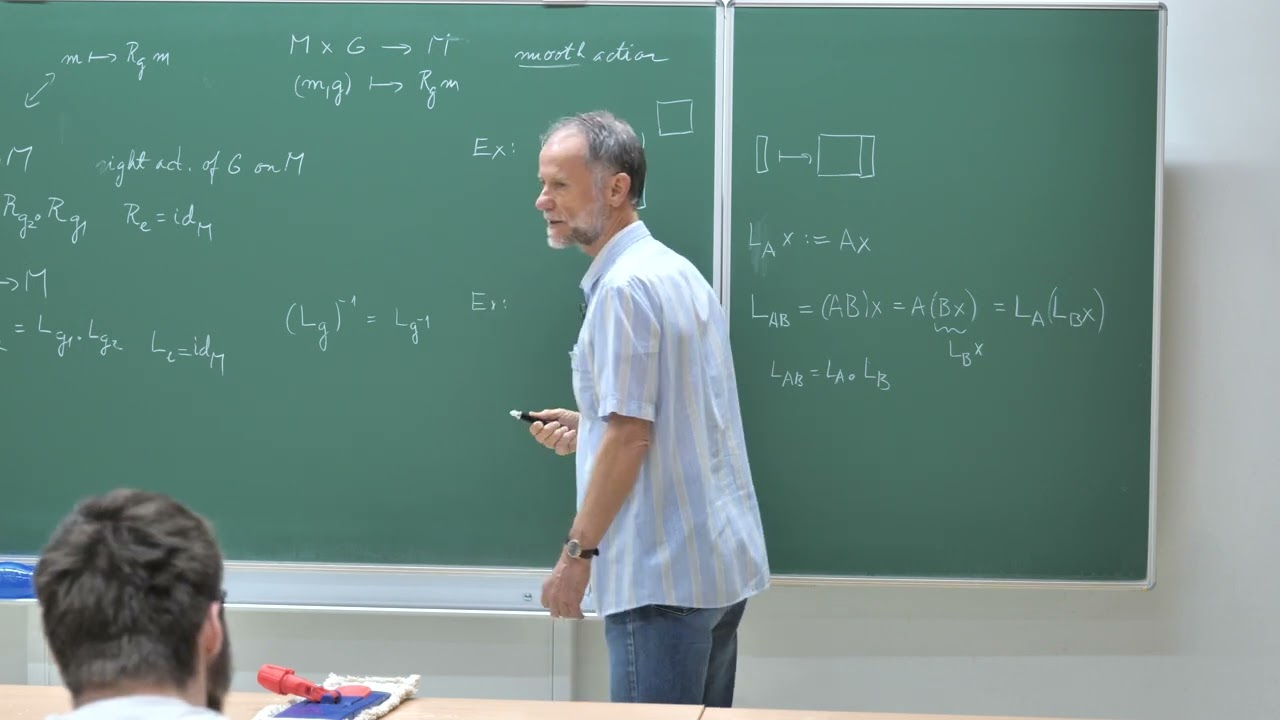
21 | Action of a group on a manifold, orbits, stabilizers
Keywords
Summary
147 words
Critical Evaluation
Value of the Information & Strength of the Argument
The lecture provides a solid foundation in group actions, with clear definitions and rigorous proofs. The instructor carefully distinguishes left and right actions and demonstrates the conversion trick. The examples are well-chosen and illustrate the concepts effectively. The argumentation is logical and builds step by step, making the material accessible to students with a background in linear algebra and group theory.
Scientific Rigor, Source Quality, Title Accuracy
The lecture is mathematically rigorous, with definitions, proofs, and examples presented in a systematic manner. The instructor does not cite external sources, but the content is standard and can be found in textbooks on Lie groups and differential geometry. The title accurately describes the content, which is focused on group actions, orbits, and stabilizers. No comments were provided for analysis.
136 words
Title / Content Match
The title accurately reflects the content, which covers group actions on manifolds, orbits, and stabilizers.
Quality & Reliability
8/10
The lecture is a formal university course, presenting definitions, proofs, and examples with mathematical rigor. The content is standard and well-established, but the video is a raw lecture without additional references or verification.
Key Moments
Markers derived by PSI from the transcript: the creator did not define chapters.
- Definition of right and left actions
- Example: Actions of GL(n,R) on R^n
- Example: Actions of G on G (left/right translations, conjugation)
- General trick: Right action from a left action (and vice versa)
- Definition of orbit O_m
- Example: Orbits for actions of GL(n,R) and SO(n) on R^n
- Definition of stabilizer G_m
- Stabilizers G_m and G_m' if m,m' are on common orbit
- Example: Stabilizer of the north pole of a sphere
Cited Sources
- Playlist: Differential Geometry and Lie Groups for Physicists — The lecture is part of this playlist, which contains the full course.
Concurring Sources
- Group action (Wikipedia) — The definition and properties of group actions align with the lecture.
- Orbit-stabilizer theorem (Wikipedia) — The theorem relates the size of an orbit to the index of the stabilizer, which is relevant to the lecture's discussion.
Contribution & Novelties
The lecture provides a clear and thorough introduction to group actions, orbits, and stabilizers, with detailed examples that illustrate the concepts. It emphasizes the distinction between left and right actions and the trick to convert between them, which is often glossed over in textbooks. The examples with GL(n,R) and SO(n) acting on R^n are particularly illuminating, showing how orbits can be classified.
Pour aller plus loin :
- Group action (Wikipedia) — Provides a general overview of group actions, including definitions and examples.
- Orbit-stabilizer theorem (Wikipedia) — Directly related to the relationship between orbits and stabilizers discussed in the lecture.
- Lie group (Wikipedia) — Background on Lie groups, which are the main focus of the course.
115 words
Radar Profile
The radar profile shows high scores in all dimensions, indicating a lecture that is rich in information, technically deep, and reliable. The balance between quantity and quality of information is strong, with a slight emphasis on technical level.