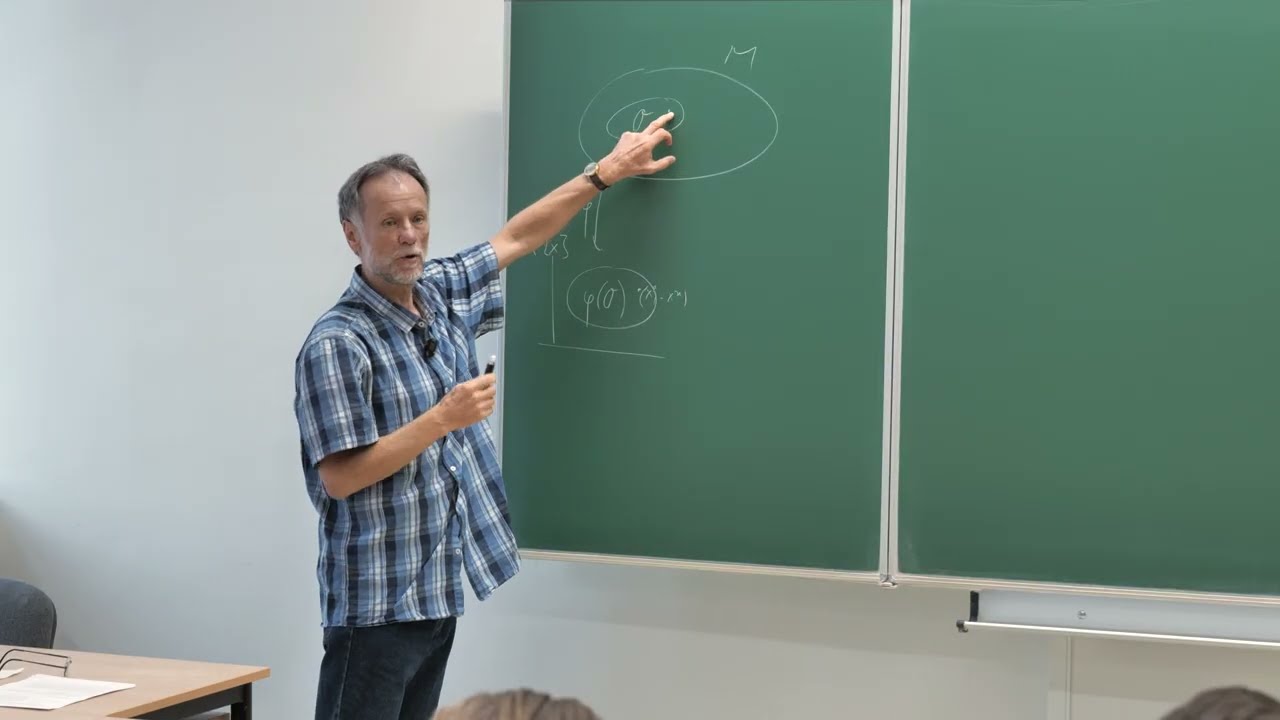
05 | Manifolds and smooth maps , atlas for S^n and RP^n
Keywords
Summary
155 words
Critical Evaluation
Value of the Information & Strength of the Argument
The lecture provides a solid foundation in manifold theory, with clear explanations and worked examples. The argumentation is logical and builds from simple to more complex concepts. The instructor emphasizes the importance of local coordinates and the construction of atlases, which are crucial for understanding manifolds. The use of stereographic projection and projective spaces illustrates key techniques. The lecture is valuable for physics students needing differential geometry for advanced topics.
Scientific Rigor, Source Quality, Title Accuracy
The lecture is mathematically rigorous, with definitions and proofs presented in a standard manner. The instructor references additional material on his webpage for detailed derivations, but no external sources are cited in the video. The title accurately reflects the content. The lecture is part of a structured course, and the playlist link in the description provides access to related lectures. No comments were provided for analysis.
151 words
Title / Content Match
The title accurately reflects the content: the lecture covers manifolds, smooth maps, and constructs atlases for spheres and projective spaces.
Quality & Reliability
8/10
The lecture is mathematically rigorous, with clear definitions and proofs sketched. The instructor is a university professor, and the content aligns with standard differential geometry. The presentation is didactic and well-structured, though some handwaving in higher-dimensional generalizations is acknowledged.
Key Moments
Markers derived by PSI from the transcript: the creator did not define chapters.
- Definition of manifold, chart, and local coordinates
- Angles as coordinates on spheres
- Stereographic projection and atlas for spheres
- Definition and atlas for real projective space RP^n
- Complex projective space CP^n and complex manifolds
- Cartesian product of manifolds
- Smooth maps between manifolds
- Diffeomorphism, embedding, and submanifold
Cited Sources
- Course playlist — All lectures in the course series
Concurring Sources
- Course playlist — The lecture is part of a structured course, and the playlist provides access to related lectures that likely cover prerequisite and follow-up material.
Contribution & Novelties
The lecture provides a clear and systematic introduction to manifolds, focusing on the construction of atlases for spheres and projective spaces. It emphasizes the importance of local coordinates and the smoothness of transition functions. The stereographic projection is presented as a universal method for spheres, and the projective space construction illustrates the use of equivalence classes. The lecture is particularly valuable for physics students, as it bridges mathematical concepts with physical applications.
Pour aller plus loin :
- Manifold (Wikipedia) — Overview of manifolds and related concepts.
- Stereographic projection (Wikipedia) — Detailed explanation of the projection used for spheres.
- Projective space (Wikipedia) — Definition and properties of projective spaces.
108 words
Radar Profile
The radar profile shows high scores in quality of information and technical level, indicating a rigorous and advanced lecture. The quantity of information is also high, but the overall score is slightly lower due to the lack of external sources and the lecture format. The balance suggests a content-rich, mathematically deep presentation.