Trustworthy Recommender Systems | Elena Štefancová
Keywords
Summary
121 words
Critical Evaluation
Value of the Information & Strength of the Argument
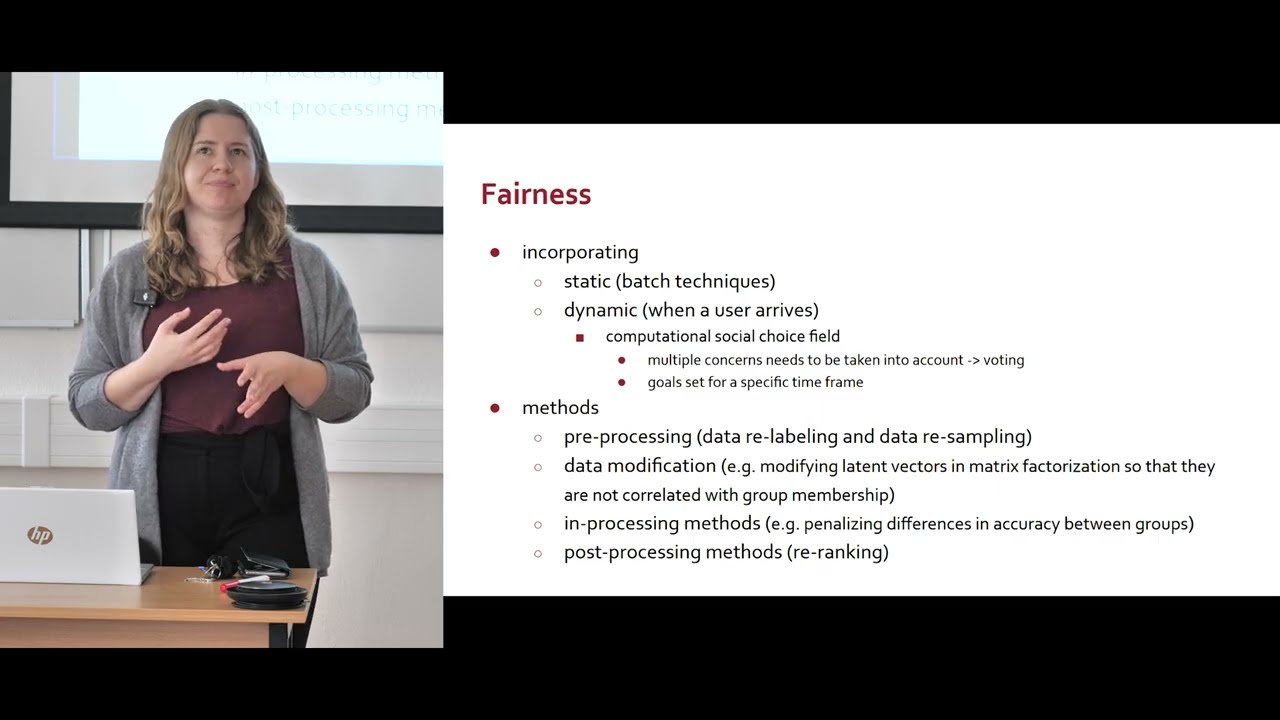
The presentation provides a valuable overview of fairness in recommender systems, highlighting the importance of multi-stakeholder fairness and dynamic approaches. The speaker’s argumentation is coherent, building from basic concepts to her specific research contributions. She supports her claims with examples and preliminary results, though she acknowledges the ongoing nature of her work. The discussion of synthetic data generation is particularly useful for researchers facing data scarcity. However, the presentation lacks depth in explaining the technical details of the algorithms and metrics, and the results are not fully contextualized within the broader literature.
Scientific Rigor, Source Quality, Title Accuracy
The presentation is based on the speaker’s own research, which is a strength in terms of originality but a limitation in terms of external validation. She mentions several papers she has published, but does not provide specific citations or references. The title accurately reflects the content, which focuses on trustworthy recommender systems. The presentation does not include a formal literature review, and the sources are not clearly identified. The speaker’s claims about the effectiveness of her methods are supported by preliminary results, but these are not peer-reviewed in the presentation. Overall, the scientific rigor is moderate, with a need for more explicit sourcing and validation.
212 words
Title / Content Match
The title accurately reflects the content, which focuses on trustworthy recommender systems, covering fairness, explainability, and dynamic aspects.
Quality & Reliability
7/10
The presentation is based on the speaker's ongoing doctoral research, with references to specific papers and methods. However, it lacks detailed citations and peer-reviewed sources, and the speaker's claims are not independently verified.
Key Moments
Markers derived by PSI from the transcript: the creator did not define chapters.
- Introduction and overview of recommender systems
- Types of recommender systems: collaborative, content-based, knowledge-based, hybrid
- Incorporating non-accuracy metrics: diversity, novelty, fairness
- Trustworthy AI aspects: robustness, privacy, transparency, fairness
- Explainability in recommender systems and evaluation methods
- Multistakeholder fairness: providers, consumers, platform
- Dynamic fairness and challenges
- Synthetic data generation for fairness experiments
- CRAFT-D system: agents and social choice mechanisms
- Results: fairness can improve accuracy
- Publications and future work on dynamic fairness and explainability
Cited Sources
- MovieLens dataset — Mentioned as a real-world dataset used for experiments
- Last.fm dataset — Mentioned as a real-world dataset for music recommendations
Concurring Sources
- Fairness in Recommender Systems — Provides background on fairness metrics and challenges.
- Social Choice Theory — Relevant to the voting mechanisms used in the proposed system.
Contribution & Novelties
The presentation contributes to the field of trustworthy recommender systems by proposing a dynamic fairness approach using a multi-agent system (CRAFT-D) that integrates multiple fairness metrics through social choice mechanisms. It also introduces a synthetic data generation method that allows for controlled experiments on fairness, addressing the scarcity of suitable real-world datasets. The work emphasizes the importance of considering both provider and consumer fairness, and individual and group fairness, and shows that incorporating fairness can improve accuracy. The approach is novel in its dynamic handling of fairness and its use of synthetic data to simulate user arrival and concept drift.
Pour aller plus loin :
- Fairness in Recommender Systems — Overview of fairness concepts and metrics.
- Social Choice Theory — Theoretical basis for voting mechanisms used in CRAFT-D.
- Synthetic Data Generation — General methods and applications.
- Explainable AI — Related to explainability aspects discussed.
144 words
Radar Profile
The radar profile shows moderate scores across all dimensions, with slightly higher scores in information quantity and quality, indicating a solid but not exceptional presentation. The technical level is moderate, suggesting the content is accessible to a broad audience. The overall reliability is moderate, reflecting the lack of external citations.