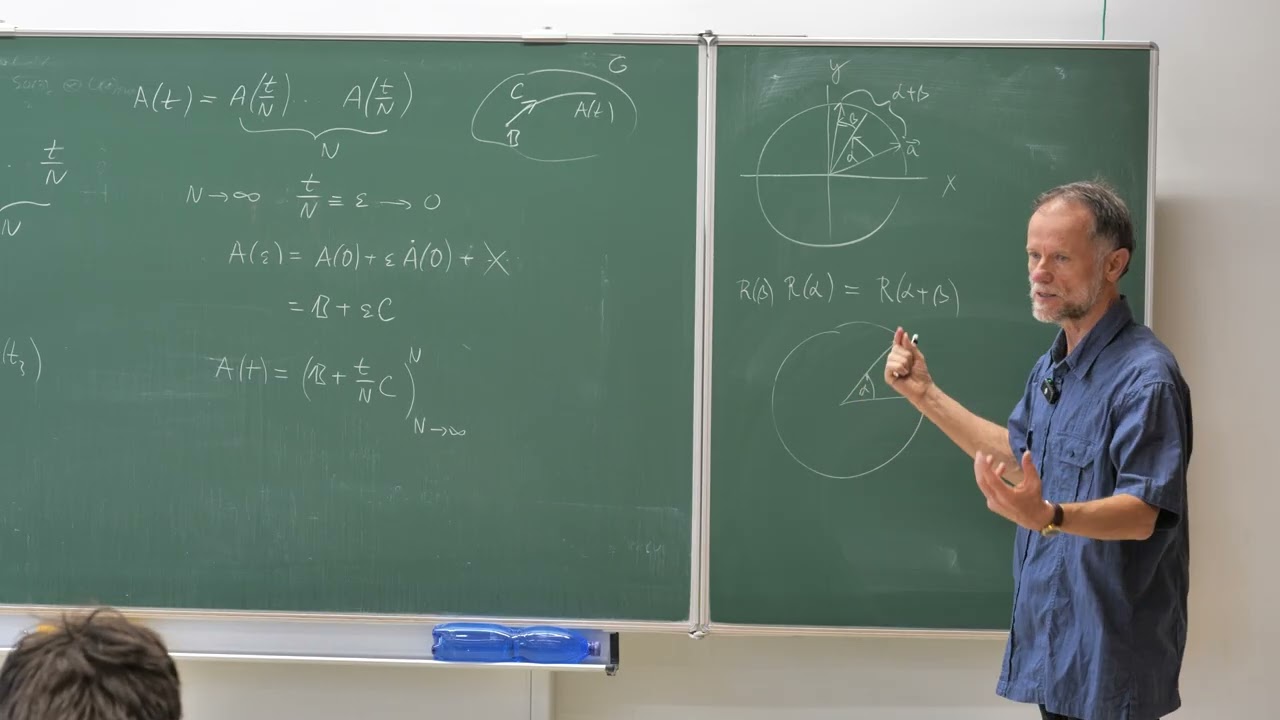
08 | 1-parameter subgroups (and examples), exponential mapping
Keywords
Summary
183 words
Critical Evaluation
Value of the Information & Strength of the Argument
The lecture provides a clear and rigorous introduction to 1-parameter subgroups and the exponential map, which are fundamental concepts in Lie theory. The instructor builds the theory step by step, starting from the definition and deriving the differential equation that leads to the matrix exponential. The argumentation is solid: the derivation is logical, and the examples are worked out in detail, illustrating the abstract concepts with concrete computations. The lecture also highlights important properties such as the surjectivity of the exponential map and its failure in certain cases, which adds depth to the understanding. The value of the information is high for students of mathematical physics, as it bridges abstract mathematics with practical applications in physics, particularly in the study of symmetries and rotations.
Scientific Rigor, Source Quality, Title Accuracy
The lecture is scientifically rigorous, with clear definitions, precise statements, and careful derivations. The instructor does not cite external sources explicitly, but the content is standard and well-established in the field. The title accurately reflects the content, as the lecture indeed covers 1-parameter subgroups and the exponential mapping with examples. The lecture is part of a university course, and the instructor references exercises from a textbook (likely ‘Lie Groups for Physicists’ by Robert Gilmore, given the exercise numbers mentioned), but these are not explicitly cited in the video description. The description provides a link to the full playlist, which is the only source listed. Overall, the scientific quality is high, and the title is appropriate.
254 words
Title / Content Match
The title accurately reflects the content: the lecture focuses on 1-parameter subgroups and the exponential mapping, with examples for SO(2), O(2), SU(2), and SO(3).
Quality & Reliability
8/10
The lecture is a rigorous mathematical exposition of 1-parameter subgroups and the exponential map in Lie groups. The reasoning is clear, definitions are precise, and examples are worked out in detail. The content is standard and well-established in mathematical physics. The presentation is academic, with no apparent bias or unsupported claims. The main limitation is the lack of explicit citations to external sources, but the material is foundational and the derivations are self-contained.
Key Moments
Markers derived by PSI from the transcript: the creator did not define chapters.
- Introduction to 1-parameter subgroups and definition.
- Derivation of the differential equation for 1-parameter subgroups.
- Solution of the equation: any 1-parameter subgroup is of the form exp(tC).
- Example: 1-parameter subgroups on SO(2).
- Definition of exponential mapping and exponential Lie groups.
- Example: exponential mapping for O(2) and its non-surjectivity.
- Example: 1-parameter subgroups on SU(2).
- Example: 1-parameter subgroups on SO(3).
- 1-parameter subgroup as a geodesic.
Cited Sources
- Lecture playlist: Differential geometry and Lie groups for physicists — The playlist containing all lectures of the course, including this one.
Concurring Sources
- Lie Groups, Lie Algebras, and Representations: An Elementary Introduction — A standard textbook covering Lie groups and Lie algebras, including 1-parameter subgroups and the exponential map.
Contribution & Novelties
This lecture provides a clear and detailed exposition of 1-parameter subgroups and the exponential map, with worked examples for SO(2), O(2), SU(2), and SO(3). It emphasizes the importance of these concepts for physics, particularly in the study of symmetries. The lecture also discusses the surjectivity of the exponential map and its failure in certain cases, which is a subtle point often overlooked in introductory treatments.
Pour aller plus loin :
- Lie group — Wikipedia article providing an overview of Lie groups, including 1-parameter subgroups and the exponential map.
- Exponential map (Lie theory) — Wikipedia article specifically on the exponential map in the context of Lie groups.
- Matrix exponential — Wikipedia article on the matrix exponential, which is central to the lecture.
- Special unitary group — Wikipedia article on SU(2), one of the groups discussed.
- Special orthogonal group — Wikipedia article on SO(n), including SO(2) and SO(3).
146 words
Radar Profile
The radar profile shows high scores in quality of information and technical level, indicating a rigorous and advanced lecture. The quantity of information is also high, but the reliability score is slightly lower due to the lack of explicit external citations. Overall, the lecture is well-balanced and suitable for an audience with a background in mathematics or physics.
💬 No comments were provided for analysis.