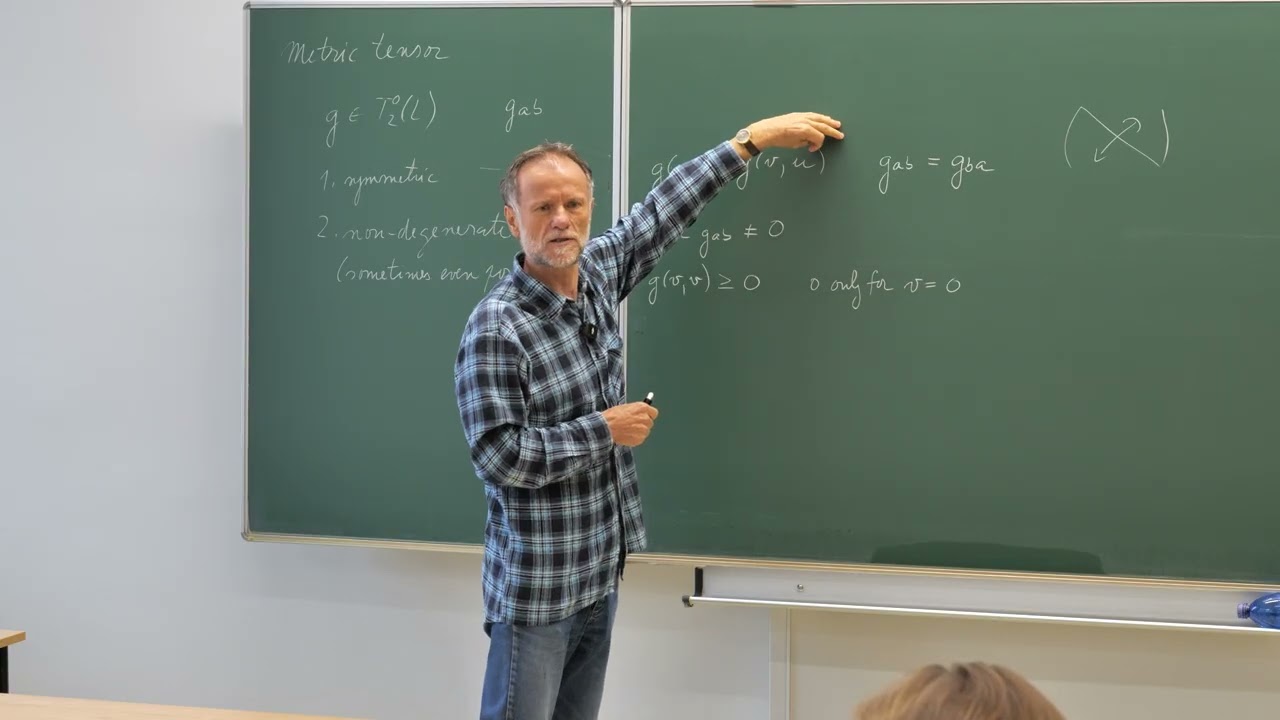
03 | Metric and cometric, structured set, standard matrix groups
Keywords
Summary
165 words
Critical Evaluation
Value of the Information & Strength of the Argument
The lecture provides a solid foundation in linear algebra and group theory, with clear explanations and derivations. The argumentation is logical and rigorous, building concepts step by step. The lecturer emphasizes the importance of understanding the underlying structures and the properties used in each operation, which adds depth to the presentation. The value lies in its pedagogical approach, making abstract concepts accessible through careful explanation and examples.
Scientific Rigor, Source Quality, Title Accuracy
The lecture is scientifically rigorous, with precise definitions and derivations. The lecturer refers to a textbook (section 24) and provides a playlist for the full course, but no external sources are cited. The title accurately reflects the content, covering metric and cometric, structured sets, and standard matrix groups. The presentation is well-structured and methodical, typical of a university lecture.
141 words
Title / Content Match
The title accurately reflects the content: the lecture covers the metric and cometric, structured sets, and standard matrix groups.
Quality & Reliability
8/10
Lecture by a university professor, methodical and rigorous, with clear definitions and derivations. The content is standard mathematical material, presented accurately. The video is part of a structured course, and the lecturer encourages questions and provides exercises. No obvious errors or misleading claims.
Key Moments
Markers derived by PSI from the transcript: the creator did not define chapters.
- Definition of metric tensor: symmetric, non-degenerate bilinear form.
- Introduction of the cometric as the inverse tensor.
- Explanation of lowering and raising indices using metric and cometric.
- Definition of a group and its properties.
- Group of bijections of a set.
- Bijections of structured sets and automorphism groups.
- Linear structure and the group Aut V = GL(V).
- The group GL(n,R) and its isomorphisms with GL(V).
- Adding a bilinear form to the vector space.
- Symmetric non-degenerate case, groups O(r,s) and O(n).
- Volume in V and SL(V), SL(n,R), SO(r,s) and SO(n).
Cited Sources
- Course playlist — The playlist containing all lectures of the course, referenced in the video description.
Concurring Sources
- Metric tensor — Standard reference for metric tensors, consistent with the lecture's definitions.
- General linear group — Standard reference for GL(V) and GL(n,R), consistent with the lecture's content.
Contribution & Novelties
The lecture provides a clear and rigorous introduction to metric tensors, cometrics, and their use in raising and lowering indices, which is fundamental for differential geometry and physics. It also introduces the concept of groups as automorphisms of structured sets, with a focus on matrix groups. The pedagogical approach of emphasizing which properties of the metric are used in each operation is valuable.
Pour aller plus loin :
- Metric tensor — Wikipedia article providing an overview of metric tensors in mathematics and physics.
- General linear group — Wikipedia article on the general linear group, including GL(n,R).
- Orthogonal group — Wikipedia article on orthogonal groups, including O(n) and O(r,s).
108 words
Radar Profile
The radar profile shows high scores in quantity and quality of information, as well as technical level and reliability, indicating a dense and rigorous lecture. The balance across dimensions suggests a well-structured and informative presentation.