16 | Induced metric, Lie transport, Lie derivative
Keywords
Summary
150 words
Critical Evaluation
Value of the Information & Strength of the Argument
The lecture provides substantial value by systematically developing the induced metric tensor from the pullback operation, clarifying its properties and computational techniques. The argumentation is solid, with clear definitions, derivations, and examples that illustrate the concepts. The connection to Lagrangian mechanics and the introduction of Lie transport and Lie derivative are well-motivated and logically presented. The instructor emphasizes important caveats, such as the potential degeneracy of the induced metric in pseudo-Riemannian cases, enhancing the depth of understanding.
Scientific Rigor, Source Quality, Title Accuracy
The scientific rigor is high, with precise mathematical definitions and derivations. The lecture is part of a structured university course, indicating a reliable pedagogical source. However, no external sources are explicitly cited within the video, limiting the ability to verify specific claims. The title accurately reflects the content, covering the three main topics in a coherent sequence. The lecture’s technical level is advanced, consistent with a university course for physicists.
162 words
Title / Content Match
The title accurately reflects the main topics covered: induced metric, Lie transport, and Lie derivative, with a clear progression from the former to the latter.
Quality & Reliability
8/10
The lecture is part of a university course on differential geometry for physicists, presented by an academic instructor. The content is mathematically rigorous, with clear definitions, derivations, and examples. The presentation is systematic and pedagogically structured, though it lacks explicit citations to external sources within the video.
Key Moments
Markers derived by PSI from the transcript: the creator did not define chapters.
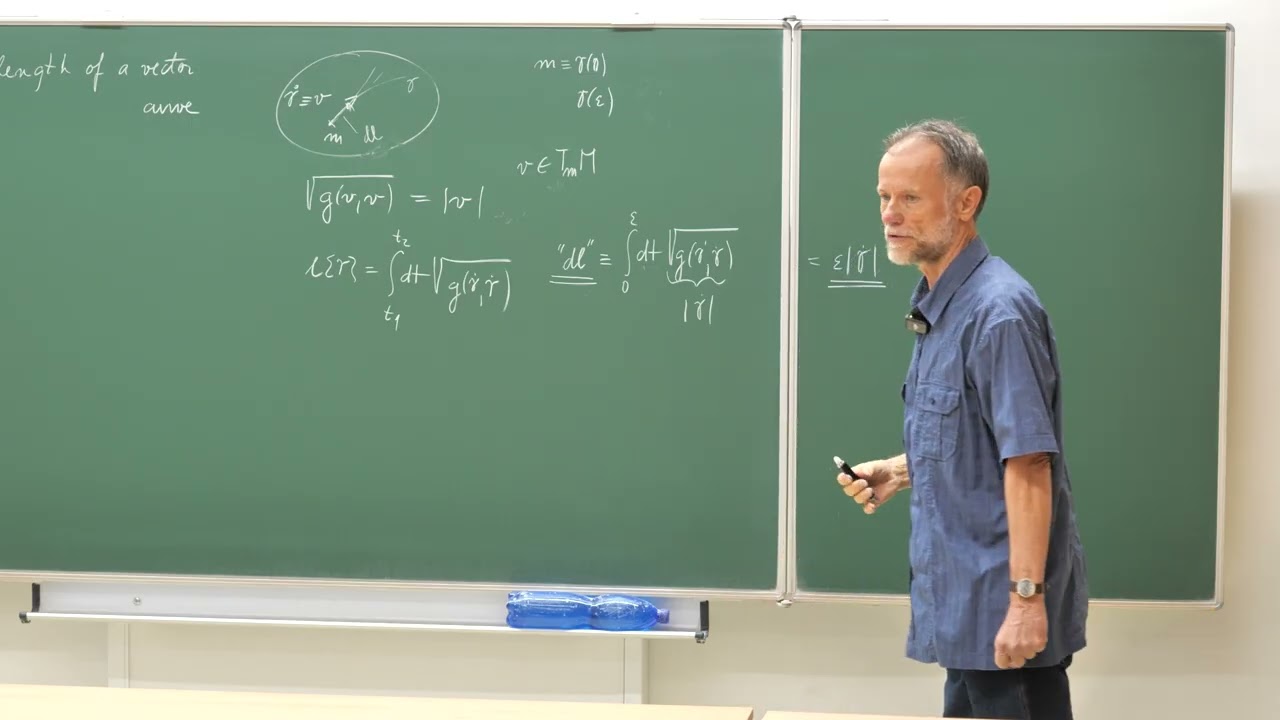
- Length of a vector versus length of the corresponding curve
- Induced metric tensor definition and properties
- Example: induced metric on the unit sphere from standard embedding
- General coordinate expression for induced metric
- Curved and flat toruses
- Rotational surface (e.g., cone)
- Pseudosphere (space-like surface)
- Kinetic energy in Lagrangian mechanics
- Potential energy in Lagrangian mechanics
- Flow of a vector field again (see Lecture 13)
- Composition property of flow
- Lie transport as pull-back w.r.t. flow
- Lie derivative introduced (see also 1:28:05)
- Rotational and translation invariance as Lie invariances
Cited Sources
- Playlist: Differential geometry and Lie groups for physicists — The lecture is part of this playlist, providing context and related lectures.
Concurring Sources
- Playlist: Differential geometry and Lie groups for physicists — The lecture is part of this playlist, providing context and related lectures.
Contribution & Novelties
The lecture provides a clear and rigorous exposition of induced metrics, Lie transport, and Lie derivatives, with a focus on applications in physics. It bridges abstract differential geometry with concrete examples from mechanics and relativity, offering a solid foundation for further study.
Pour aller plus loin :
- Pullback (differential geometry) — Essential for understanding the induced metric.
- Lie derivative — Core concept introduced in the lecture.
- Flow (mathematics) — Relevant to the flow of a vector field and Lie transport.
- Configuration space (physics) — Context for the Lagrangian mechanics application.
- Pseudo-Riemannian manifold — Relevant to the pseudosphere example and degeneracy issues.
101 words
Radar Profile
The radar profile shows high scores in quantity of information, technical level, and reliability, with slightly lower but still strong quality of information. This indicates a dense, advanced, and trustworthy lecture, though the presentation could benefit from more explicit citations.