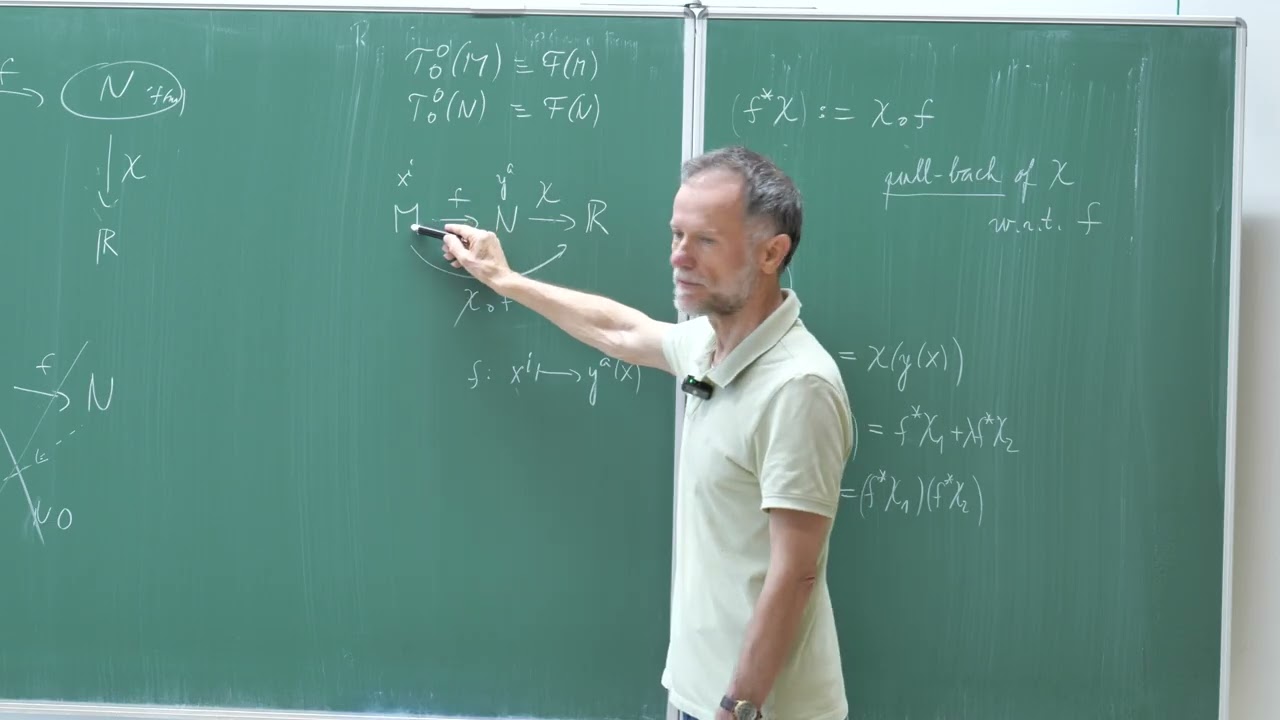
15 | Pull-back and push forward operations
Keywords
Summary
138 words
Critical Evaluation
Value of the Information & Strength of the Argument
The lecture provides a thorough and rigorous introduction to pull-back and push-forward operations, which are fundamental in differential geometry. The instructor carefully defines each operation, proves key properties, and illustrates with coordinate computations. The argumentation is solid, building from simple cases (functions) to more complex ones (tensors), and clearly explains the limitations of push-forward for vector fields. The value lies in its clear pedagogical structure and the emphasis on the conceptual meaning of these operations, which is essential for physicists using differential geometry.
Scientific Rigor, Source Quality, Title Accuracy
The lecture is scientifically rigorous, with definitions and proofs presented in a formal manner. The instructor does not cite external sources, but the content is standard and well-established in differential geometry. The title accurately reflects the content. There are no comments provided, so no analysis of public reception is possible.
148 words
Title / Content Match
The title accurately reflects the content, which focuses on pull-back and push-forward operations in differential geometry.
Quality & Reliability
8/10
The lecture is a formal university course presentation, mathematically rigorous, with clear definitions and derivations. The instructor is knowledgeable and the content is standard differential geometry. However, the video has low production quality, no visual aids, and the audio is sometimes unclear, which slightly reduces reliability.
Key Moments
Markers derived by PSI from the transcript: the creator did not define chapters.
- Definition of pull-back of functions (0,0)-tensor fields) as composition with the map.
- Definition of push-forward of vectors (1,0)-tensors) using the image of curves.
- Discussion of problems with push-forward of vector fields, including non-injectivity and non-surjectivity.
- Definition of pull-back of covector fields (0,1)-tensors) via push-forward of vectors.
- Anecdote about education of differential geometry in England.
- Alternative definition of push-forward of vectors using derivations.
- Definition of pull-back of (0,p)-tensor fields.
- Summary of what has been done so far.
- Pull-back and push-forward for diffeomorphisms.
- Important properties of these operations.
Cited Sources
- Lecture playlist — The playlist containing all lectures of this course.
Concurring Sources
- Pullback (differential geometry) — Standard reference for pullback operations.
- Pushforward (differential) — Standard reference for pushforward operations.
Contribution & Novelties
The lecture provides a clear and systematic introduction to pull-back and push-forward operations, which are essential tools in differential geometry. It emphasizes the conceptual differences and limitations, particularly for vector fields, and connects the definitions to coordinate computations. The pedagogical approach is valuable for physics students.
Pour aller plus loin :
- Pullback (differential geometry) — Wikipedia article on pullback of differential forms and tensors.
- Pushforward (differential) — Wikipedia article on pushforward of tangent vectors.
- Tensor field — Wikipedia article on tensor fields, providing background on the objects discussed.
88 words
Radar Profile
The radar profile shows high scores in technical level and information quality, reflecting the advanced and rigorous nature of the lecture. The scores for quantity of information and global reliability are also high, indicating a comprehensive and trustworthy presentation. The overall profile suggests a content that is dense and specialized, suitable for an audience with prior knowledge in mathematics or physics.