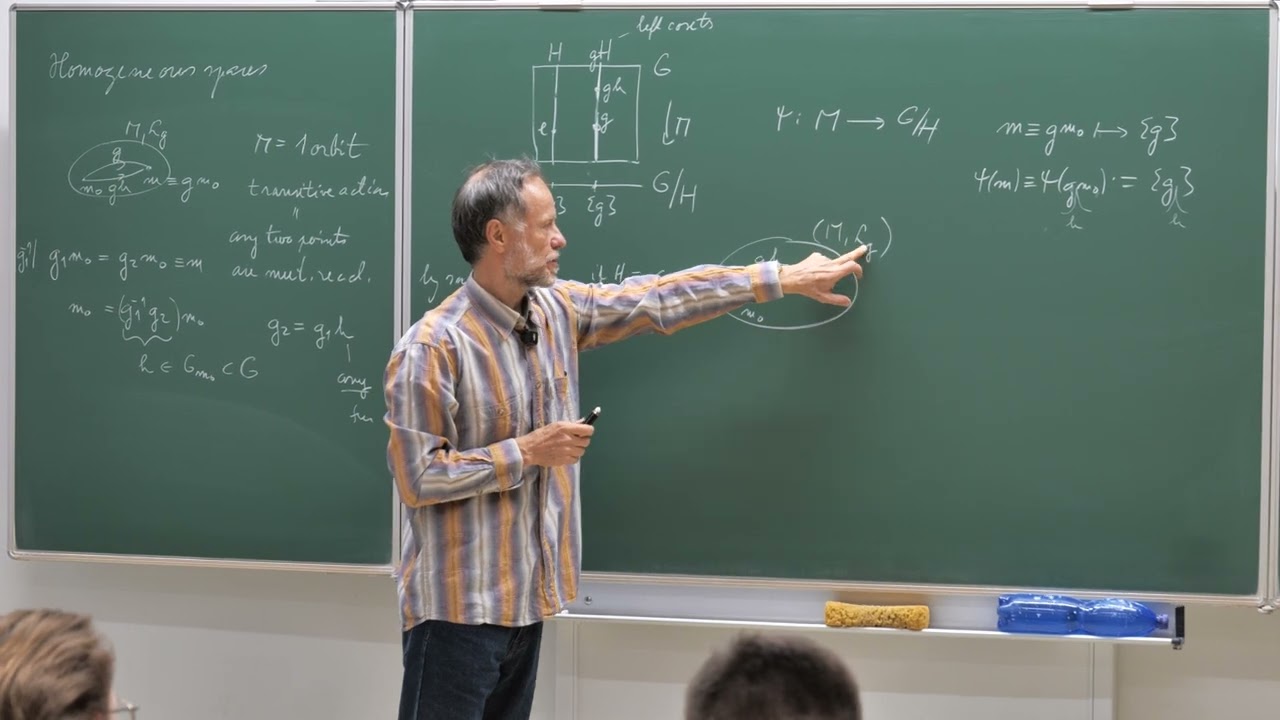
24 | M as G/H, factor-group, homomorphism theorem
Keywords
Summary
146 words
Critical Evaluation
Value of the Information & Strength of the Argument
The lecture provides a solid and rigorous treatment of the topic. It builds concepts from definitions, proves key theorems, and illustrates with concrete examples. The argumentation is clear and logical, with careful attention to well-definedness and consistency. The value lies in its clear exposition of abstract algebraic concepts and their geometric interpretations, which is valuable for physics students.
Scientific Rigor, Source Quality, Title Accuracy
The scientific rigor is high: definitions are precise, proofs are given, and examples are worked out. The lecture does not cite external sources, but it is based on standard mathematical knowledge. The title accurately reflects the content. No comments were provided for analysis.
116 words
Title / Content Match
The title accurately reflects the content, which covers the identification of homogeneous spaces with coset spaces, factor groups, and the homomorphism theorem.
Quality & Reliability
8/10
The lecture is a rigorous mathematical exposition, with clear definitions, proofs, and examples. The content is standard and well-established in group theory and differential geometry. The presentation is coherent and pedagogically structured, though it lacks explicit references to external sources.
Key Moments
Markers derived by PSI from the transcript: the creator did not define chapters.
- Introduction to homogeneous spaces and transitive actions
- Natural mapping from M to G/H
- Theorem: any G-homogeneous space is isomorphic to G/H
- Example: Spheres S^n = SO(n)/SO(n-1)
- Example: Spheres S^{2n-1} = SU(n)/SU(n-1)
- Principal homogeneous space definition and example
- G/H as a group: factor-group and normal subgroup
- Example: SO(2) in SO(3) is not normal
- Homomorphism theorem for groups
- Example: GL(n)/SL(n) = GL(1)
- Example: Z/3Z = Z_3
- Discrete kernel case, covering (beginning)
Cited Sources
- Playlist: Differential geometry and Lie groups for physicists — The lecture is part of this playlist, which contains the full course.
Concurring Sources
- Homogeneous space — Standard mathematical reference supporting the definition and properties of homogeneous spaces.
- Quotient group — Standard reference for factor groups and normal subgroups.
Contribution & Novelties
The lecture provides a clear and rigorous exposition of the classification of homogeneous spaces and the conditions under which a coset space becomes a group. It bridges abstract algebra and geometry, with applications to spheres and general linear groups. The treatment of principal homogeneous spaces and the homomorphism theorem is particularly insightful for physics students.
Pour aller plus loin :
- Homogeneous space — Wikipedia article providing background and examples.
- Quotient group — Wikipedia article on factor groups and normal subgroups.
- Isomorphism theorems — Wikipedia article covering the homomorphism theorem.
89 words
Radar Profile
The radar profile shows high scores in information quantity, quality, technical level, and reliability, indicating a dense and rigorous mathematical lecture. The balance suggests a well-structured presentation with strong theoretical foundations.