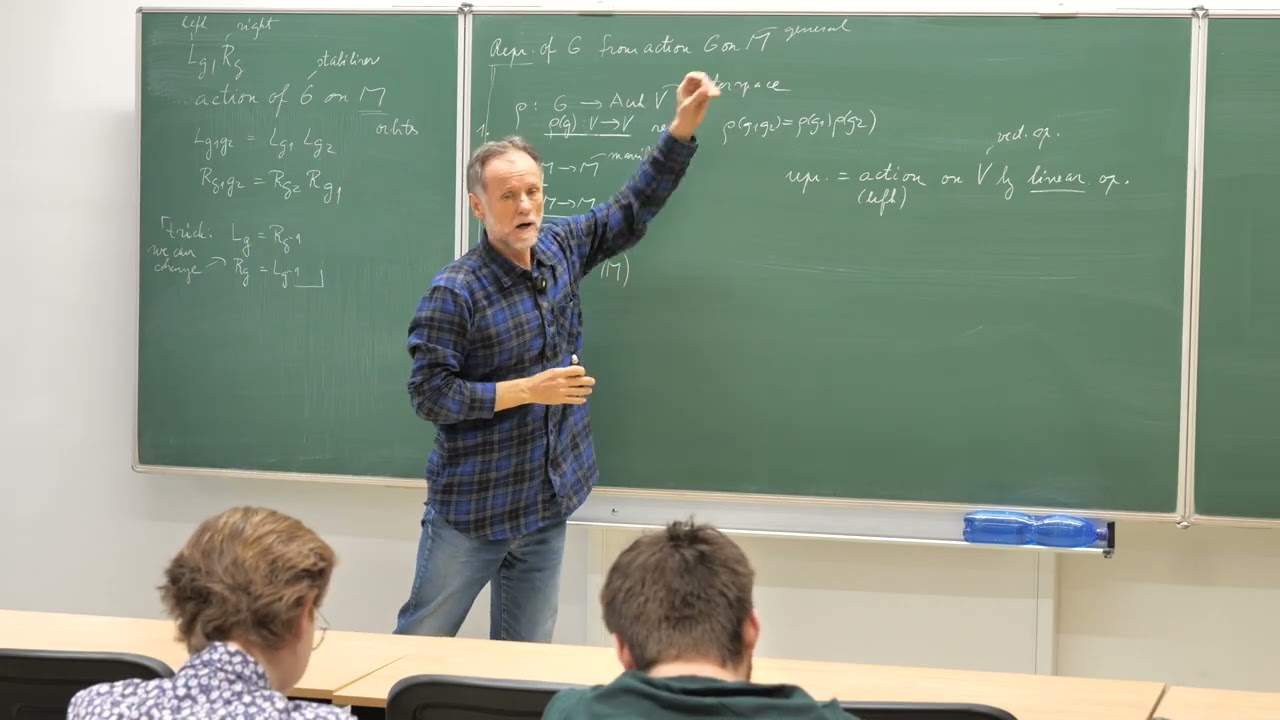
22 | Fundamental fields, generators of an action of G on M
Keywords
Summary
211 words
Critical Evaluation
Value of the Information & Strength of the Argument
The lecture provides a clear and rigorous introduction to fundamental fields and generators of group actions. The argumentation is solid, building from definitions to proofs and examples. The lecturer carefully explains the difference between actions and representations, and the construction of the representation on functions is justified step by step. The use of pullbacks and Lie derivatives is well-motivated, and the examples help to illustrate the abstract concepts. The lecture also highlights the connection between the Lie algebra and the commutator of vector fields, which is a key insight. Overall, the content is valuable for students and researchers in mathematical physics.
Scientific Rigor, Source Quality, Title Accuracy
The lecture is mathematically rigorous, with precise definitions and proofs. The sources are not explicitly cited, but the content is standard in differential geometry and Lie group theory. The title accurately reflects the content, focusing on fundamental fields and generators. The lecture is part of a structured university course, which adds to its credibility. No external sources are mentioned, but the mathematical derivations are self-contained and correct.
183 words
Title / Content Match
The title accurately reflects the content: the lecture focuses on fundamental fields and generators of group actions on manifolds.
Quality & Reliability
8/10
The lecture is a rigorous mathematical exposition, with clear definitions, proofs, and examples. The content is consistent with standard differential geometry and Lie group theory. The presentation is logical and the derivations are correct. The video is part of a university course, indicating a structured and reliable source.
Key Moments
Markers derived by PSI from the transcript: the creator did not define chapters.
- Representation as an action: specific features
- Representation of G (in F(M)) from an action of G on M
- The same representation as a pull-back
- The flow on M given by a 1-parameter subgroup exp(tX)
- Fundamental field, generators of the action
- The derived representation (in terms of fundamental fields)
- Properties of fundamental fields (and generators)
- Example: All that for the action of GA(1,R) on R
- Example: Generators of the action of SO(3) on R3
Cited Sources
- Playlist: Differential geometry and Lie groups for physicists — The lecture is part of this playlist, which contains the full course.
Concurring Sources
- Playlist: Differential geometry and Lie groups for physicists — The lecture is part of this playlist, which contains the full course.
Contribution & Novelties
The lecture provides a clear and systematic exposition of fundamental fields and generators of group actions, emphasizing their role in constructing representations on function spaces. It bridges the gap between abstract group actions and concrete vector fields, and illustrates the concepts with worked examples. The connection between the Lie algebra and the commutator of vector fields is highlighted, which is a key insight for applications in physics.
Pour aller plus loin :
- Lie group action — Wikipedia article on Lie group actions, providing context and definitions.
- Fundamental vector field — Wikipedia article on fundamental vector fields, directly related to the lecture’s topic.
- Lie derivative — Wikipedia article on Lie derivatives, which are used to define the derived representation.
118 words
Radar Profile
The radar profile shows high scores in quality of information, technical level, and reliability, with a slightly lower score in quantity of information due to the focused scope of the lecture. This indicates a technically deep and reliable content, though not overly broad in coverage.