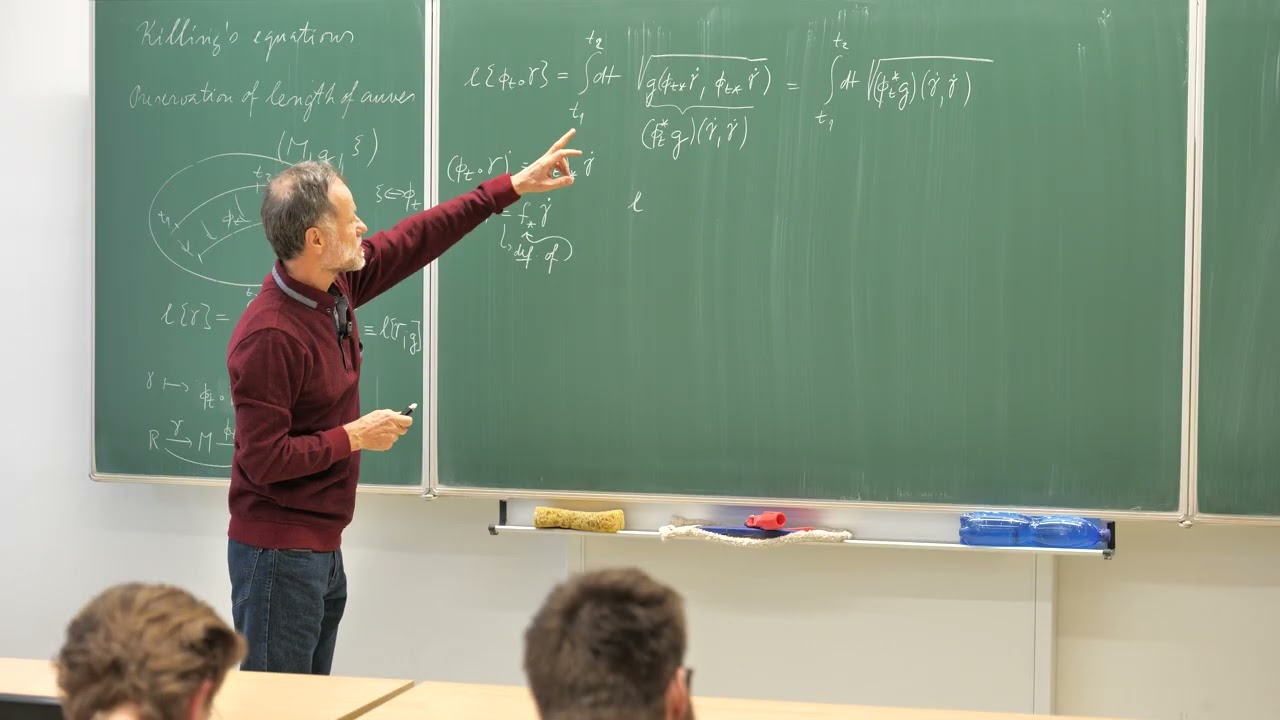
19 | Isometries of Riemannian manifolds and Killing equations
Keywords
Summary
228 words
Critical Evaluation
Value of the Information & Strength of the Argument
The lecture provides a solid introduction to isometries and Killing vectors, with clear derivations and proofs. The value lies in its pedagogical approach: it starts from the geometric intuition of preserving curve lengths, then formalizes the concept via Lie derivatives, and finally demonstrates the solution process through multiple examples. The argumentation is rigorous, using standard results from differential geometry (e.g., properties of Lie derivatives, pushforwards, and pullbacks) to justify each step. The lecturer also highlights important subtleties, such as the exclusion of reflections and the overdetermined nature of the Killing equations. The examples are well-chosen to illustrate different scenarios, from flat spaces to curved surfaces, and they effectively show how to solve the equations in practice. The proof that Killing vectors form a Lie algebra is concise and relies on previously established identities, making it accessible to students with a background in tensor calculus.
Scientific Rigor, Source Quality, Title Accuracy
The lecture is mathematically rigorous, with careful derivations and proofs. The instructor does not cite external sources, but the content aligns with standard textbooks on differential geometry and mathematical physics, such as those by do Carmo, Lee, or Nakahara. The title accurately reflects the content, as the lecture is entirely devoted to isometries and Killing equations. The presentation is well-structured, with clear definitions, theorems, and examples. The instructor also provides practical insights, such as the maximum dimension of the Lie algebra of Killing vectors, which is useful for solving problems. No comments were provided for analysis.
255 words
Title / Content Match
The title accurately reflects the content: the lecture focuses on isometries of Riemannian manifolds and the derivation and solution of Killing equations.
Quality & Reliability
8/10
The lecture is mathematically rigorous, with clear derivations and proofs. The instructor demonstrates a deep understanding of differential geometry and Lie groups, and the content is consistent with standard textbooks. The presentation is well-structured, with examples that illustrate the concepts. However, as a single lecture, it does not provide external references or citations, and the lack of interactive verification limits the score.
Key Moments
Markers derived by PSI from the transcript: the creator did not define chapters.
- Introduction: preservation of length of curves under diffeomorphisms.
- Definition of isometries of a Riemannian manifold.
- Derivation of Killing equations from the Lie derivative of the metric.
- Discussion: reflections are not infinitesimal isometries.
- Proof that Killing vectors form a Lie algebra.
- Coordinate expression of Killing equations.
- Example: Killing vectors for the 2D Euclidean plane.
- Using commutators to find more Killing vectors.
- Example: Killing vectors for the 2D flat torus.
- Example: Killing vectors for 2D rotational surfaces.
- Example: Killing vectors for the 2D curved torus.
- Example: Killing vectors for the 2D round sphere.
Cited Sources
- Playlist: Differential geometry and Lie groups for physicists — The lecture is part of this course playlist, which contains all lectures in the series.
Concurring Sources
- Killing vector field - Wikipedia — The Wikipedia article on Killing vector fields confirms the definition and properties discussed in the lecture, including the Lie algebra structure and the maximum dimension.
Contribution & Novelties
This lecture provides a clear and systematic introduction to isometries and Killing vectors, with a focus on practical problem-solving. It bridges the gap between abstract theory and concrete examples, making it valuable for physics students. The lecturer emphasizes the Lie algebra structure of Killing vectors and demonstrates how to use it to find all solutions efficiently.
Pour aller plus loin :
- Killing vector field - Wikipedia — Comprehensive overview of Killing vectors, including definitions, properties, and examples.
- Isometry - Wikipedia — General definition of isometries in metric spaces and Riemannian geometry.
- Lie derivative - Wikipedia — Detailed explanation of the Lie derivative, which is central to the derivation of Killing equations.
- Riemannian manifold - Wikipedia — Background on Riemannian geometry, including metric tensors and geodesics.
- Lie group - Wikipedia — Introduction to Lie groups and Lie algebras, relevant to the group structure of isometries.
144 words
Radar Profile
The radar profile shows high scores in all dimensions, with a slight dip in 'quantite_information' and 'niveau_technique' compared to 'qualite_information' and 'fiabilite_globale'. This indicates a lecture that is rich in content and technically sound, but may be somewhat dense for beginners.