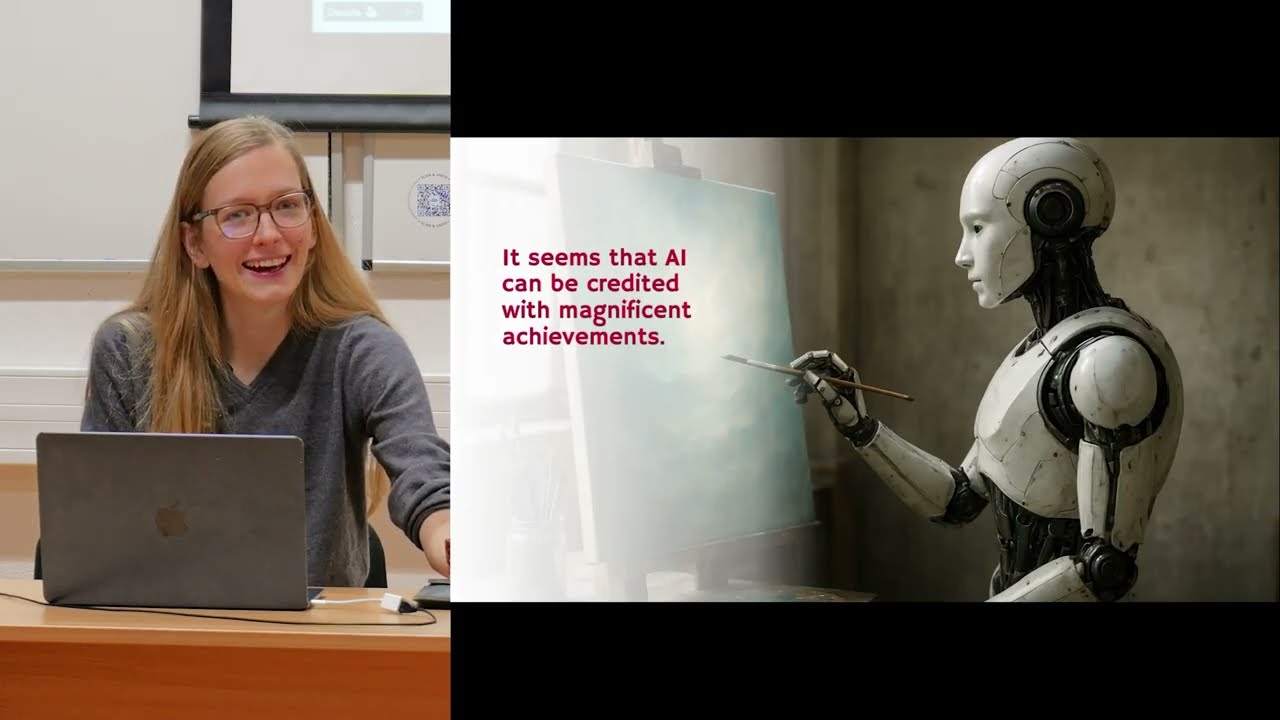
AI achievements are our achievements
Keywords
Summary
196 words
Critical Evaluation
Value of the Information & Strength of the Argument
The lecture provides a valuable philosophical analysis of AI achievements, offering a clear argument against attributing achievements to AI systems. The argument is well-structured, using a modus ponens to show that if AI achievements exist, then AI would be praiseworthy, but since AI cannot be praiseworthy, AI achievements do not exist. The speaker supports her premises with references to philosophical literature, including Bradford’s theory of achievement and debates on praiseworthiness. She also addresses counterarguments, such as Kel’s proposal, and offers a nuanced alternative by introducing vicarious and collective responsibility. The argumentation is solid, though it could benefit from more engagement with potential objections, such as the possibility of AI having a form of agency. Overall, the lecture contributes to the ongoing debate on AI and human values.
Scientific Rigor, Source Quality, Title Accuracy
The lecture demonstrates scientific rigor by grounding the discussion in established philosophical theories and citing relevant literature. The speaker references specific philosophers and works, such as Bradford’s theory of achievement, Kel’s paper in Analysis, and Danaher and Niholm’s concept of achievement gap. The sources are credible within the field of philosophy. The title accurately reflects the content, as the central thesis is that AI achievements are ultimately human achievements. The lecture is well-organized and the argument is presented clearly, though it is a single perspective without extensive counterarguments. The speaker’s affiliation with reputable institutions adds to the credibility. Overall, the sources and title align well with the content.
250 words
Title / Content Match
The title accurately reflects the central thesis: AI achievements are ultimately human achievements through responsibility.
Quality & Reliability
8/10
The lecture is based on a well-structured philosophical argument, referencing established theories (Bradford, Kel, Danaher, Niholm, Tigard) and published work. The speaker is a researcher in philosophy of AI, affiliated with reputable institutions. The argument is clearly presented, though it is a single perspective without counterarguments in depth.
Key Moments
Markers derived by PSI from the transcript: the creator did not define chapters.
- Introduction: speaker's background and departments.
- Examples of AI achievements: art competition and Go game.
- Kel's argument for AI achievements based on Bradford's theory.
- Speaker's argument against AI achievements: praiseworthiness.
- Discussion of achievement gap and its implications.
- Optimistic solution: vicarious and collective responsibility.
- Conclusion: preserving human agency and values.
Cited Sources
- Kel, P. (2022). Artificial achievements. Analysis. — Speaker references Kel's argument that AlphaGo deserves credit for defeating Lee Sedol.
- Bradford, G. (2015). Achievement. Oxford University Press. — Speaker uses Bradford's theory of achievement to define what constitutes an achievement.
- Danaher, J., & Niholm, S. (2023). The AI Achievement Gap. Philosophy & Technology. — Speaker discusses the concept of achievement gap as proposed by Danaher and Niholm.
- Tigard, D. (2021). The AI Achievement Gap: A Misnomer. Journal of Applied Philosophy. — Speaker mentions Tigard's critique of the achievement gap concept.
Concurring Sources
- Kel, P. (2022). Artificial achievements. Analysis. — The speaker engages with Kel's argument, which is the main target of her critique.
- Bradford, G. (2015). Achievement. Oxford University Press. — The speaker uses Bradford's theory as a foundation for discussing achievements.
Dissenting Sources
- Kel, P. (2022). Artificial achievements. Analysis. — Kel argues that AI systems can have achievements, which the speaker directly challenges.
Contribution & Novelties
The lecture offers a novel perspective on AI achievements by arguing that they should be attributed to humans through vicarious and collective responsibility. This provides a constructive solution to the achievement gap problem, suggesting that humans can still find meaning in AI-driven successes. The speaker also highlights the importance of historical autonomy and moral agency in determining praiseworthiness, adding depth to the debate.
Pour aller plus loin :
- Vicarious responsibility — Relevant to the concept of holding stakeholders responsible for AI outcomes.
- Collective responsibility — Discusses how groups can be held responsible for outcomes.
- Meaning of life — Explores the philosophical concept of meaning, relevant to the impact of AI on human purpose.
113 words
Radar Profile
The radar profile shows high scores in quality of information and reliability, reflecting the speaker's expertise and use of established philosophical theories. The quantity of information is moderate, as the lecture focuses on a specific argument. The technical level is moderate, suitable for an academic audience but not overly complex. Overall, the lecture is well-balanced, with strengths in argumentation and credibility.
💬 No comments were provided for analysis.