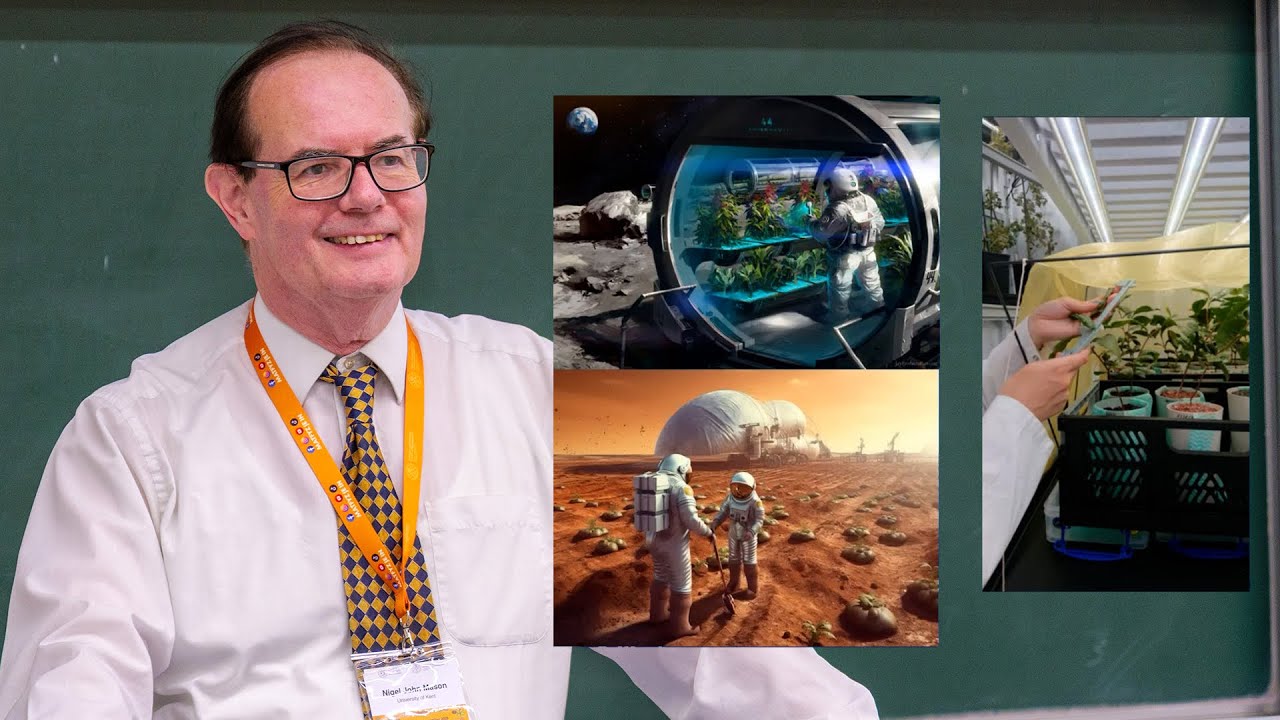
Space agriculture | A new field of space science | Professor Nigel Mason | University of Kent
Keywords
Summary
186 words
Critical Evaluation
Value of the Information & Strength of the Argument
The lecture provides a broad overview of the challenges and opportunities in space agriculture, making a compelling case for its importance as humanity expands into space. The speaker effectively argues that sustainable food production is critical for long-term space missions and bases, citing the limitations of current astronaut diets and the need for self-sufficiency. He supports his points with examples such as the Great British Space Dinner and the psychological benefits of plant growth on the ISS. However, the argumentation is largely qualitative and anecdotal, lacking quantitative data or detailed scientific evidence. The talk is more of an introduction and call for interdisciplinary collaboration than a rigorous scientific analysis.
Scientific Rigor, Source Quality, Title Accuracy
The speaker, Professor Nigel Mason, is a credible expert in space science, and the lecture is presented in an academic setting. However, the talk does not provide specific citations or references to scientific literature, relying instead on general knowledge and personal anecdotes. The title accurately reflects the content, which is an introductory lecture on space agriculture. The description includes only hashtags and no additional sources. The talk is not a formal scientific presentation but rather a discussion aimed at fostering interest and collaboration in this new field.
211 words
Title / Content Match
The title accurately reflects the content: a lecture on space agriculture as a new field, presented by a professor from the University of Kent.
Quality & Reliability
7/10
The speaker is a professor at the University of Kent with expertise in space science, and the content is a lecture introducing space agriculture. The talk is largely descriptive and anecdotal, with some references to ongoing research and space agency plans. While the speaker is credible, the talk lacks detailed citations and rigorous scientific depth, relying more on general knowledge and personal experiences.
Key Moments
Markers derived by PSI from the transcript: the creator did not define chapters.
- Introduction and thanks; purpose of the meeting.
- Definition of space agriculture and its interdisciplinary nature.
- Why space agriculture is developing now; space agencies' plans for lunar bases.
- Challenges of living in space: microgravity, radiation, temperature extremes.
- Astronaut food limitations and the need for sustainable food production.
- Experiments with lunar soil simulants and worms; tardigrades for radiation research.
- Psychological benefits of plant growth for astronauts.
- Conditions needed for growing food in space: light, CO2, nutrients, water.
- Questions about pollination and crop cultivation in space.
- Conclusion and call for interdisciplinary collaboration.
Cited Sources
- ESA — Mentioned as a space agency involved in lunar base plans.
- NASA — Mentioned as a space agency involved in space agriculture and lunar missions.
- DLR — Mentioned as a German space agency conducting experiments with lunar soil and worms.
- JAXA — Mentioned as a Japanese space agency involved in lunar observatories.
Concurring Sources
- NASA's Space Food and Nutrition — Supports the discussion of astronaut food limitations and the need for sustainable food production.
- ESA's Moon Village — Supports the mention of ESA's plans for a lunar base.
Dissenting Sources
- No discordant sources found — The lecture does not contradict established scientific knowledge; it is an introductory overview.
Contribution & Novelties
The lecture provides an accessible introduction to the emerging field of space agriculture, highlighting its interdisciplinary nature and the need for collaboration between plant scientists and space scientists. It brings together various aspects of space exploration, such as lunar bases, Mars missions, and the challenges of sustaining human life, and connects them to the practical question of food production. The talk also emphasizes the psychological benefits of plant growth for astronauts, a factor often overlooked in space mission planning.
Pour aller plus loin :
- NASA’s Space Food and Nutrition — Provides an overview of current space food and nutritional challenges.
- ESA’s Moon Village — Discusses ESA’s plans for a lunar base, relevant to the context of space agriculture.
- Tardigrades in Space — Wikipedia article on tardigrades, which are used in radiation research and space experiments.
- Lunar Regolith Simulant — Wikipedia article on lunar soil simulants used in experiments.
- Hydroponics — Wikipedia article on hydroponics, a method for growing plants without soil, relevant to space agriculture.
165 words
Radar Profile
The radar profile shows moderate scores across all dimensions, with slightly higher scores in quantity and quality of information, and lower in technical level. This reflects the lecture's nature as an accessible introduction rather than a deep technical analysis.
💬 No comments were provided for analysis.