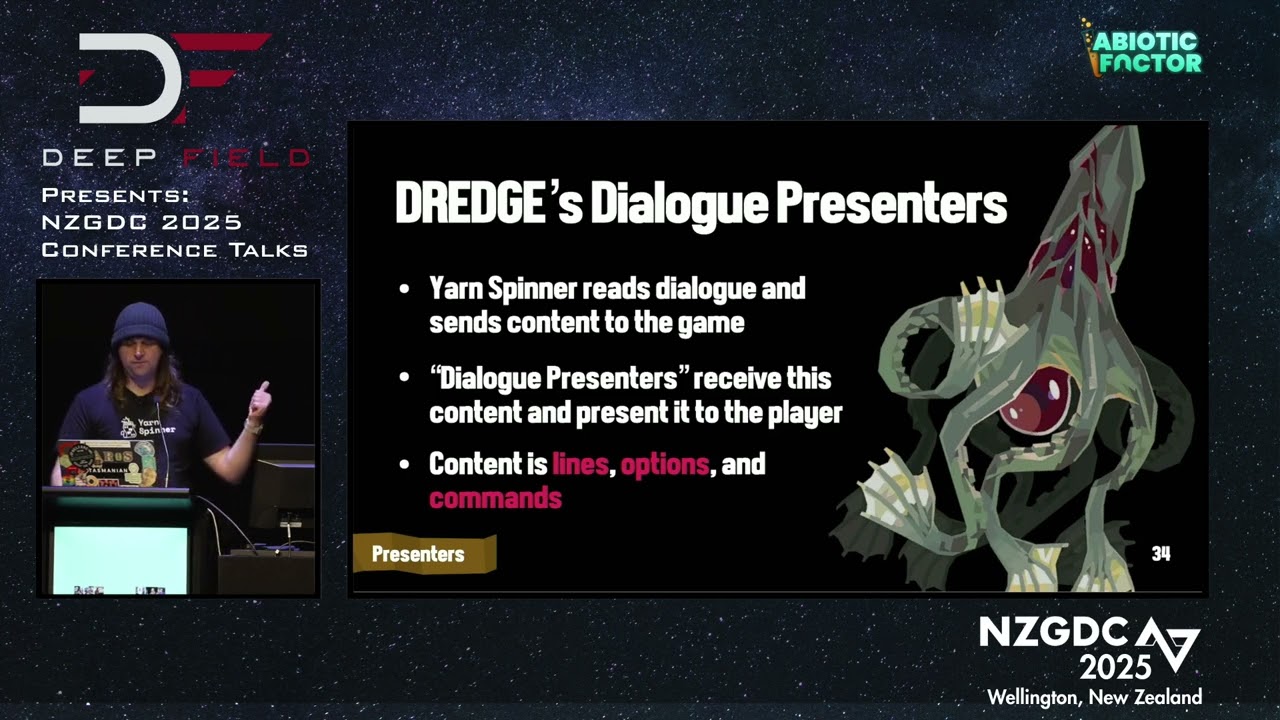
Weaving the Net: DREDGE and Yarn Spinner | Jon Manning | NZGDC 2025
Keywords
Summary
164 words
Critical Evaluation
Value of the Information & Strength of the Argument
The talk provides valuable insights into the practical application of a dialogue system in a successful game. Manning’s argumentation is solid, based on his direct involvement as the developer of Yarn Spinner and his collaboration with the DREDGE team. He presents concrete examples from the game’s code and design, illustrating how Yarn Spinner was customized to meet DREDGE’s specific needs. The discussion of design decisions, such as the use of semantic color tags for accessibility and the handling of unavailable choices, demonstrates a thoughtful approach to narrative design. The talk also highlights the importance of integrating dialogue with gameplay systems, using temporal markers and state queries to create dynamic and responsive storytelling. Overall, the information is highly relevant for game developers and narrative designers, offering both theoretical and practical knowledge.
Scientific Rigor, Source Quality, Title Accuracy
The talk is scientifically rigorous in its technical details, as Manning is the original developer of Yarn Spinner and worked closely with the DREDGE team. He provides first-hand accounts of the development process and explains the reasoning behind design choices. The sources cited are primarily the game itself and the Yarn Spinner tool, which are directly relevant. The title accurately reflects the content, as the talk is indeed a case study of DREDGE’s narrative systems using Yarn Spinner. The presentation is well-structured and clear, with no apparent contradictions or unsupported claims. The only minor weakness is that the talk is based on personal experience and may not be generalizable to all projects, but this is inherent to case studies.
264 words
Title / Content Match
The title accurately reflects the content, which is a case study of DREDGE's narrative systems and their implementation using Yarn Spinner.
Quality & Reliability
8/10
Presentation by the lead developer of Yarn Spinner, with direct involvement in the DREDGE project, providing first-hand technical details and design rationale. Claims are consistent with publicly known information about the game, and the talk includes concrete examples from the game's code and systems.
Key Moments
Markers derived by PSI from the transcript: the creator did not define chapters.
- Introduction and background of the speaker and Yarn Spinner.
- Overview of DREDGE and its success, and the use of Yarn Spinner.
- Discussion of the narrative structure of DREDGE, including the Kubler-Ross stages of grief.
- Explanation of the writing process and the shift to editing Yarn scripts directly.
- Delivery mechanisms: dialogue only when docked, guidelines for text boxes, and quests.
- Live demonstration of the opening dialogue and the Yarn script behind it.
- Details on lines, choices, and metadata, including semantic color tags and paralanguage.
- Handling of unavailable choices and the 'autoresolve next line' command.
- Integration with gameplay systems: custom commands, state management, and temporal markers.
- Use of Yarn Spinner for non-dialogue UI and the issue with text size.
Cited Sources
- Yarn Spinner — The open-source dialogue tool used in DREDGE, developed by the speaker.
Concurring Sources
- DREDGE on Wikipedia — Provides general information about the game, its development, and its success, consistent with the talk.
Contribution & Novelties
The talk provides a detailed case study of how a successful game integrated an off-the-shelf dialogue system, offering practical insights into customization, accessibility, and integration with gameplay. It highlights the importance of semantic color tags for accessibility and the use of temporal markers for dynamic storytelling.
Pour aller plus loin :
- Yarn Spinner documentation — Official documentation for the tool, useful for understanding its features.
- DREDGE on Wikipedia — Overview of the game, its development, and reception.
- Narrative design in games — General concept of narrative design in video games.
90 words
Radar Profile
The radar profile shows high scores in information quantity, quality, and reliability, with a slightly lower technical level, indicating a talk that is informative and credible but not overly technical for a general game development audience.
💬 No comments were provided for analysis.