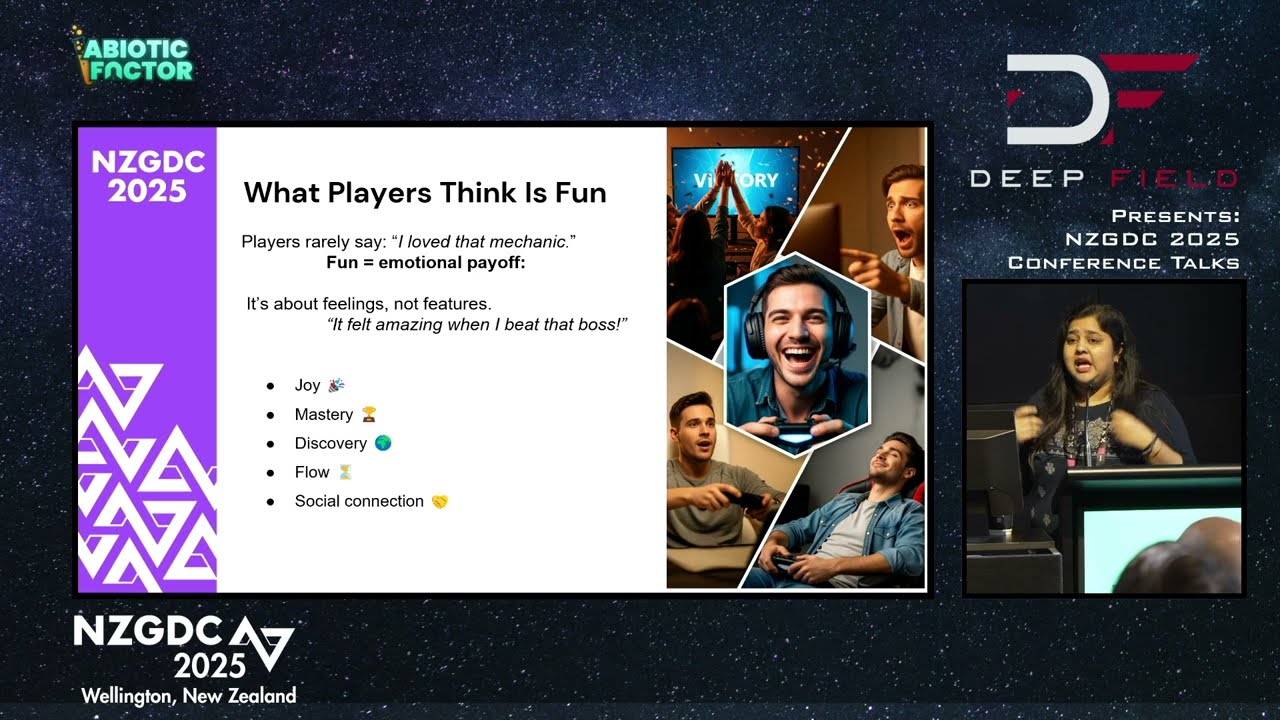
Is My Game Fun? | NZGDC 2025
Keywords
Summary
228 words
Critical Evaluation
Value of the Information & Strength of the Argument
The talk provides valuable insights into the elusive concept of fun in game design, bridging academic psychology with practical industry experience. The argumentation is solid, grounded in established theories (flow, reward system) and real-world examples. The speaker effectively demonstrates the gap between developer intentions and player experiences, and offers a practical framework (alignment triangle) and methodology (triangulation) for measuring fun. The case studies of Star Stable Online and Horse Riding Tales are particularly compelling, illustrating how similar visions can lead to different outcomes based on understanding player motivations. The talk is well-structured and persuasive, though some claims are anecdotal and could benefit from more empirical evidence.
Scientific Rigor, Source Quality, Title Accuracy
The talk demonstrates scientific rigor by referencing established psychological concepts (flow theory, dopamine reward system) and a recognized player motivation model (Quantic Foundry). However, specific sources are not cited in the video or description, limiting verifiability. The title accurately reflects the content, which directly addresses the question of game fun. The speaker’s credentials (PhD in cognitive psychology, industry experience) lend credibility. The talk is an expert opinion rather than a systematic review, but it is well-informed and practical.
199 words
Title / Content Match
The title accurately reflects the core question addressed, and the talk delivers a comprehensive answer.
Quality & Reliability
8/10
The speaker is a game user researcher with a PhD in cognitive psychology and over a decade of experience. The talk is grounded in established psychological theories (flow, reward system) and practical case studies. However, it is primarily an expert opinion with limited empirical data presented, and some claims are anecdotal.
Key Moments
Markers derived by PSI from the transcript: the creator did not define chapters.
- Introduction: The question 'Is my game fun?' and why it matters.
- Speaker introduction: Nidhi Aggarwal's background and role.
- Agenda overview: three perspectives on fun.
- Developer perspective: the development bubble and blind spots.
- Player perspective: emotional experience and intrinsic motivations.
- Case studies: Star Stable Online vs Horse Riding Tales.
- Cognitive psychology: flow, reward system, and memory.
- Measuring fun: triangulation of behavior, self-report, and physiology.
- Alignment triangle: developer vision, player expectations, delivered experience.
- Conclusion: three takeaways and Q&A.
Cited Sources
- Quantic Foundry Gamer Motivation Model — Mentioned as a model used to understand player motivations.
Concurring Sources
- Quantic Foundry Gamer Motivation Model — Supports the diversity of player motivations.
Contribution & Novelties
The talk offers a practical framework (alignment triangle) and a triangulation methodology for measuring fun, bridging cognitive psychology and game design. It provides actionable insights for developers to avoid common blind spots and align their vision with player expectations.
Pour aller plus loin :
- Flow (psychology) — Foundational concept for understanding optimal experience.
- Reward system — Explains dopamine’s role in motivation and pleasure.
- Player experience and game design — Overview of game design principles.
74 words
Radar Profile
The radar profile shows high scores in information quantity, quality, and reliability, with a moderate technical level. This indicates a well-informed talk that is accessible to a broad audience, balancing theoretical depth with practical application.
💬 No comments were provided for analysis.