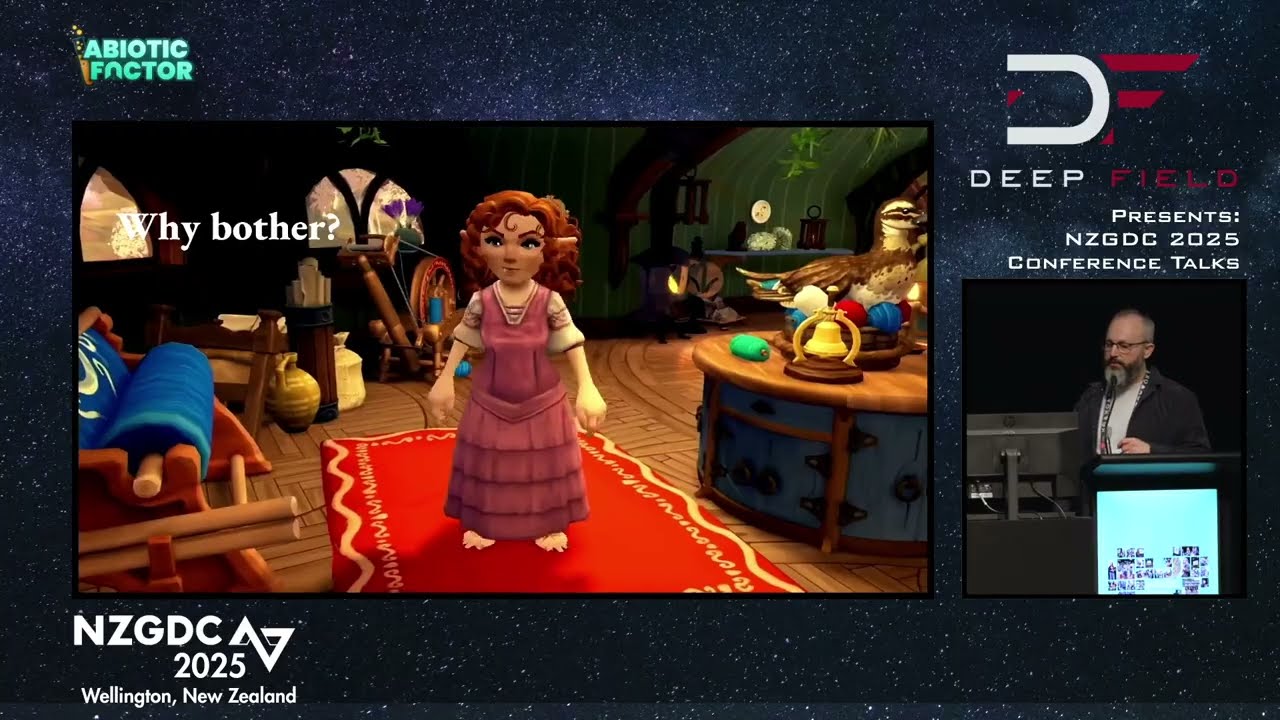
How To Build Your Own Third Person Camera System | Jacob Grossman | NZGDC 2025
Keywords
Summary
142 words
Critical Evaluation
Value of the Information & Strength of the Argument
The talk provides valuable, practical insights into a niche area of game programming. The argumentation is solid, grounded in real-world experience from a shipped title. The speaker clearly explains the reasoning behind design choices, such as using animation curves as multipliers rather than absolute values, and the pitfalls of naive implementations. The mathematical explanations are accessible and well-illustrated with diagrams and GIFs.
Scientific Rigor, Source Quality, Title Accuracy
The speaker credits Max Kaufman’s blog post as the basis for the camera location function, and references the influential GDC talk ‘50 Game Camera Mistakes’ for broader principles. The title accurately reflects the content. The talk is well-structured and the technical details are presented with clarity. The demo project on GitHub provides a valuable resource for further study.
135 words
Title / Content Match
The title accurately reflects the content: a detailed guide on building a third-person camera system.
Quality & Reliability
8/10
The talk is a practical tutorial by an experienced game programmer, grounded in real project experience (Tales of the Shire). It references established practices (e.g., GDC talk '50 Game Camera Mistakes') and provides a demo project. The mathematical explanations are clear and correct, though some simplifications are made for presentation.
Key Moments
Markers derived by PSI from the transcript: the creator did not define chapters.
- Introduction and overview of the talk's topics.
- Why build your own camera system? High-quality game feel.
- Defining camera parameters: tracking point, pitch, yaw, framing, field of view.
- Constructing the camera location: math for offset and rotation.
- Modifying parameters at runtime: pitch, yaw, distance, field of view using animation curves.
- Examples of opinionated camera systems in games like Yakuza Zero and The Legend of Zelda: Breath of the Wild.
- Solving constant camera control: auto camera assist with springs and dead zones.
- Debug tools for visualizing camera variables.
- Wrap-up and resources: GitHub demo project and contact.
Cited Sources
- GitHub demo project — Referenced at the beginning and end of the talk as a resource for the code and math discussed.
- Max Kaufman's blog post — Credited as the basis for the camera location function.
- GDC talk: 50 Game Camera Mistakes — Referenced for the principle of varying camera distance with pitch.
Concurring Sources
- Max Kaufman's blog post — The camera location function is based on this blog post, which the speaker modified and expanded upon.
Contribution & Novelties
The talk fills a gap in available resources by providing a step-by-step guide to programming a third-person camera system, including the underlying math and practical considerations. It offers a clear structure for defining parameters and constructing the camera location, and introduces a method for solving constant camera control using springs and dead zones. The demo project on GitHub allows viewers to explore the implementation directly.
Pour aller plus loin :
- Unity Animation Curves — Official documentation on animation curves, used for parameter modulation.
- Spring Physics in Game Development — General concept of springs, applicable to camera smoothing.
- GDC Talk: 50 Game Camera Mistakes — The referenced talk on common camera pitfalls.
111 words
Radar Profile
The radar profile shows high scores in quantity and quality of information, with a slightly lower but still solid technical level. This indicates a well-balanced talk that is both informative and accessible, with a strong practical focus.
💬 No comments were provided for analysis.