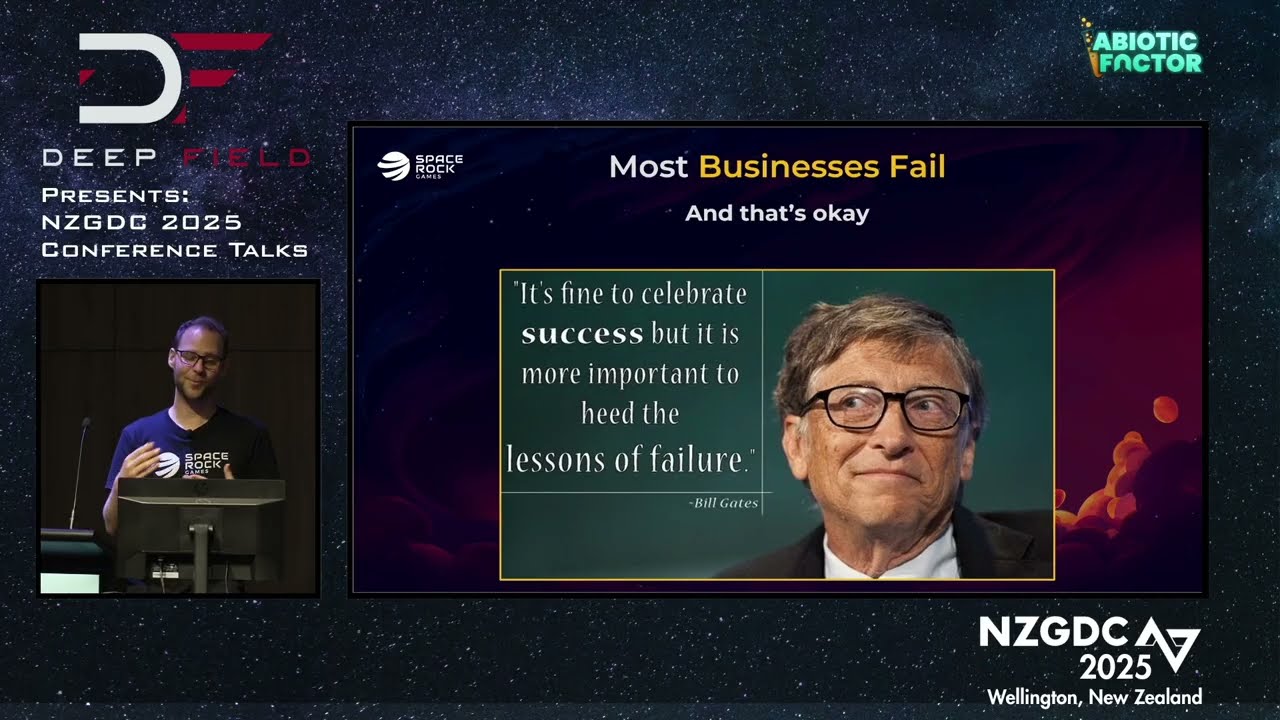
So You Want to Start a Game Studio? | NZGDC 2025
Keywords
Summary
184 words
Critical Evaluation
Value of the Information & Strength of the Argument
The talk provides valuable, practical insights from a founder’s perspective, covering topics like fundraising, team management, and strategic pivots. The speaker uses concrete examples and specific numbers (e.g., salaries, budgets, timelines) to illustrate his points, which strengthens the argumentation. He is candid about mistakes and failures, which adds authenticity. However, the argumentation is largely anecdotal and based on personal experience, lacking broader data or comparative analysis. The advice is actionable but may not be universally applicable, as it is shaped by the specific context of the New Zealand game industry and the speaker’s particular circumstances.
Scientific Rigor, Source Quality, Title Accuracy
The talk is a personal reflection, so it does not cite external sources. The speaker references his own company’s experiences and mentions industry events like the 2023 industry downturn, but without providing citations. The title accurately reflects the content, and the talk is well-structured, moving from personal journey to lessons learned. The speaker’s credibility is enhanced by his role as CEO and his transparent discussion of failures. However, the lack of external references and the subjective nature of the content limit its scientific rigor. The talk is more of an expert opinion than a research-based presentation.
206 words
Title / Content Match
The title accurately reflects the content: a comprehensive talk about starting a game studio, covering both the journey and key lessons.
Quality & Reliability
7/10
The talk is a personal retrospective from a founder with direct experience in starting and pivoting a game studio. It offers practical, hard-won lessons, but relies on anecdotal evidence and personal opinions rather than systematic research or data. The speaker is transparent about failures and provides specific numbers, enhancing credibility, but the lack of external sources and the subjective nature limit its scientific rigor.
Key Moments
Markers derived by PSI from the transcript: the creator did not define chapters.
- Introduction: speaker introduces himself and his background.
- Story of how he became an entrepreneur in Hungary, with three failed businesses.
- Moving to New Zealand and starting Space Rock Games during the pandemic.
- Realization that part-time game development doesn't work; pivot to service-based work.
- First clients and the decision to raise venture capital.
- Raising funds and the mistake of stopping external work to focus on own IP.
- The 2023 industry downturn and the collapse of publisher interest.
- The difficult pivot back to services, including layoffs and abandoning the IP.
- Key lessons: networking, business development, and the importance of working on the business.
- Final advice and conclusion.
Contribution & Novelties
The talk offers a candid, first-hand account of the challenges of starting a game studio, particularly in the context of New Zealand. It provides practical advice on fundraising, team management, and strategic pivots, with specific examples and numbers. The emphasis on the importance of not stopping what works and the reality of founder roles adds unique insights.
Pour aller plus loin :
- Game Developers Conference — Official site for the Game Developers Conference, a key networking event mentioned in the talk.
- Venture capital in the video game industry — Overview of venture capital, relevant to the fundraising discussion.
- Bootstrapping (business) — Concept of bootstrapping, which the speaker contrasts with capital-intensive approaches.
111 words
Radar Profile
The radar profile shows high scores in quantity of information and reliability, reflecting the speaker's extensive experience and detailed account. The technical level is moderate, as the talk focuses on business aspects rather than technical game development. The overall balance suggests a practical, experience-based presentation.