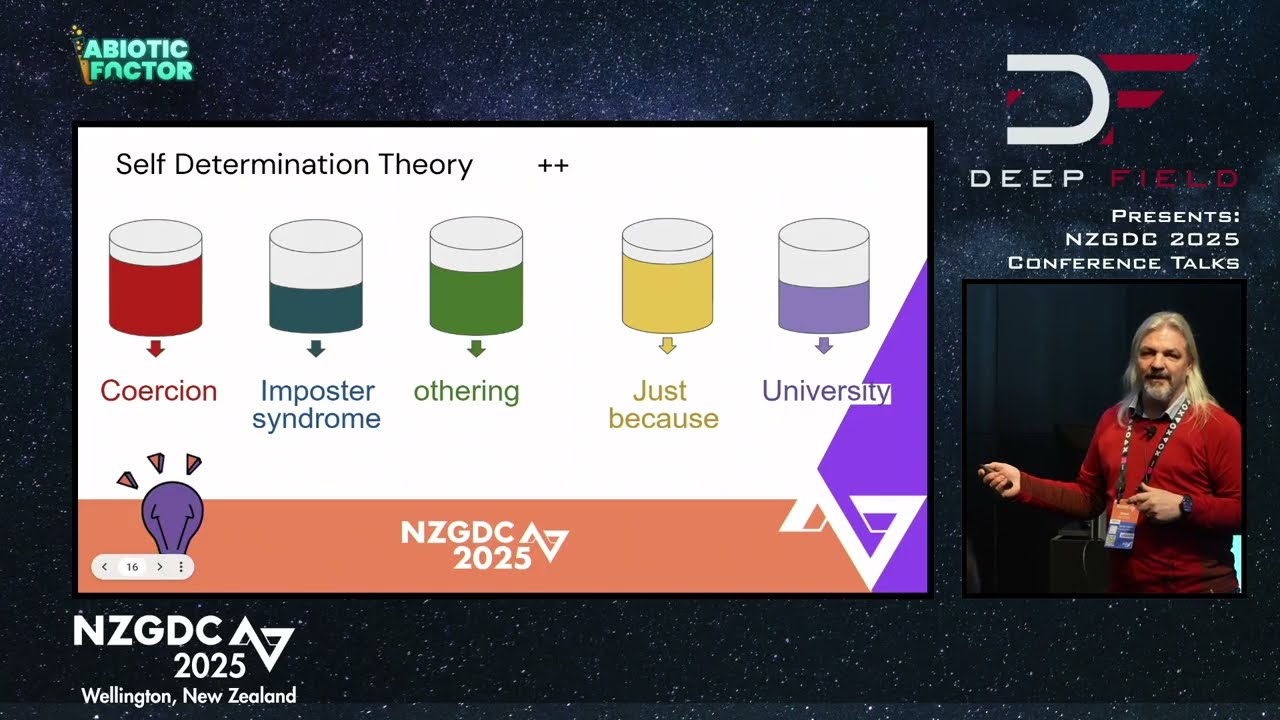
Extremism and Game Development | Simon McCullum | NZGDC 2025
Keywords
Summary
142 words
Critical Evaluation
Value of the Information & Strength of the Argument
The talk provides valuable insights into the often-overlooked role of game design in extremism pathways. It argues that game developers have a responsibility to understand and mitigate these risks, and that good community management is crucial. The argumentation is coherent, drawing on personal experience, academic theory, and survey data. However, some claims lack rigorous evidence, and the speaker acknowledges the exploratory nature of the research.
Scientific Rigor, Source Quality, Title Accuracy
The speaker references academic research (e.g., Axelrod) and surveys, but does not provide specific citations. The title accurately reflects the content. The talk is based on research funded by the Department of Prime Minister and Cabinet, adding some credibility, but the lack of detailed sources limits its scientific rigor.
129 words
Title / Content Match
The title accurately reflects the content, focusing on extremism in game communities and game development's role.
Quality & Reliability
7/10
The talk is based on research funded by the Department of Prime Minister and Cabinet and references academic theories (e.g., Axelrod's simulations) and surveys, but lacks detailed citations and peer-reviewed sources. The speaker is an academic, adding credibility, but the content is largely anecdotal and exploratory.
Key Moments
Markers derived by PSI from the transcript: the creator did not define chapters.
- Introduction: speaker's background and the context of extremism in game communities.
- Discussion of risk factors for radicalization and their prevalence among gamers.
- Survey data on toxic communities and their impact on player spending and retention.
- Examples of extremist content in games like Roblox and Minecraft.
- Proposed solutions: female-only spaces, layered bans, and pro-social design.
- Workshop outcomes: tools for community managers and policy analysis.
- Conclusion: the challenge of rehabilitating banned players and the need for societal involvement.
Cited Sources
- Department of Prime Minister and Cabinet (New Zealand) — Funding source for the research on extremism.
- Axelrod's research on cooperation and defection — Referenced for the tipping point of 10% defectors in communities.
Concurring Sources
- Anti-Defamation League report on hate in games — Reports on hate and harassment in online games, supporting the speaker's claims.
Dissenting Sources
- Research on the link between violent video games and aggression — Some studies suggest a link between violent games and aggression, which contrasts with the speaker's focus on community dynamics rather than content.
Contribution & Novelties
The talk provides a unique perspective from a game developer on extremism pathways, emphasizing the role of game design and community management. It offers practical suggestions for moderation and policy, and highlights the need for rehabilitation pathways.
Pour aller plus loin :
- Self-Determination Theory — The speaker uses this theory to explain player motivation.
- Radicalization — Overview of the process of radicalization.
- Online disinhibition effect — Relevant to toxic behavior in online communities.
73 words
Radar Profile
The radar profile shows moderate scores across all dimensions, with slightly higher scores in information quantity and quality, reflecting the talk's informative but not deeply technical nature. The low technical score indicates that the content is accessible to a general audience.
💬 No comments were provided for analysis.