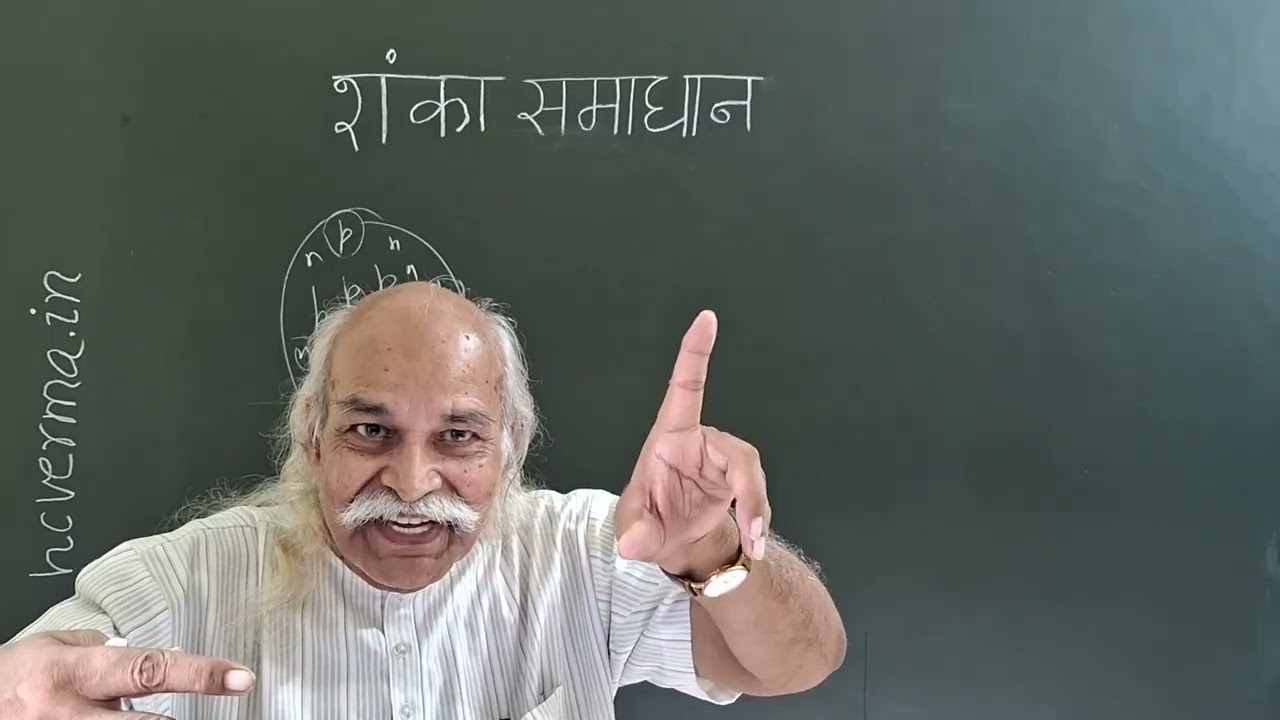
Question on Nuclear Stability (Hindi)
Keywords
Summary
191 words
Critical Evaluation
Value of the Information & Strength of the Argument
The video provides a clear and insightful explanation of nuclear stability, going beyond the simplistic N/Z ratio rule. It correctly identifies the role of the Pauli exclusion principle in determining nuclear energy levels and explains why beta decay occurs in C-14. The argumentation is logical and well-structured, building from basic concepts to the specific case. The value lies in correcting a common misconception and offering a deeper physical understanding.
Scientific Rigor, Source Quality, Title Accuracy
The scientific rigor is high; the explanation is based on established nuclear physics principles. No external sources are cited, but the content aligns with standard textbook knowledge. The title accurately reflects the content, and the video fulfills its promise of addressing the question. The lack of citations is not a major issue for an educational explanation, but it would be beneficial to reference standard texts for further reading.
152 words
Title / Content Match
The title accurately reflects the content: a question about nuclear stability, specifically addressing why C-14 is radioactive despite a low N/Z ratio.
Quality & Reliability
8/10
The explanation is scientifically accurate, based on fundamental nuclear physics principles (Pauli exclusion principle, nuclear forces, beta decay). The reasoning is clear and logical, though it simplifies complex nuclear stability concepts for educational purposes.
Key Moments
Markers derived by PSI from the transcript: the creator did not define chapters.
- Introduction and student's question about C-14 radioactivity.
- Explanation that adding neutrons increases nuclear attraction, not repulsion.
- Discussion on heavy nuclei and why they have higher N/Z ratios.
- Introduction of Pauli exclusion principle for nucleons.
- Energy level diagrams for protons and neutrons in carbon-12 and carbon-14.
- Explanation of beta decay and energy release in C-14.
- Conclusion: stability depends on minimizing total energy, not just N/Z ratio.
Contribution & Novelties
The video offers a unique pedagogical approach by explaining nuclear stability through the lens of the Pauli exclusion principle and energy levels, rather than the oversimplified N/Z ratio rule. It provides a clear, intuitive explanation of why C-14 is radioactive, which is often not covered in standard textbooks.
Pour aller plus loin :
- Pauli exclusion principle — Foundational quantum principle applied to nucleons.
- Beta decay — The process by which C-14 decays.
- Nuclear shell model — Explains energy levels in nuclei, relevant to the discussion.
85 words
Radar Profile
The radar profile shows high scores in information quality and quantity, with a moderate technical level. This indicates a well-explained educational video that balances depth with accessibility.