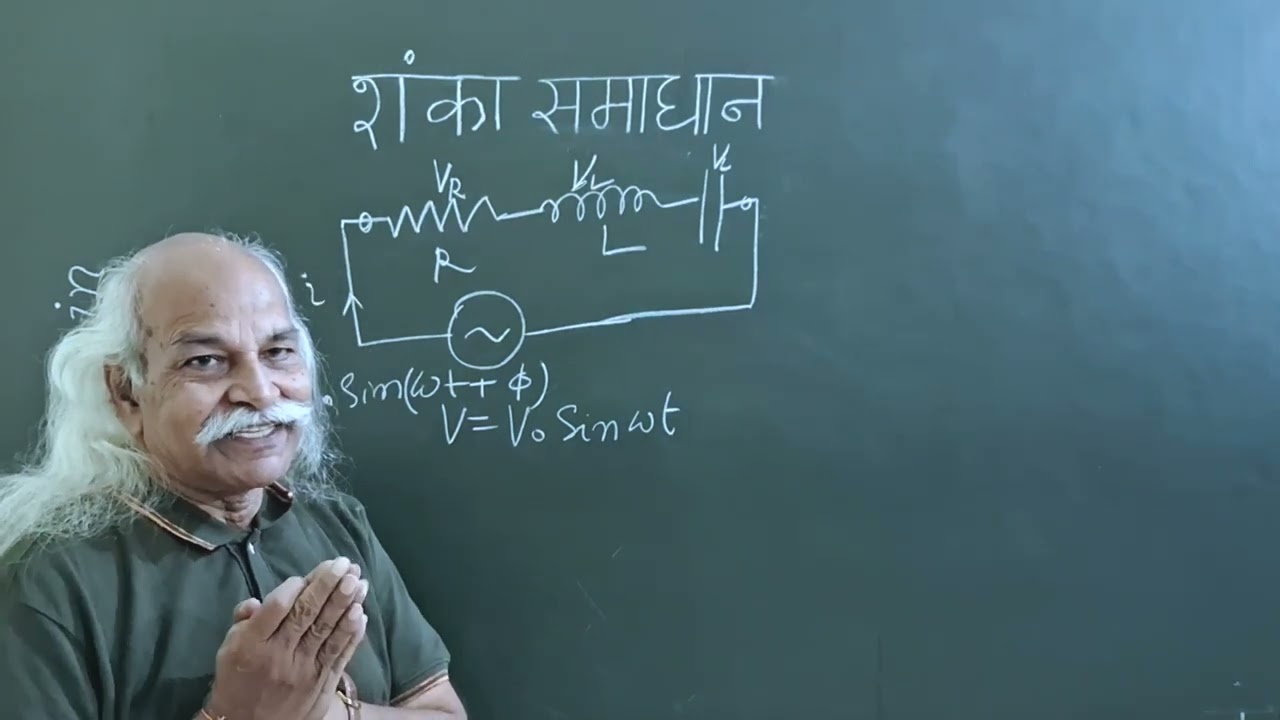
Vector representation of voltages and currents
Keywords
Summary
150 words
Critical Evaluation
Value of the Information & Strength of the Argument
The video provides a clear and valuable explanation of a common conceptual difficulty. The argumentation is solid: it starts with a concrete question, uses an intuitive analogy (area), and then demonstrates the mathematical convenience with a step-by-step example. The reasoning is logical and well-structured, making it accessible to students. The value lies in clarifying that phasors are a mathematical tool, not a physical reality, which helps prevent misconceptions.
Scientific Rigor, Source Quality, Title Accuracy
The scientific rigor is high; the explanation is consistent with standard physics. The sources are not explicitly cited, but the content is based on well-established principles. The title accurately reflects the content. The video does not claim to present new research but rather to clarify a concept, which it does effectively.
134 words
Title / Content Match
The title accurately reflects the content, which explains why vectors are used for voltages and currents in AC circuits.
Quality & Reliability
9/10
The explanation is clear, accurate, and grounded in standard physics. The analogy with area vectors is apt. The mathematical derivations are correct and well-motivated.
Key Moments
Markers derived by PSI from the transcript: the creator did not define chapters.
- Introduction and question about vector representation of voltage and current in AC circuits.
- Explanation that voltage and current are scalars, but vectors are used for calculation convenience.
- Analogy with area: scalar but represented as a vector for flux calculations.
- Setup of a series AC circuit with resistor, inductor, and capacitor.
- Discussion of phase differences between voltage and current.
- Introduction of phasor representation for voltages.
- Demonstration of vector addition to find total voltage.
- Comparison with trigonometric method and conclusion that phasors are a mathematical shortcut.
Contribution & Novelties
The video provides a clear pedagogical explanation of why phasors are used in AC circuits, emphasizing that it is a mathematical convenience. It reinforces the distinction between physical quantities and mathematical representations.
Pour aller plus loin :
- Phasor — Wikipedia article on phasors, the mathematical concept used.
- Alternating current — Wikipedia article on AC, providing background.
- Impedance — Wikipedia article on impedance, which is often represented using phasors.
68 words
Radar Profile
The radar profile shows high scores in quality and reliability, with slightly lower but still good scores in quantity and technical level. This indicates a focused, accurate, and well-explained video, though it is not exhaustive in covering all aspects of AC circuits.
💬 Très positif. Sur les 30 commentaires analysés, tous expriment une grande admiration et gratitude envers H C Verma, soulignant sa clarté pédagogique et son humilité.