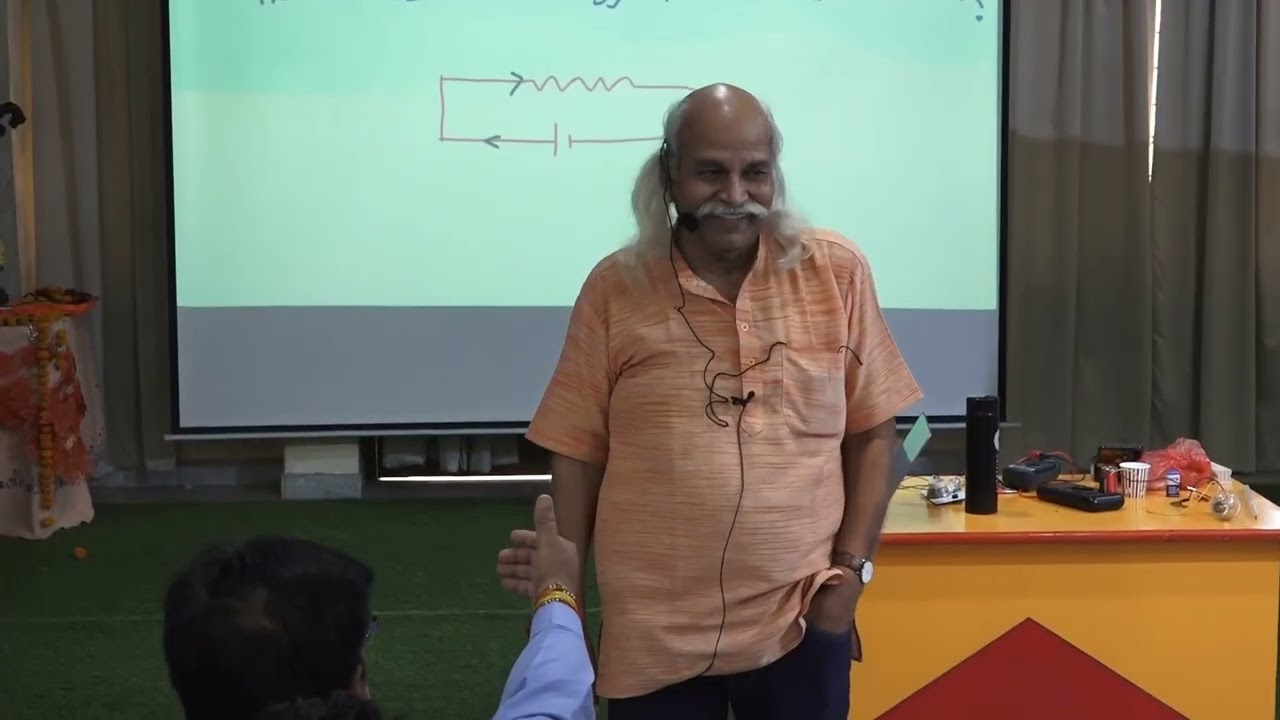
Battery, connecting wires and resistance 5/5
Keywords
Summary
150 words
Critical Evaluation
Value of the Information & Strength of the Argument
The video provides valuable insights into the physical interpretation of circuit concepts, challenging common misconceptions. The argumentation is solid, based on fundamental electromagnetic principles. Verma clearly explains the model nature of internal resistance and justifies the energy flow via the Poynting vector, using logical reasoning and analogies. The interactive format allows for addressing student doubts, enhancing the pedagogical value.
Scientific Rigor, Source Quality, Title Accuracy
The scientific rigor is high, as the content aligns with established physics. However, no external sources are cited, and the video is an expert opinion rather than a peer-reviewed presentation. The title accurately reflects the content, focusing on the energy path. The description mentions the focus on energy path, which is consistent. No comments were provided for analysis.
132 words
Title / Content Match
The title accurately reflects the content, which focuses on the energy path from battery to resistance, as described in the description.
Quality & Reliability
8/10
The video presents a rigorous conceptual discussion by a renowned physics educator, emphasizing the physical interpretation of internal resistance and energy flow in circuits. The reasoning is consistent with established electromagnetic theory, though it is an expert opinion rather than a peer-reviewed study.
Key Moments
Markers derived by PSI from the transcript: the creator did not define chapters.
- Introduction and discussion on internal resistance as a model.
- Explanation that internal resistance is not a physical component but a model for chemical weakening.
- Discussion on energy flow from battery to resistor, questioning the path.
- Introduction of electric field outside the wire and surface charges.
- Explanation of the continuity of tangential electric field across the wire surface.
- Discussion on energy residing in electric and magnetic fields.
- Application of Poynting vector to show energy flow into the resistor.
- Detailed analysis of electric and magnetic fields around the battery and wires.
- Conclusion and summary of key concepts.
Contribution & Novelties
The video offers a unique pedagogical approach to explaining internal resistance and energy flow in circuits, emphasizing the role of electromagnetic fields. It clarifies misconceptions and provides a deeper understanding of the Poynting vector in simple circuits.
Pour aller plus loin :
- Poynting vector — Directly related to the energy flow discussion.
- Internal resistance — Contextualizes the model discussion.
- Surface charge — Relevant to the electric field outside wires.
69 words
Radar Profile
The radar profile shows high scores in quality and technical level, with slightly lower scores in quantity and reliability, reflecting the depth of explanation but limited external sourcing.