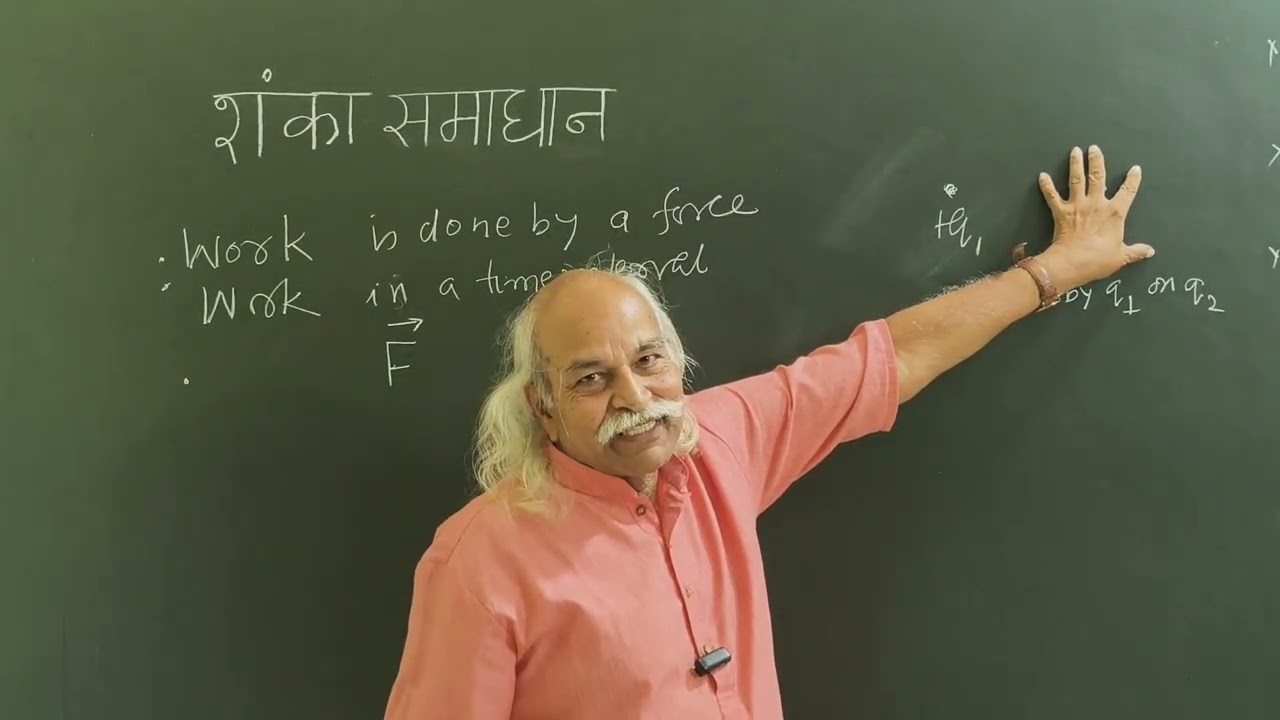
Talk on Work
Keywords
Summary
148 words
Critical Evaluation
Value of the Information & Strength of the Argument
The video provides a solid conceptual foundation for understanding work in physics. The argumentation is logical and progressive, starting from the basic definition and building up to the work-energy theorem. The use of examples, such as forces on a particle and the projection of a ball, helps to clarify abstract concepts. The explanation of the dot product and the integral is accessible, and the connection between work and energy is well-established. The value lies in its pedagogical clarity and the emphasis on the physical meaning behind the mathematical formalism.
Scientific Rigor, Source Quality, Title Accuracy
The scientific rigor is high, as the content is accurate and aligns with standard physics textbooks. However, the video does not cite any external sources, which is typical for a tutorial. The title ‘Talk on Work’ is appropriate and directly reflects the content. The video is a single continuous lecture without references to literature, but the explanations are precise and reliable.
165 words
Title / Content Match
The title 'Talk on Work' is accurate and descriptive, reflecting the video's content.
Quality & Reliability
8/10
The video is a clear and rigorous explanation of the concept of work in physics, delivered by a renowned physics educator. The content is accurate and well-structured, with a focus on conceptual clarity. The explanation of the work-energy theorem is correct and the presentation is methodical. However, the video lacks citations to external sources, and the production quality is basic (a single take with a whiteboard).
Key Moments
Markers derived by PSI from the transcript: the creator did not define chapters.
- Introduction: distinguishing everyday work from physics work.
- Work is done by a force; multiple forces can act on a body.
- Work is defined over a time interval, not at an instant.
- Definition of work as dot product of force and displacement.
- Integral form of work for varying forces.
- Work-energy theorem: net work equals change in kinetic energy.
- Positive and negative work explained with examples.
Contribution & Novelties
The video offers a clear and intuitive explanation of work in physics, emphasizing the conceptual distinction from everyday usage. It provides a step-by-step derivation of the work-energy theorem, making it accessible to students. The pedagogical approach is the main contribution, as it clarifies common misconceptions.
Pour aller plus loin :
- Work (physics) - Wikipedia — Provides a comprehensive overview of work, including historical context and mathematical formulations.
- Work-Energy Theorem - HyperPhysics — A concise explanation of the theorem with examples.
- Kinetic Energy - Wikipedia — Discusses kinetic energy and its relation to work.
93 words
Radar Profile
The radar profile shows high scores in quality and reliability, with slightly lower scores in quantity and technical level, reflecting a focused tutorial that prioritizes conceptual clarity over exhaustive coverage.