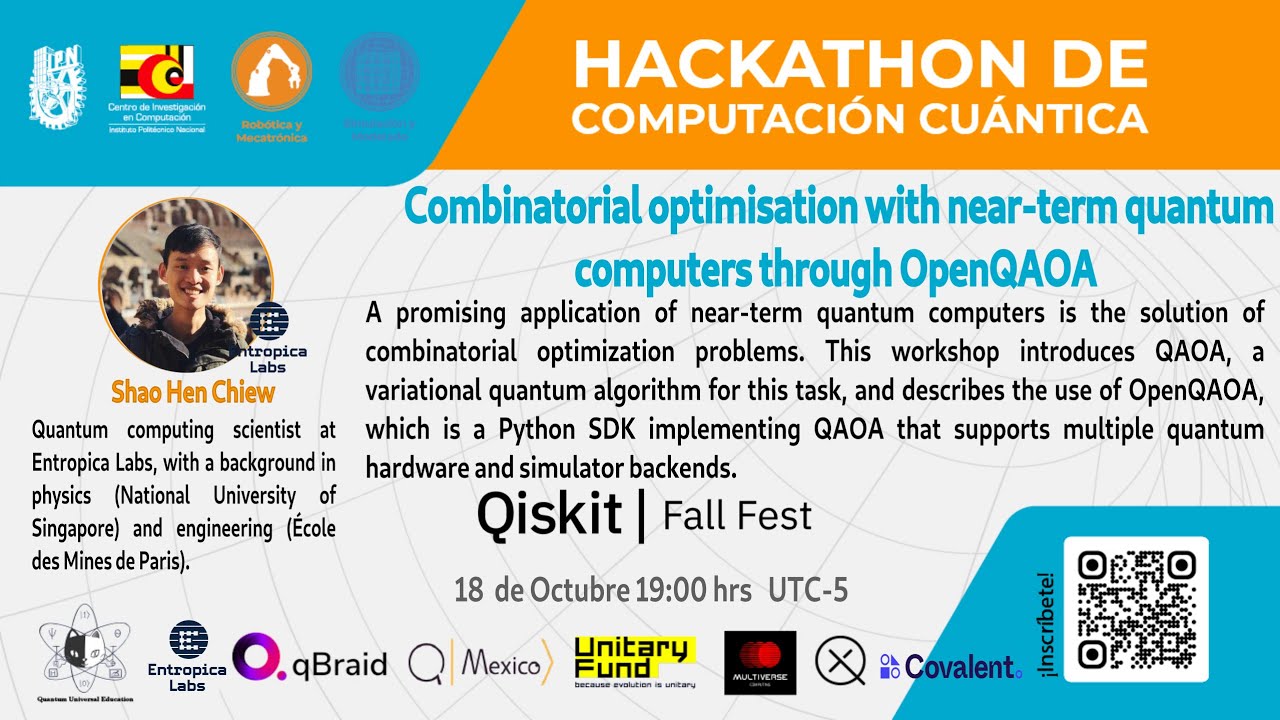
Qiskit FallFest CIC-IPN Mexico 2022 - Combinatorial optimisation through OpenQAOA
Keywords
Summary
160 words
Critical Evaluation
Value of the Information & Strength of the Argument
The presentation provides a clear and structured introduction to QAOA and its implementation via OpenQAOA. The value lies in its pedagogical approach, breaking down complex concepts into understandable components. The argumentation is solid, logically progressing from VQAs to combinatorial optimization to QAOA specifics. The speaker effectively uses examples (number partitioning) and analogies to illustrate key points. However, the talk lacks depth in certain areas, such as the mathematical derivation of the cost Hamiltonian and the performance guarantees of QAOA. The discussion on OpenQAOA is brief, focusing more on conceptual understanding than practical usage.
Scientific Rigor, Source Quality, Title Accuracy
The scientific rigor is adequate for a tutorial. The speaker references a review paper on VQAs and a QAOA paper, but does not provide specific citations or URLs during the talk. The title accurately reflects the content, and the presentation stays on topic. The Q&A sessions address audience questions, clarifying concepts and distinguishing QAOA from other algorithms. No public comments were provided for analysis.
172 words
Title / Content Match
The title accurately reflects the content: a workshop on combinatorial optimization using OpenQAOA, presented at Qiskit FallFest.
Quality & Reliability
7/10
The presentation is a technical tutorial by a quantum computing scientist, providing a clear and structured introduction to variational quantum algorithms, QAOA, and the OpenQAOA package. The content is accurate and well-explained, but it is a high-level overview without in-depth derivations or experimental validation.
Key Moments
Markers derived by PSI from the transcript: the creator did not define chapters.
- Introduction by Alberto and speaker self-introduction.
- Overview of variational quantum algorithms (VQAs) and their components.
- Explanation of combinatorial optimization and QUBO formulation.
- Introduction to QAOA: circuit ansatz, cost Hamiltonian, and optimization.
- Discussion on OpenQAOA package and its features.
- Q&A session on QAOA vs Grover's algorithm and layer selection.
Cited Sources
- Review paper on variational quantum algorithms (mentioned but not specified) — Referenced in the presentation as a source for the VQA framework diagram.
- QAOA paper (mentioned but not specified) — Referenced for the QAOA circuit structure.
Concurring Sources
- Quantum Approximate Optimization Algorithm: Performance, Mechanism, and Implementation on Near-Term Devices — A foundational paper on QAOA, providing theoretical background and performance analysis.
Contribution & Novelties
The presentation offers a clear and accessible introduction to QAOA and its practical implementation via OpenQAOA, which is valuable for practitioners. It bridges theoretical concepts with a concrete software tool, making it easier for researchers to apply QAOA to real-world problems. The talk also clarifies common misconceptions, such as the difference between QAOA and Grover’s algorithm.
Pour aller plus loin :
- Quantum Approximate Optimization Algorithm (Wikipedia) — Provides a comprehensive overview of QAOA, its formulation, and applications.
- OpenQAOA GitHub repository — The official repository for the OpenQAOA package, with documentation and examples.
- Variational Quantum Algorithms (arXiv review) — A detailed review of VQAs, covering theory and applications.
107 words
Radar Profile
The radar profile shows balanced scores across all dimensions, with slightly higher quality of information and technical level. This indicates a well-structured and informative tutorial, though it could benefit from more depth in certain areas.