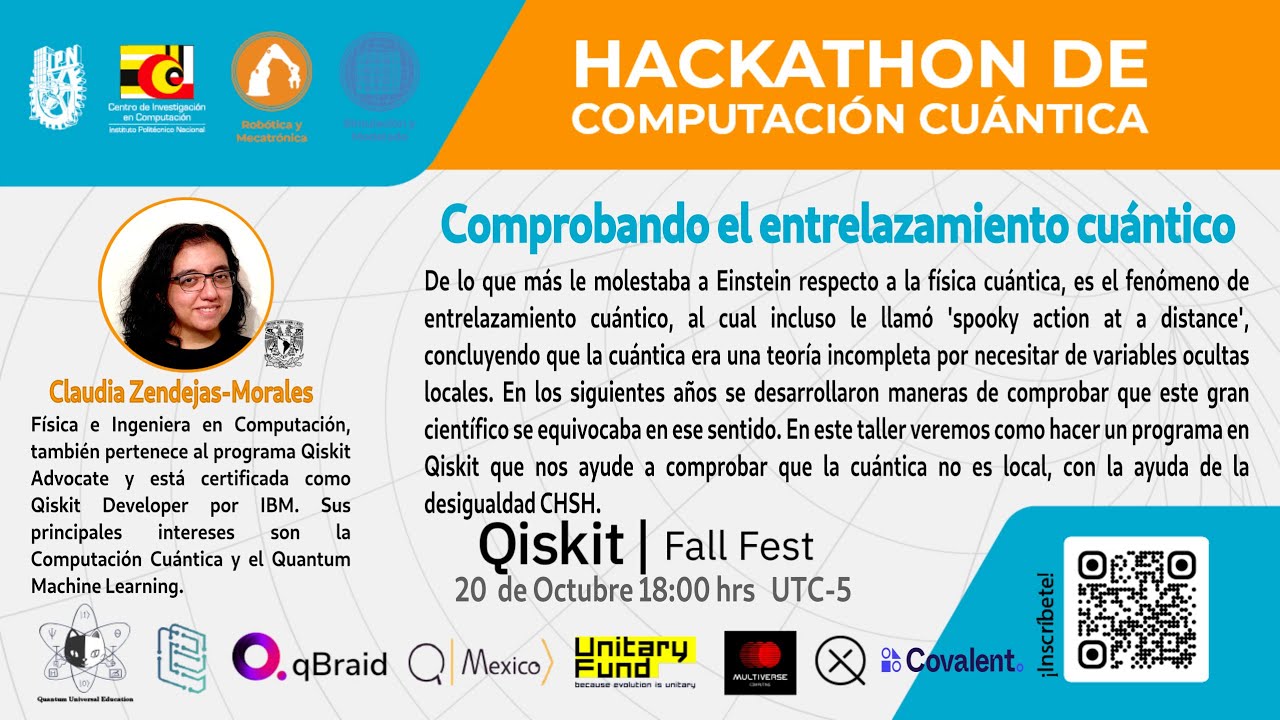
Qiskit Fall Fest CIC-IPN Mexico 2022- Comprobando el entrelazamiento cuántico
Keywords
Summary
160 words
Critical Evaluation
Value of the Information & Strength of the Argument
The talk provides a clear and accessible explanation of Bell’s inequality and its experimental verification. The speaker uses analogies (coins, slot machines) to illustrate the concept of hidden variables and the logic behind Bell’s test. The argumentation is sound, progressing from the EPR paradox to Bell’s theorem and the CHSH inequality, and finally to modern experiments. The use of a virtual lab demonstration adds practical value. However, the presentation is introductory and does not delve into the mathematical derivations in depth, which might limit its value for advanced viewers.
Scientific Rigor, Source Quality, Title Accuracy
The speaker references key scientific papers and experiments, including the EPR paper (1935), Bell’s theorem, and the CHSH inequality. She mentions the 2022 Nobel Prize winners and the Big Bell Test. However, she does not provide specific citations or URLs within the talk, and the description only contains the speaker’s name. The title accurately reflects the content, as the talk is indeed about verifying quantum entanglement. The scientific rigor is high, as the concepts are accurately presented, but the lack of explicit sources in the video description is a minor weakness.
195 words
Title / Content Match
The title accurately reflects the content: the speaker explains and demonstrates quantum entanglement verification through Bell inequalities.
Quality & Reliability
8/10
The talk is based on well-established quantum mechanics concepts and references key experiments (Bell, CHSH, Nobel Prize 2022). The speaker is a certified Qiskit advocate, indicating expertise. However, the presentation is a recorded talk with limited depth and no formal citations in the video itself.
Key Moments
Markers derived by PSI from the transcript: the creator did not define chapters.
- Introduction of the speaker and topic.
- Explanation of quantum entanglement and EPR paradox.
- Introduction of hidden variables and Bell's inequality.
- Detailed explanation of the CHSH inequality.
- Description of experimental setups and the Big Bell Test.
- Demonstration using the Quantum Flytrap virtual lab.
- Results showing violation of Bell inequality and conclusion.
Cited Sources
- EPR paper (1935) — Referenced as the origin of the entanglement concept.
- Bell's theorem — Referenced as the basis for testing hidden variables.
- CHSH inequality — Referenced as a refined version of Bell's inequality.
- 2022 Nobel Prize in Physics — Referenced for closing loopholes in Bell tests.
- Big Bell Test — Referenced as an experiment using human choices.
Concurring Sources
- Bell's theorem - Wikipedia — Confirms the theoretical basis of Bell's inequality.
- CHSH inequality - Wikipedia — Confirms the formulation of the CHSH inequality.
Contribution & Novelties
The talk provides a clear pedagogical explanation of Bell’s inequality and its experimental verification, making complex quantum concepts accessible. It also highlights recent developments such as the 2022 Nobel Prize and the Big Bell Test, which are not commonly covered in introductory materials.
Pour aller plus loin :
- Bell’s theorem - Wikipedia — Provides a comprehensive overview of Bell’s theorem and its implications.
- CHSH inequality - Wikipedia — Detailed explanation of the CHSH inequality and its derivation.
- Quantum entanglement - Wikipedia — General reference on quantum entanglement.
- Big Bell Test - Wikipedia — Information about the global experiment using human randomness.
101 words
Radar Profile
The radar profile shows high scores in quality and reliability, moderate in quantity and technical level, indicating a well-structured but not overly technical presentation. The talk is suitable for a general audience interested in quantum mechanics.