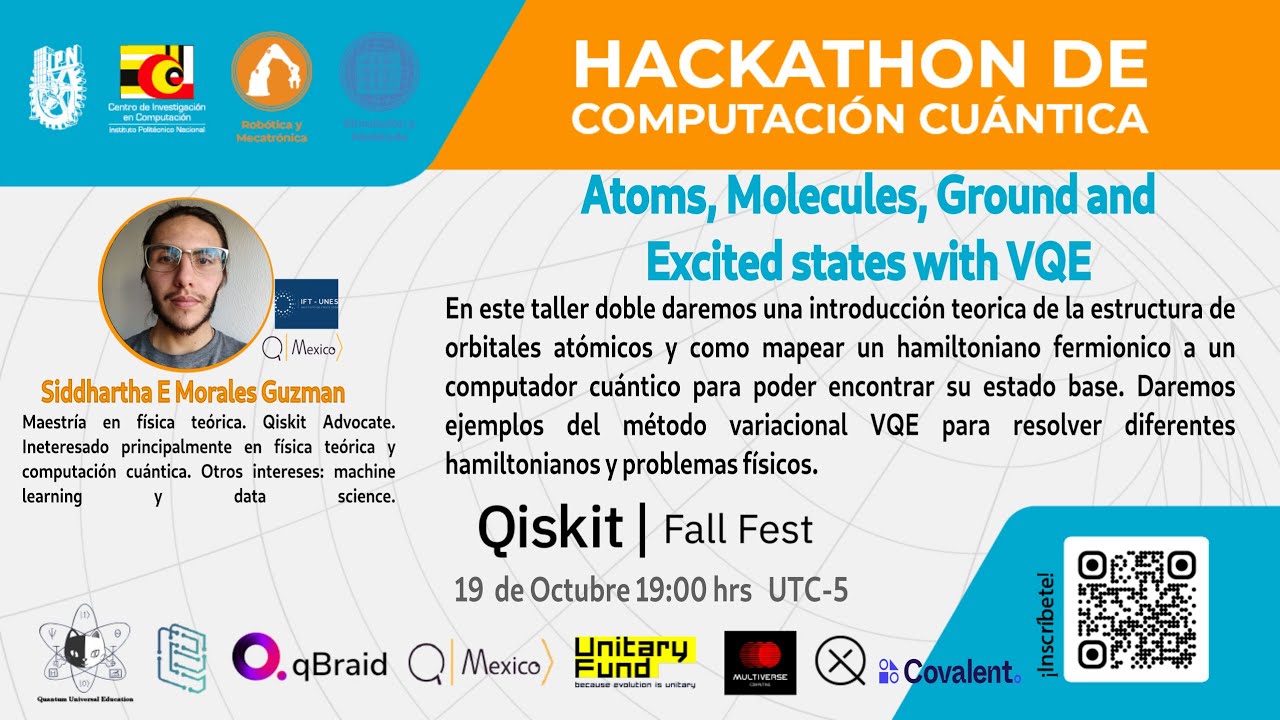
Qiskit Fall Fest CIC-IPN Mexico 2022 - Atoms, Molecules, Ground and Excited states with VQE
Keywords
Summary
178 words
Critical Evaluation
Value of the Information & Strength of the Argument
The talk provides a solid introduction to VQE and its applications, with clear explanations of key concepts such as Hamiltonian decomposition, ansatz design, and gradient computation. The argumentation is coherent and builds logically from basic principles to specific algorithms. The speaker effectively communicates the potential of VQE for quantum chemistry, citing the example of simulating molecules with 127 qubits. However, the talk lacks depth in some areas, such as the mathematical details of the parameter-shift rule and the comparison of different fermion-to-qubit mappings. The presentation is more descriptive than analytical, but it serves as a good overview for an audience with some quantum computing background.
Scientific Rigor, Source Quality, Title Accuracy
The speaker mentions a review article as the basis for the talk, but does not provide specific citations during the presentation. The content is consistent with established literature on VQE and quantum chemistry. The title accurately reflects the content, focusing on VQE for atoms and molecules. The talk does not include any commercial or promotional content. The speaker’s credentials (UNAM, Perimeter Institute, IPN) lend some credibility, but the lack of explicit references reduces the overall rigor.
196 words
Title / Content Match
The title accurately reflects the content: the talk focuses on VQE for computing ground and excited states of atoms and molecules.
Quality & Reliability
7/10
The talk is based on a review article and covers established quantum algorithms (VQE, QAOA, etc.) with correct theoretical foundations. However, it is a high-level overview without detailed derivations or citations to specific sources during the talk, and the speaker mentions personal background but not peer-reviewed references.
Key Moments
Markers derived by PSI from the transcript: the creator did not define chapters.
- Introduction and welcome
- Speaker introduction and background
- Basic idea of variational algorithms and cost functions
- Quantum mechanics: Hermitian operators and Pauli decomposition
- Measurement in quantum computers and expectation values
- Ansatz design and parameterized quantum circuits
- Gradient computation using parameter-shift rule
- VQE algorithm for ground states
- Excited states via modified Hamiltonian
- Other variational algorithms: adiabatic, subspace, fast-forwarding
- Application to quantum chemistry: second quantization and fermionic operators
- Jordan-Wigner and parity mappings
- Current hardware and future prospects
Cited Sources
- Review article on variational quantum algorithms — The speaker mentions a review article as the basis for the talk, but does not provide a specific URL or title.
Concurring Sources
- Qiskit documentation on VQE — Qiskit provides tutorials and documentation on VQE, which align with the concepts presented in the talk.
Contribution & Novelties
The talk provides a comprehensive overview of VQE and its applications, with a clear explanation of the parameter-shift rule and the extension to excited states. It also discusses various fermion-to-qubit mappings and their implications for circuit depth. The presentation is valuable for those new to quantum chemistry on quantum computers.
Pour aller plus loin :
- Variational quantum eigensolver — Overview of VQE and its applications.
- Parameter shift rule — Explanation of the gradient computation technique.
- Jordan-Wigner transformation — Mapping fermions to qubits.
- Quantum chemistry on quantum computers — General background on quantum chemistry.
93 words
Radar Profile
The radar profile shows a balanced performance across all dimensions, with slightly higher scores in information quantity and technical level, indicating a content-rich and technically sound presentation. The lower score in information quality suggests some gaps in depth and sourcing.
💬 No comments were provided for analysis.