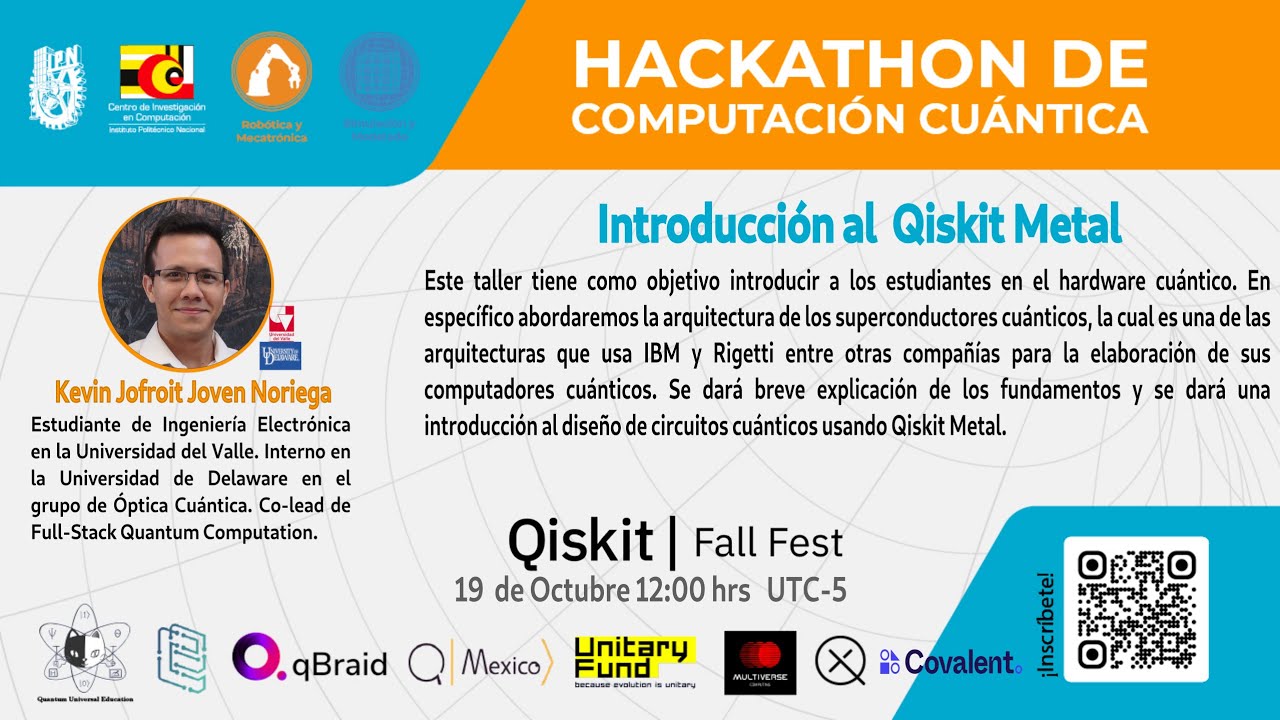
Qiskit Fall Fest CIC-IPN Mexico 2022 - Introducción al Qiskit Metal
Keywords
Summary
153 words
Critical Evaluation
Value of the Information & Strength of the Argument
The talk provides a clear and accessible introduction to superconducting qubits and quantum chip design. The speaker effectively explains complex concepts such as the DiVincenzo criteria, Josephson junctions, and qubit coupling using analogies and circuit diagrams. The argumentation is coherent, building from basic principles to the practical use of Qiskit Metal. However, the talk lacks depth in some areas, such as the detailed physics of qubit coherence and noise, and does not provide quantitative examples or comparisons of different architectures.
Scientific Rigor, Source Quality, Title Accuracy
The talk is scientifically accurate but lacks explicit citations to external sources. The speaker mentions various companies and technologies (IBM, Google, Intel, Microsoft) but does not provide specific references. The title accurately reflects the content, which is an introduction to Qiskit Metal. The talk is well-structured and pedagogically sound, but the lack of references reduces its scientific rigor.
153 words
Title / Content Match
The title accurately reflects the content, which is an introduction to Qiskit Metal within the context of the Qiskit Fall Fest event.
Quality & Reliability
7/10
The talk provides a solid introductory overview of superconducting qubits and Qiskit Metal, with accurate explanations of the DiVincenzo criteria and qubit architectures. However, it lacks depth in some areas and does not provide detailed references or citations.
Key Moments
Markers derived by PSI from the transcript: the creator did not define chapters.
- Introduction to the talk and speaker's background.
- Explanation of the DiVincenzo criteria for quantum computers.
- Overview of different qubit architectures (superconducting, trapped ion, etc.).
- Introduction to Josephson junctions and their role in superconducting qubits.
- Explanation of transmon and Xmon qubit designs.
- Discussion on qubit coupling methods: direct and resonator-mediated.
- Introduction to Qiskit Metal and its purpose for quantum chip design.
- Demonstration of designing a chip layout using Qiskit Metal.
- Q&A session addressing audience questions.
Cited Sources
- Qiskit Metal — Mentioned as the main tool for quantum chip design.
Concurring Sources
- Qiskit Metal — The tool introduced in the talk is available and documented.
Contribution & Novelties
The talk provides a practical introduction to Qiskit Metal, a relatively new tool for quantum chip design. It bridges the gap between theoretical quantum computing and hardware implementation, making it accessible to a broader audience. The speaker’s emphasis on the DiVincenzo criteria and qubit architectures offers a solid foundation for beginners.
Pour aller plus loin :
- Qiskit Metal documentation — Official documentation for Qiskit Metal.
- Superconducting qubits — Overview of superconducting qubits on Wikipedia.
- Josephson effect — Explanation of the Josephson effect, fundamental to qubit design.
86 words
Radar Profile
The radar profile shows a balanced performance across all dimensions, with slightly higher scores in information quantity and quality, reflecting the talk's comprehensive yet introductory nature. The technical level is moderate, suitable for a general audience, while reliability is good but not exceptional due to lack of citations.
💬 Sur les 59 commentaires analysés, les spectateurs ont exprimé un intérêt pour les sujets avancés et ont posé des questions techniques sur les architectures de qubits et les outils de conception.