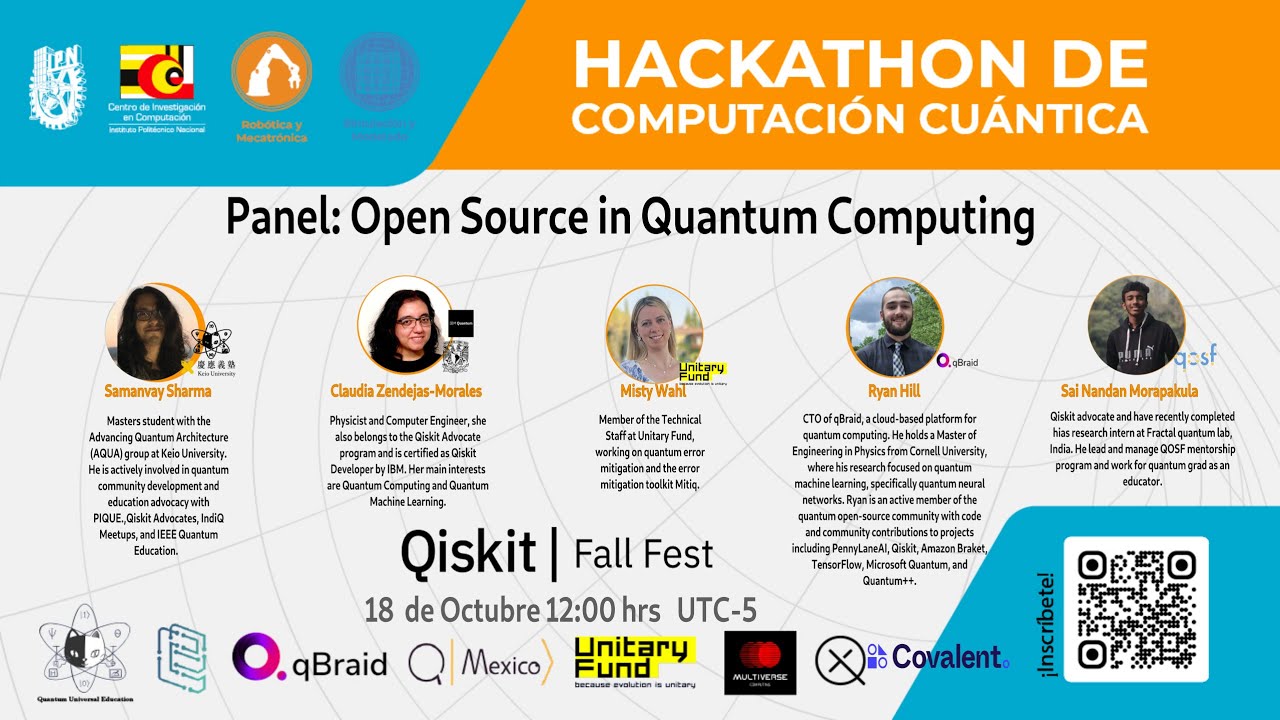
Qiskit Fall Fest CIC-IPN Mexico 2022 - Foro Open Source in Quantum Computing
Keywords
Summary
169 words
Critical Evaluation
Value of the Information & Strength of the Argument
The value of the information lies in the firsthand accounts of professionals who have successfully navigated the quantum computing landscape through open-source involvement. The panel provides concrete examples of how open-source contributions can lead to career opportunities, as illustrated by Misty Wahl’s transition from a mechanical engineering background to technical staff at Unitary Fund, and Ryan Hill’s progression from a student to a developer at qBraid. The argumentation is persuasive, built on personal narratives and practical advice rather than abstract theory. The panelists consistently advocate for open-source participation as a meritocratic path to learning and professional growth, supported by specific programs like the Unitary Fund micro-grants and the QOSF mentorship program. The discussion is coherent and well-moderated, with each speaker adding a distinct perspective while reinforcing the central theme.
Scientific Rigor, Source Quality, Title Accuracy
The panelists are credible figures within their respective organizations, lending authority to their statements. However, the discussion is informal and lacks formal citations or references to specific research papers or technical documentation. The sources cited are primarily the organizations themselves and their programs, which are mentioned in the context of opportunities for the audience. The title accurately reflects the content, as the video is indeed a forum on open source in quantum computing. The technical depth is moderate, suitable for a general audience interested in the field, but not for those seeking advanced technical details. Overall, the information is reliable within the scope of personal experiences and community knowledge, but it does not constitute a rigorous scientific review.
262 words
Title / Content Match
The title accurately reflects the content: a forum on open source in quantum computing, held during Qiskit Fall Fest at CIC-IPN Mexico.
Quality & Reliability
7/10
Panel of practitioners from various quantum open-source organizations, sharing personal experiences and community insights. No formal citations or peer-reviewed references, but the speakers are credible and the information is practical and consistent.
Key Moments
Markers derived by PSI from the transcript: the creator did not define chapters.
- Introduction of panelists and topic: open source in quantum computing.
- Ryan Hill explains the importance of open source for qBraid, a cloud-based quantum platform.
- Misty Wahl discusses Unitary Fund's mission and the role of open source in building the quantum ecosystem.
- Sai Nandan Morapakula describes the Quantum Open Source Foundation's mentorship program and its non-profit nature.
- Claudia Zendejas-Morales highlights how open source projects help individuals learn and contribute to large projects like Qiskit.
- Samanvay Sharma shares the background of Quantum Universal Education and its focus on accessible learning.
- Panelists share personal journeys into quantum computing, emphasizing open-source contributions as a starting point.
- Discussion on internship opportunities and guidance for applying to open-source programs.
- Addressing the downsides of open-source communities, such as reliance on volunteers and unpredictable timelines.
- Advice on learning multiple quantum frameworks and essential tools for contributing to open source.
Cited Sources
- Unitary Fund — Misty Wahl mentions Unitary Fund's mission and micro-grant program.
- qBraid — Ryan Hill discusses qBraid's cloud-based platform and its reliance on open-source packages.
- Quantum Open Source Foundation (QOSF) — Sai Nandan Morapakula describes QOSF's mentorship program and its non-profit nature.
- Quantum Universal Education — Samanvay Sharma talks about the group's mission and its funding by Unitary Fund.
- IBM Quantum — Claudia Zendejas-Morales is a developer at IBM Quantum and discusses Qiskit.
Concurring Sources
- Qiskit — The open-source quantum computing framework is central to the discussion and is referenced by multiple panelists.
- PennyLane — Ryan Hill mentions learning PennyLane and contributing to its community.
- Quantum Open Source Foundation — The organization's mentorship program is discussed as a key opportunity for open-source involvement.
Contribution & Novelties
The video provides a unique compilation of personal career trajectories in quantum computing, all centered on open-source contributions. It offers practical advice for newcomers, such as starting with ‘good first issues’ and reading contribution guidelines. The panel also highlights specific programs like the Unitary Fund micro-grants and QOSF mentorship, which are valuable resources for those seeking to enter the field. The discussion on the downsides of open-source communities, such as volunteer availability, adds a nuanced perspective rarely covered in similar content.
Pour aller plus loin :
- Qiskit — The open-source quantum computing framework mentioned by multiple panelists.
- PennyLane — A quantum machine learning library discussed by Ryan Hill.
- Quantum Open Source Foundation — The organization’s official website, providing details on mentorship programs.
- Unitary Fund — The non-profit supporting open-source quantum projects, including micro-grants.
- Quantum Universal Education — The community group’s website, offering resources and learning opportunities.
146 words
Radar Profile
The radar profile shows high scores in quantity and quality of information, reflecting the panel's rich content and credible speakers. The technical level is moderate, as the discussion is more about community and career than deep technical details. The overall reliability is strong, given the speakers' expertise, but the lack of formal citations slightly reduces the score.
💬 Sur les 0 commentaires analysés, aucune tendance n'a pu être dégagée.