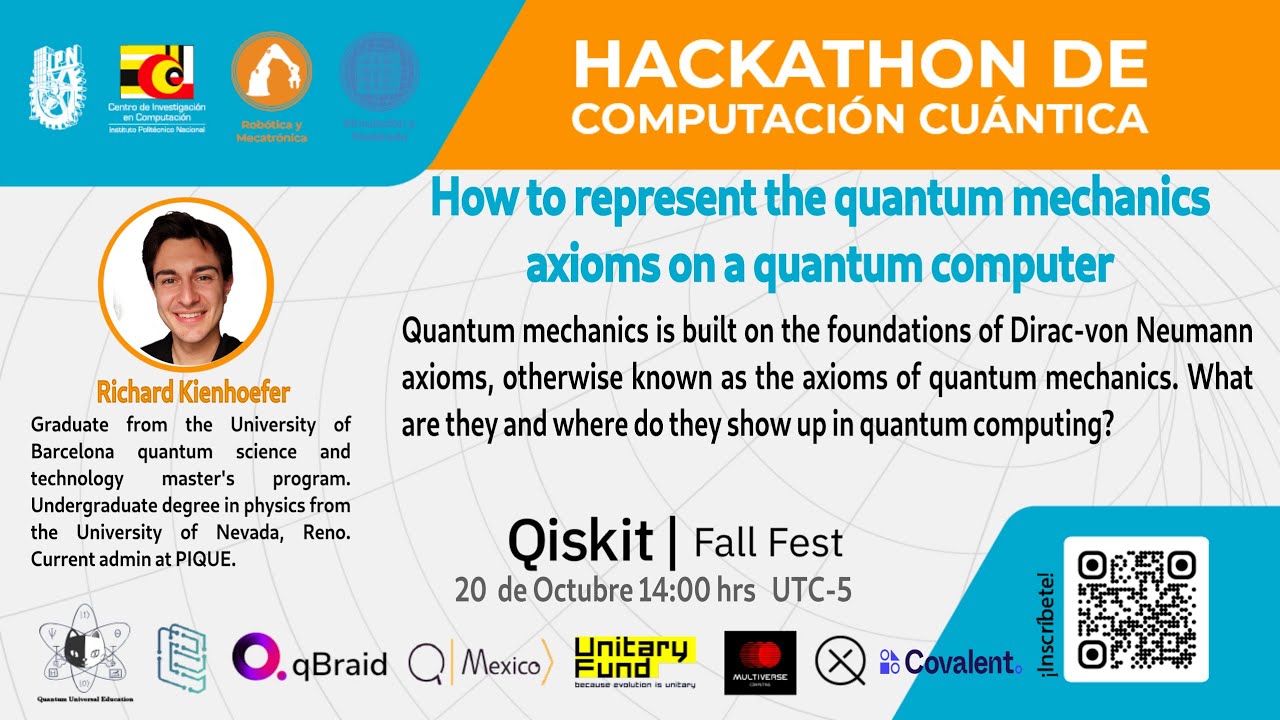
Qiskit Fall Fest CIC-IPN Mexico 2022 - How to represent the quantum computing axioms on a QC
Keywords
Summary
191 words
Critical Evaluation
Value of the Information & Strength of the Argument
The value of the information lies in its clear pedagogical approach, connecting abstract quantum mechanics postulates to concrete quantum computing concepts and Qiskit implementations. The argumentation is structured logically, following the sequence of postulates and providing examples for each. However, the depth is limited, and some explanations are brief or slightly imprecise, such as the treatment of the time evolution postulate. The live demonstrations help solidify the concepts, but the overall argumentation could be strengthened with more rigorous derivations and references.
Scientific Rigor, Source Quality, Title Accuracy
The scientific rigor is moderate: the content is based on standard quantum mechanics and quantum computing knowledge, but the presentation lacks formal citations. The speaker mentions a textbook by J. H. (likely Jack Hidary) and a paper on qubit reset, but no specific URLs are provided. The title accurately reflects the content, and the presentation is well-organized. However, the lack of explicit sources and the informal tone reduce the overall rigor.
167 words
Title / Content Match
The title accurately reflects the content: the speaker explains how the axioms of quantum mechanics are represented in quantum computing.
Quality & Reliability
6/10
The presentation is a tutorial that explains the six postulates of quantum mechanics and their representation in quantum computing. It is based on standard textbook material and includes a live demonstration with Qiskit. However, the presentation is informal, with some imprecisions in language and a lack of rigorous citations. The speaker demonstrates a good understanding of the concepts but the depth is limited.
Key Moments
Markers derived by PSI from the transcript: the creator did not define chapters.
- Introduction and speaker background
- Overview of the six postulates of quantum mechanics
- First postulate: state of a physical system and ket notation
- Demonstration of two-qubit and three-qubit states in Qiskit
- Second postulate: observables and quantum gates
- Third postulate: measurements and eigenvalues/eigenstates
- Fourth postulate: probabilities and normalization
- Fifth postulate: wave function collapse
- Sixth postulate: time evolution and qubit reset
- Q&A session and discussion
Cited Sources
- Quantum Computing: An Applied Approach — Referenced for the illustration of Shor's algorithm and probability amplitudes.
- Paper on qubit reset — Referenced for the time evolution postulate and qubit reset demonstration.
Concurring Sources
- Quantum Mechanics for Scientists and Engineers — Standard textbook on quantum mechanics that covers the postulates.
- Quantum Computation and Quantum Information — Nielsen and Chuang's book, a standard reference for quantum computing.
Contribution & Novelties
The presentation provides a clear and accessible mapping of the six postulates of quantum mechanics to quantum computing concepts, using Qiskit for live demonstrations. It is particularly useful for beginners to understand the foundational principles behind quantum computing. The novelty lies in the pedagogical approach of systematically going through each postulate and showing its computational counterpart.
Pour aller plus loin :
- Quantum mechanics - Wikipedia — General overview of quantum mechanics.
- Qiskit documentation — Official documentation for Qiskit, useful for further exploration.
- Quantum Computing: An Applied Approach — The textbook referenced in the presentation.
- Schrödinger equation - Wikipedia — For the time evolution postulate.
104 words
Radar Profile
The radar profile shows moderate scores across all dimensions, indicating a balanced but not exceptional presentation. The information quantity and quality are adequate, but the technical level and reliability are limited by the informal style and lack of deep rigor.
💬 Sur les 0 commentaires analysés, aucune tendance n'est disponible.