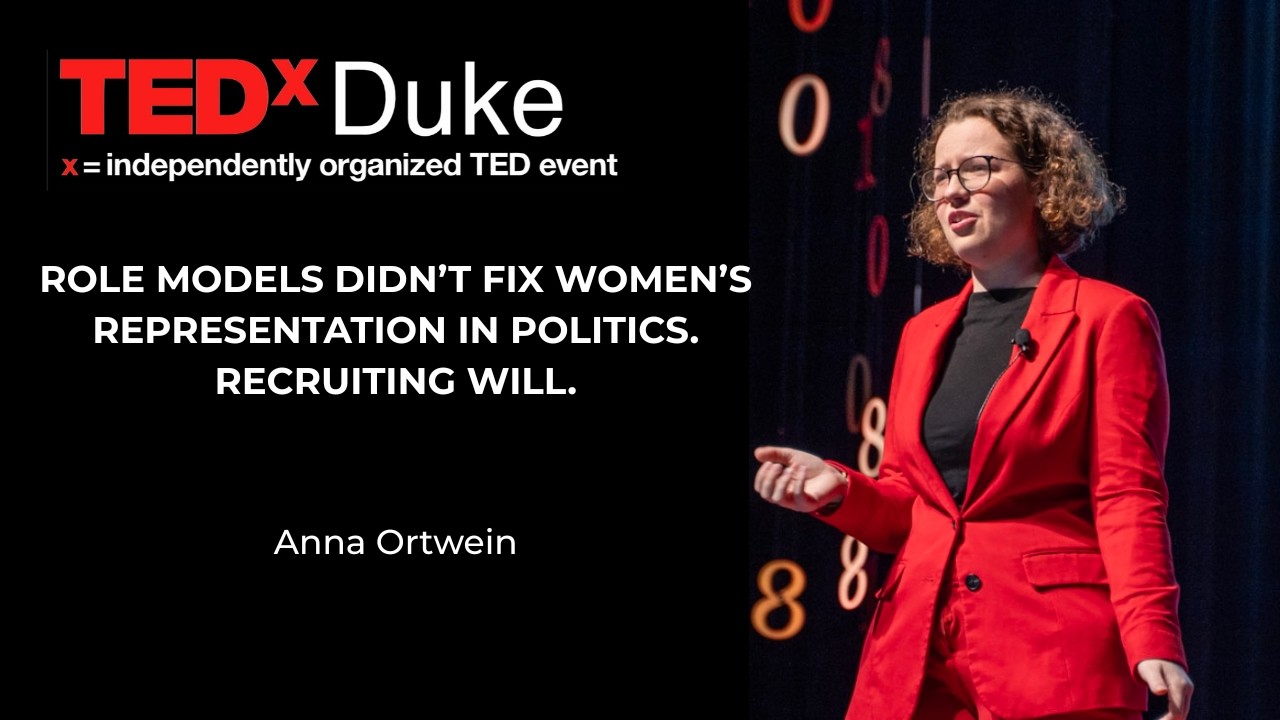
Role models didn’t fix women’s representation in politics. Recruiting will | Anna Ortwein | TEDxDuke
Keywords
Summary
149 words
Critical Evaluation
The talk provides a compelling personal narrative that illustrates the systemic barriers women face in politics. Ortwein’s argument that role models alone are insufficient is well-supported by the stagnation of representation despite Merkel’s chancellorship. She effectively uses her own experience to highlight issues like sexism, ageism, and gatekeeping. However, the talk lacks rigorous scientific evidence; while she mentions research and statistics, she does not cite specific studies or sources, making it difficult to verify claims. The argument that women have a slight electoral advantage is presented without data, and the claim that voters prefer married candidates with children is not substantiated. The example of gun violence is used to show gendered policy priorities, but the KFF survey is not cited in detail. The talk is more of an opinion piece based on personal experience and anecdotal evidence than a systematic analysis. The adéquation between title and content is strong, as the talk consistently focuses on recruitment as the key solution. Overall, the talk is persuasive and raises important points, but its scientific rigor is limited by the lack of cited sources and reliance on personal anecdotes.
186 words
Title / Content Match
The title accurately reflects the core argument that role models alone are insufficient and that systemic changes in recruitment are needed to improve women's representation.
Quality & Reliability
6/10
The talk is based on personal experience and anecdotal evidence, with some references to research and statistics (e.g., KFF survey, representation percentages). However, specific sources are not cited in the talk or description, limiting verifiability. The argument is coherent and plausible but lacks rigorous scientific backing.
Key Moments
Markers derived by PSI from the transcript: the creator did not define chapters.
- Introduction: Anna Ortwein shares sexist comments she received as a young female candidate.
- Introduces the German word 'trotzdem' as a literary device representing systemic obstacles.
- Discusses Angela Merkel's chancellorship and the stagnation of women's representation in the Bundestag.
- Compares to the US with Kamala Harris and the 2024 election, noting women's representation remains at 28%.
- Shares her experience with the local party president who opposed her candidacy and spread lies.
- Discusses the intersection of age and gender, and the intimidation from the far-right AfD.
- Argues that the problem is not electability but the double bind of marriage and motherhood expectations.
- Explains how women's representation affects policy priorities, using gun violence as an example.
- Calls for changes in recruitment, transparent nominations, and support structures like childcare.
- Concludes with a call for a 180-degree turnaround to make politics fit women.
Cited Sources
- TEDx Talks — The talk is part of the TEDx program, and the description links to the TEDx website for more information.
Concurring Sources
- Inter-Parliamentary Union — Provides data on women's representation in parliaments worldwide, supporting the statistics mentioned.
Dissenting Sources
- Study on women's electoral advantage — The claim that women have a slight electoral advantage is not universally supported; some studies show mixed results depending on context.
Contribution & Novelties
The talk offers a personal perspective on the systemic barriers women face in politics, emphasizing that role models alone are insufficient and that recruitment processes need to change. It highlights the intersection of age and gender, and proposes concrete solutions such as transparent nominations, support structures, and accessible campaign training.
Pour aller plus loin :
- Women in Politics — Overview of women’s political representation globally.
- Gender and Political Recruitment — IPU report on women’s political participation.
- Campaign School at Yale — Example of campaign training mentioned in the talk.
89 words
Radar Profile
The radar profile shows moderate scores across all dimensions, indicating a balanced but not deeply technical talk. The highest score is in quantity of information, while technical level is lower, reflecting the accessible nature of the presentation.
💬 No comments were provided for analysis.