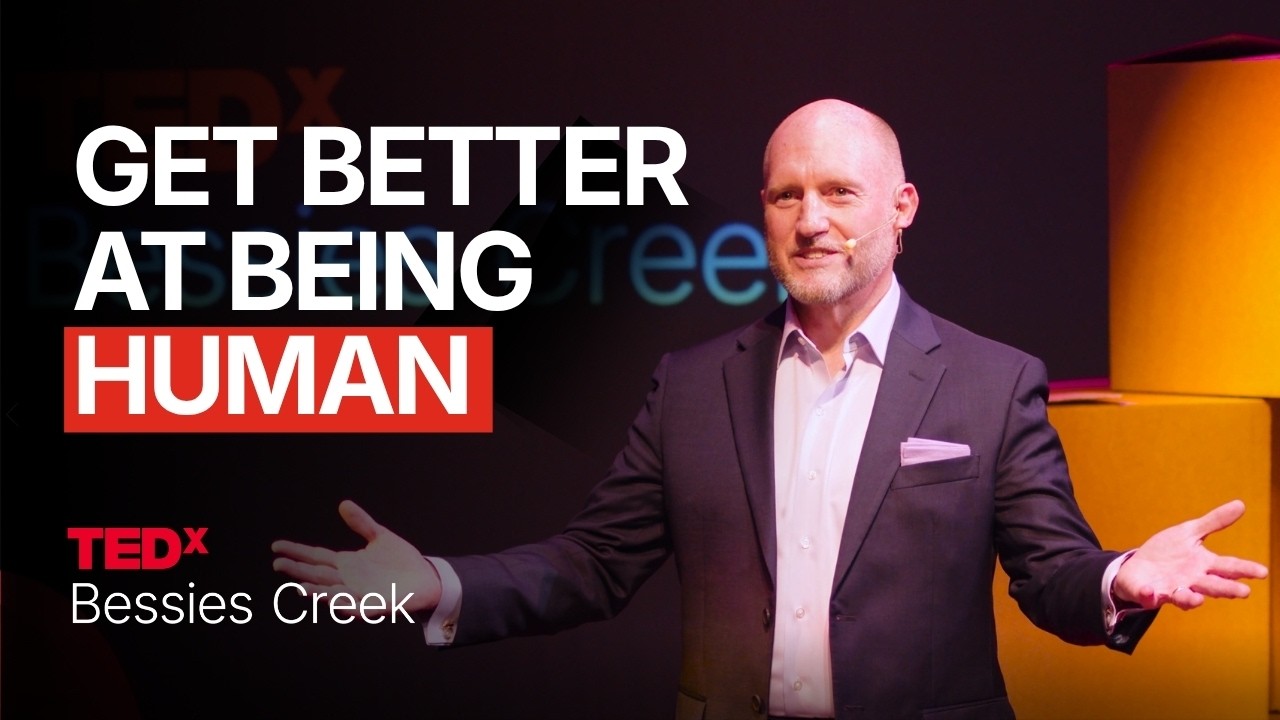
Getting better at being human | Jay Clancy | TEDxBessies Creek
Keywords
Summary
148 words
Critical Evaluation
The talk presents a compelling narrative about the human tendency to avoid complexity and the unintended consequences of control-oriented systems. Clancy’s argument is coherent and resonates with common experiences in workplaces and personal life. However, the talk lacks empirical evidence and specific references to support its claims. While the speaker mentions ‘multidisciplinary research’ and ‘30 years of experience’, no concrete studies or data are cited, which weakens the scientific rigor. The reasoning is largely anecdotal, relying on metaphors like the caveman and Disney princess to illustrate points. The talk would benefit from incorporating research on organizational psychology, systems thinking, or human development to strengthen its credibility. The structure is clear, with a logical progression from problem to pattern to solution, but the solution remains vague, emphasizing a shift in mindset rather than actionable steps. The title accurately reflects the content, and the talk is accessible to a general audience. Overall, it offers valuable insights into the pitfalls of over-control and the importance of embracing human complexity, but it falls short of a rigorous scientific analysis.
175 words
Title / Content Match
The title accurately reflects the content, which focuses on improving our ability to navigate human complexity in personal and organizational contexts.
Quality & Reliability
6/10
The talk is based on the speaker's 30 years of experience and multidisciplinary research, but specific sources are not cited. The argument is anecdotal and conceptual, lacking empirical evidence. The talk is well-structured and coherent, but the lack of verifiable references reduces its reliability.
Key Moments
Markers derived by PSI from the transcript: the creator did not define chapters.
- Introduction: personal story about putting dog to sleep and the challenge of transitioning to work.
- Introduction of the pattern: avoiding humanity rather than learning from it.
- Caveman metaphor illustrating the origin of our relationship with humanity.
- Example of employee falling asleep at work and the failure of HR processes.
- Explanation of the vicious cycle: control leads to distrust and dependence.
- Call to action: embrace humanity and transform organizations into ecosystems for development.
Cited Sources
- TEDx Talks — General TEDx information; no specific sources cited in the talk.
Concurring Sources
- Theory U — Supports the idea of shifting from controlling to sensing and presencing in complex situations.
- Organizational learning — Relevant to the talk's call for organizations to become ecosystems for development.
Dissenting Sources
- Scientific Management — Represents a traditional control-oriented approach that the talk criticizes.
Contribution & Novelties
The talk offers a novel perspective on organizational and societal problems by framing them as a consequence of avoiding our humanity. It synthesizes concepts from organizational learning and human development into a coherent pattern. The speaker’s emphasis on ‘getting better at being human’ as a collective endeavor is a refreshing departure from typical solution-oriented approaches.
Pour aller plus loin :
- Theory U — A framework for leading profound change by presencing, relevant to the talk’s call for new ways of navigating complexity.
- Organizational learning — The field that studies how organizations adapt and learn, directly related to the talk’s focus on transforming organizations.
- Humanistic psychology — Emphasizes the importance of embracing human experience, aligning with the talk’s message.
- Complexity theory — Offers insights into why simple solutions fail in complex human systems.
132 words
Radar Profile
The radar profile shows moderate scores across all dimensions, indicating a balanced but not highly technical talk. The highest score is in quality of information, reflecting the coherent narrative, while technical level is low, consistent with a general audience talk.