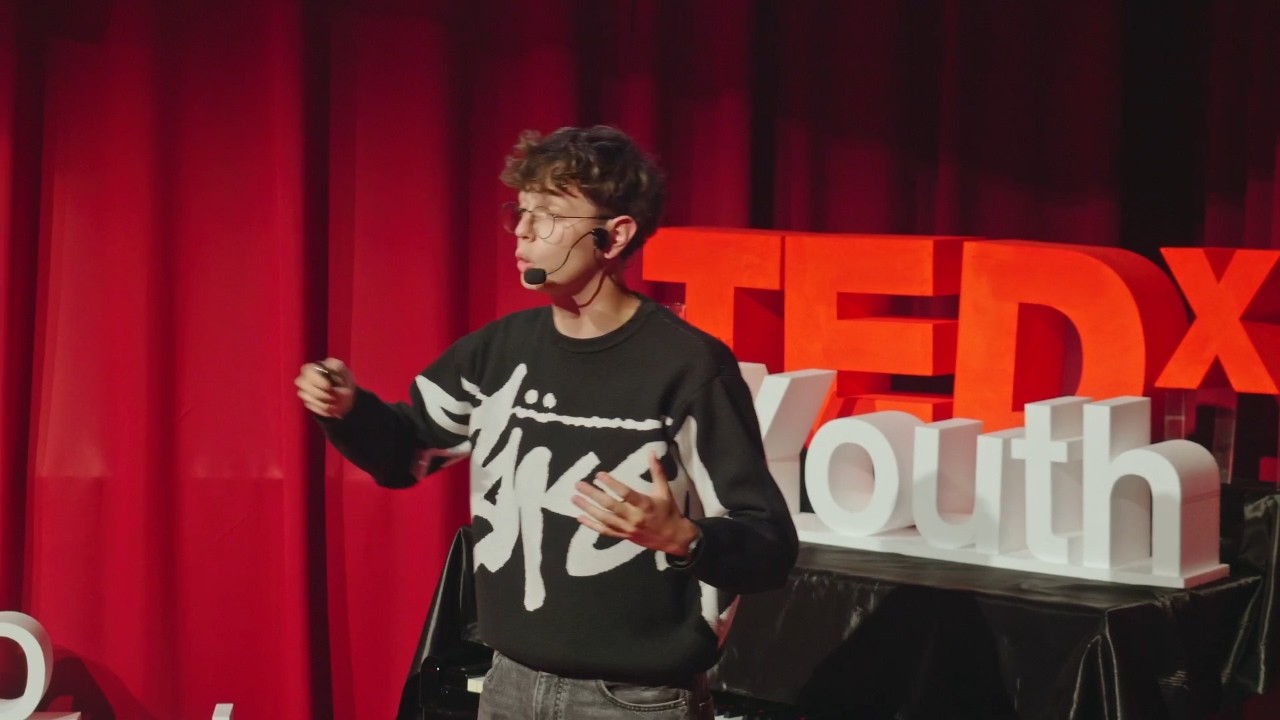
L'architettura dell'attesa | Mattia Pagnini | TEDxLiceo Marconi Pesaro Youth
Keywords
Summary
194 words
Critical Evaluation
Value of the Information & Strength of the Argument
The talk provides valuable insights into the cognitive and neural mechanisms underlying musical expectation, drawing on established theories and research. The argumentation is coherent and engaging, using a live musical demonstration to illustrate concepts. However, it relies heavily on popularized summaries without citing specific studies, which limits its depth. The speaker effectively builds a narrative from tension to resolution, but some claims, such as the ‘20% of brain energy’ for music, are oversimplified and lack precise references.
Scientific Rigor, Source Quality, Title Accuracy
The scientific rigor is moderate: the speaker references credible researchers and theories, but does not provide direct citations or links to primary literature. The quality of sources is acceptable for a TEDx talk, but not exhaustive. The title accurately reflects the content, focusing on the architecture of expectation. The talk is well-structured and the content aligns with the title.
151 words
Title / Content Match
The title 'The Architecture of Expectation' accurately reflects the content, which explores how the brain builds and resolves musical expectations.
Quality & Reliability
7/10
The talk references established researchers (David Huron, Robert Zatorre, Daniela Lucangeli) and concepts (ITPRA theory, mere exposure effect, prediction error, Broca's area, OPERA hypothesis) that are well-known in music cognition and neuroscience. However, it lacks direct citations or links to specific studies, and some simplifications may overlook nuances. Overall, the information is reliable but presented in a popularized manner.
Key Moments
Markers derived by PSI from the transcript: the creator did not define chapters.
- Introduction: suspended chord creates tension and anticipation.
- Explanation of ITPRA theory by David Huron.
- Discussion of freeze response and brain energy consumption.
- Resolution of the chord and dopamine release in the striatum (Zatorre).
- Evolutionary perspective: music as social glue.
- Mere exposure effect and why we repeat music.
- Earworms and the brain's loop.
- Prediction error and cortisol response; learning from mistakes (Lucangeli).
- Music and language share Broca's area; OPERA hypothesis.
- Warning about algorithmic streaming and conclusion with silence.
Cited Sources
- TEDx Program — General information about TEDx events, mentioned in the video description.
Concurring Sources
- Zatorre, R. J., & Salimpoor, V. N. (2013). From perception to pleasure: Music and its neural substrates. — Supports the claim about dopamine release in the striatum during musical pleasure.
Dissenting Sources
- Critique of the '20% brain energy' claim — The claim that listening to music uses 20% of brain energy is not supported by specific research; it is likely an oversimplification.
Contribution & Novelties
The talk offers a compelling synthesis of music cognition research, connecting expectation, emotion, and learning in an accessible way. It emphasizes the importance of embracing uncertainty and errors for cognitive growth, and warns against the homogenization of music consumption by algorithms. The original contribution lies in framing music as a ‘gym for the mind’ and advocating for deliberate engagement with musical tension.
Pour aller plus loin :
- ITPRA theory — Overview of Huron’s theory of expectation.
- Robert Zatorre’s research — Official lab page with publications on music and the brain.
- OPERA hypothesis — Hypothesis linking music training to language abilities.
- Melodic intonation therapy — Therapy for aphasia using singing.
- Mere exposure effect — Psychological phenomenon explaining preference for familiar stimuli.
120 words
Radar Profile
The radar profile shows high scores in information quality and technical level, with moderate scores in quantity and reliability. This indicates a well-articulated talk that balances scientific depth with accessibility, though it could benefit from more explicit citations.
💬 No comments were provided for analysis.