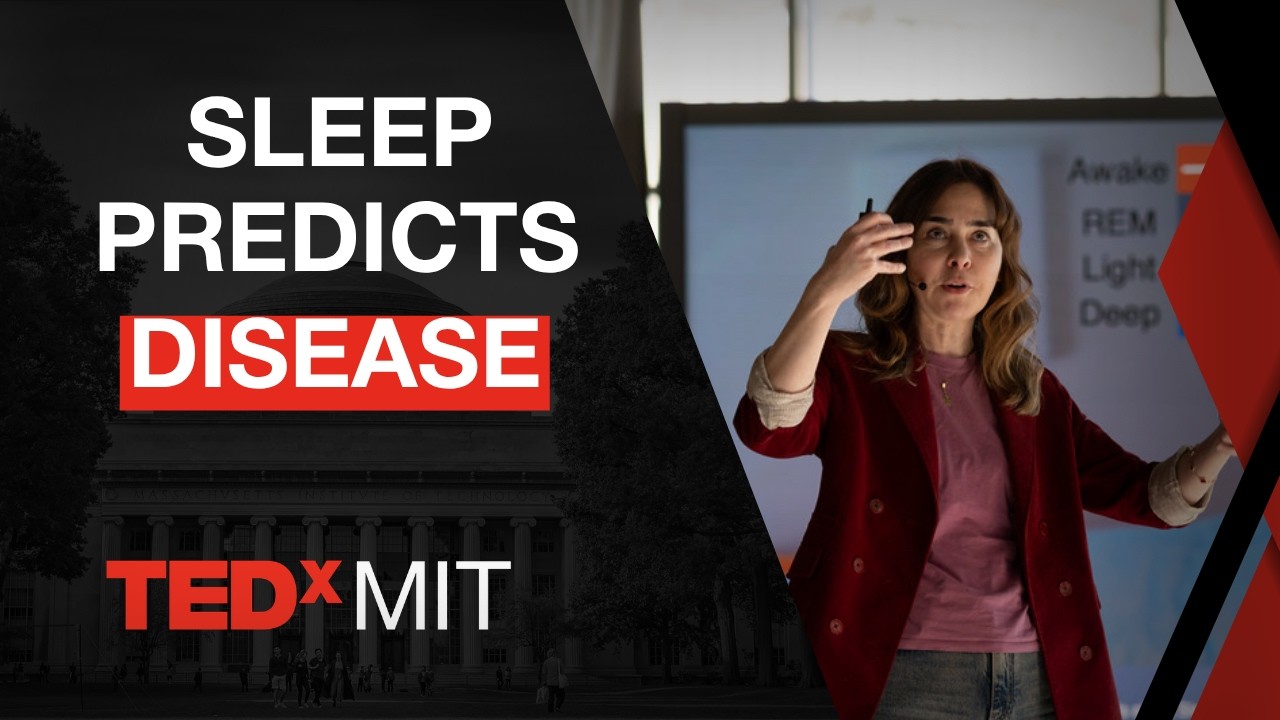
Could AI Predict Disease Risk From Sleep Data? | Dina Katabi | TEDxMIT
Keywords
Summary
160 words
Critical Evaluation
The talk presents an innovative and promising application of AI to healthcare, leveraging wireless sensing and foundation models to extract health information from sleep. The speaker, Dina Katabi, is a respected MIT professor with a strong track record in wireless sensing, which lends credibility to the research. However, the talk lacks detailed methodology and specific results, making it difficult to assess the rigor of the studies. The claims of detecting diseases and medications from sleep data are impressive but are presented without peer-reviewed evidence, and the TEDx disclaimer explicitly states that the research is ongoing and warrants further review. The argumentation is logical, drawing parallels between text generation and physiological signal translation, but the technical depth is limited, likely due to the TEDx format. The sources cited are minimal, with only general TEDx guidelines and the TEDx website, and no direct references to the research papers. The talk’s strength lies in its potential impact on preventive medicine, but the lack of concrete data and external validation tempers its scientific value. The adéquation between title and content is good, as the talk directly addresses the question posed. Overall, the talk is engaging and thought-provoking, but it should be viewed as a preliminary overview rather than a definitive scientific presentation.
208 words
Title / Content Match
The title accurately reflects the content, focusing on AI predicting disease risk from sleep data.
Quality & Reliability
6/10
The talk presents ongoing research with preliminary results, but lacks detailed methodology and peer-reviewed references. The speaker is a reputable MIT professor, but the claims are not fully substantiated in the talk.
Key Moments
Markers derived by PSI from the transcript: the creator did not define chapters.
- Introduction: turning one night of sleep into disease risk and medication effect.
- Explanation of sleep stages and their relation to diseases.
- Introduction of the wireless device for contact-free sleep monitoring.
- Demonstration of capturing breathing and sleep hypnogram from wireless signals.
- Introduction of the AI foundation model that translates breathing to EEG.
- Results: detection of diseases and medications with 70-90% accuracy.
- Conclusion: potential applications in longevity and healthcare transformation.
Cited Sources
- TEDx Content Guidelines — Referenced in the description as guidelines for TEDx organizers.
- TEDx Official Website — Mentioned in the description for more information about TEDx events.
Concurring Sources
- Wireless Sensing for Health Monitoring — Supports the feasibility of using wireless signals for health monitoring.
- Sleep and Neurodegenerative Diseases — Provides evidence for the connection between sleep and diseases like Alzheimer's.
Dissenting Sources
- Concerns about AI in Medical Diagnosis — Raises concerns about the reliability and ethical implications of AI in medical diagnosis, which may contrast with the optimistic claims in the talk.
Contribution & Novelties
The talk introduces a novel approach to non-invasive health monitoring using wireless signals and AI foundation models, potentially enabling passive disease screening. The key innovation is the translation of breathing patterns into EEG signals, suggesting a deep connection between respiratory and neurological systems. This could lead to continuous, passive health monitoring without wearables.
Pour aller plus loin :
- Foundation Models for Medical AI — Discusses the use of foundation models in healthcare, relevant to the talk’s approach.
- Wireless Sensing for Health Monitoring — Overview of wireless sensing technologies in health, supporting the feasibility of the described system.
- Sleep and Neurodegenerative Diseases — Explores the link between sleep and diseases like Alzheimer’s, providing background for the talk’s claims.
117 words
Radar Profile
The radar profile shows moderate scores across all dimensions, indicating a balanced but not exceptional presentation. The talk provides a good overview but lacks deep technical detail and rigorous evidence, resulting in a moderate overall assessment.
💬 No comments were provided for analysis.