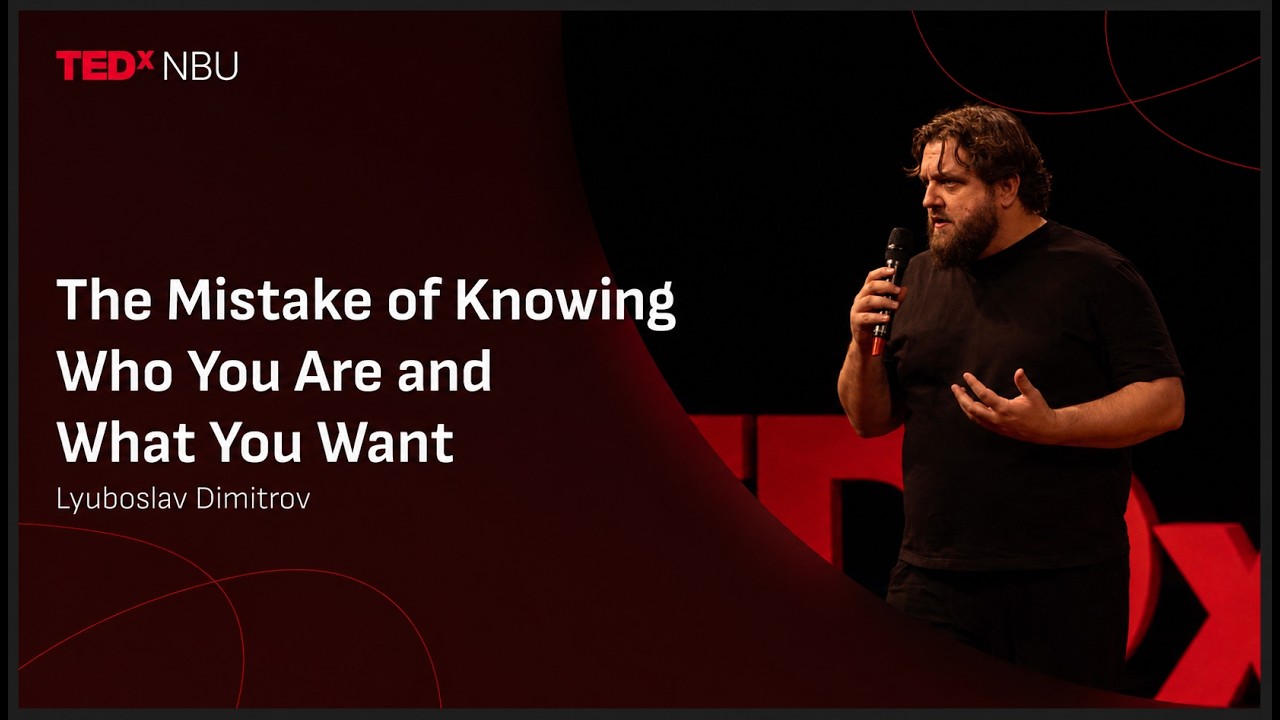
The Mistake of Knowing Who You Are and What You Want | Lyuboslav Dimitrov | TEDxNBU
Keywords
Summary
119 words
Critical Evaluation
Value of the Information & Strength of the Argument
The talk offers a refreshing perspective on the role of passion in life, arguing that it can be valuable even when not turned into a career. The argument is built on personal anecdotes and relatable examples, making it accessible and engaging. However, the reasoning is largely anecdotal and lacks empirical support, which weakens its scientific rigor. The speaker does not provide data or references to back up his claims, relying instead on his own experiences and cultural observations. The argumentation is coherent but subjective, and the talk would benefit from a more structured analysis of the concepts it touches upon.
Scientific Rigor, Source Quality, Title Accuracy
The talk is an opinion piece with no scientific sources cited. The only link provided is to TEDx, which is a general platform, not a specific reference. The title accurately reflects the content, and the talk stays on topic throughout. The speaker’s arguments are based on personal experience and cultural references, which are not verifiable or generalizable. The lack of citations and empirical evidence limits the scientific quality of the talk, but it is honest about its subjective nature. The talk is well-structured and the title-content alignment is strong.
204 words
Title / Content Match
The title accurately reflects the core message: challenging the common advice to know exactly who you are and what you want, arguing that uncertainty can be valuable.
Quality & Reliability
6/10
The talk is a personal narrative and opinion piece, not a scientific study. It draws on anecdotal experience and cultural references, with no empirical data or citations. The reasoning is coherent but subjective, and the speaker acknowledges the limitations of his perspective.
Key Moments
Markers derived by PSI from the transcript: the creator did not define chapters.
- Introduction: speaker's passion for finding meaning and working with people.
- Discussion of the speaker's passion for comedy and how it was left on the back burner.
- The tension between passion and reason, illustrated with the example of writing a script.
- The speaker's experience pitching a series and the disappointment of not getting it produced.
- The idea of using comedy in unexpected places, like a mentorship program speech.
- The speaker's attempt to start a Threads account and the realization that the platform wasn't for him.
- The final post and the decision to stop pursuing comedy as a career.
- Conclusion: embracing uncertainty and keeping passion separate from work.
Cited Sources
- TEDx — General TEDx platform mentioned in the description.
Concurring Sources
- TEDx — The talk is part of the TEDx series, which often features personal growth topics.
Contribution & Novelties
The talk offers a personal and humorous perspective on the value of keeping passion separate from one’s career, challenging the common advice to ‘follow your passion’. It contributes to the discourse on identity and personal growth by suggesting that uncertainty can be a strength. The speaker’s anecdotes about writing, performing, and social media provide relatable examples.
Pour aller plus loin :
- Identity vs. Role Confusion in Erikson’s stages of psychosocial development — Relevant to the discussion of identity formation.
- Self-determination theory — Explores intrinsic motivation and passion.
- The role of uncertainty in creativity — Discusses how ambiguity can foster creative thinking.
101 words
Radar Profile
The radar profile shows moderate scores across all dimensions, with a slightly higher score in quality of information and lower in technical level. This reflects a talk that is engaging and coherent but lacks scientific depth and empirical support.